IB BIOLOGY HL UNIT BIODIVERSITY GUIDING & LINKING QUESTIONS
 Call Kai
 Learn
 Practice Test
 Spaced Repetition
 Match
 Flashcards
 Knowt Play
1/19

There's no tags or description
Looks like no tags are added yet.
20 Terms
What is a species?
Biological species concept (Mayr, 1942): population whose members can interbreed and produce viable, fertile offspring (reproductively compatible).
What patterns are seen in the diversity of genomes within and between species?
Genes are widely shared between organisms of different species, differences that arise within a species are due to inheritances patterns causing genetic variation/recombinations and mutation. Most precise estimate yet suggests more than 80% of species still undiscovered. There are 8.7 million eukaryotic species on our planet — give or take 1.3 million.
What processes can cause changes in allele frequencies within a population?
•Mutations (Changes in DNA)
•Non-Random (preferences in breeding)
•Natural Selection (Not all have equal chance of survival)
•Small Population Size (genetic drift)
•Gene Flow (alleles enter or leave the gene pool)
What is the role of reproduction in the process of natural selection?
Those best suited to the environment will survive to reproduce.
What is the evidence for evolution?
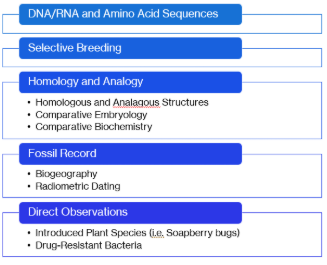
How do analogous and homologous structures exemplify commonality and diversity?
Homologous structures show a common origin for organisms due to common ancestry but different evolution due to differences in environment. Analogous structures show common evolution for organisms due to similar environments but have different origins with no common ancestor.
What tools are used to classify organisms into taxonomic groups?
Taxonomists study: Structural similarities, Chromosomal structure (karyotypes), Reproductive potential, Biochemical similarities, Comparing DNA and amino acids, Embryology/development, Breeding behavior, and Geographic distribution, and use tools such as dichotomous keys, phylogenetic trees, and cladograms to illustrate the classification of organisms based on evolutionary relationships.
How do cladistic methods differ from traditional taxonomic methods?
Cladistics focuses on branching evolutionary history or phylogeny using cladograms, whereas traditional methods often used fixed ranks (kingdom, phylum, etc.) and reflected perceived overall resemblance rather than strict common descent.
What factors are causing the sixth mass extinction of species?
Human activities causing habitat destruction, climate change, over exploitation (over fishing, hunting, logging), pollution, and the spread of invasive species.
How can conservationists minimize the loss of biodiversity?
Minimize human impact on environment as well as In-situ and ex-situ conservation efforts.
What might cause a species to persist or go extinct?
If an organism is best suited to its environment it is more likely to survive and reproduce. Organisms that are not well adapted to the environment, if unable to relocate to a more suitable environment may die or not reproduce leading to becoming endangered or extinct. Human activities can remove habitat and organisms causing endangerment or extinction.
How do species exemplify both continuous and discontinuous patterns of variation?
Through the processes of gradualism (populations change gradually (many small changes) over thousands of years) and punctuated equilibrium (Abrupt changes in population may occur due to disasters wiping out a large portion of the population. The few that remain reproduce which may cause abrupt differences in the new population that results from reproduction of the few.
How do intraspecific interactions differ from interspecific interactions?
Interspecific interactions occur between different species, while intraspecific interactions happen within the same species
What mechanisms minimize competition?
resource partitioning (utilizing different food/habitats), temporal separation (active at different times), and character displacement (evolving different physical traits)
How does the theory of evolution by natural selection predict and explain the unity and diversity of life on Earth?
The environment selects for traits that are best suited, the differences in survival and reproduction account for shifting of traits in a population. The diversity of environments and niches available contributes to the diversity of life that can survive there.
What counts as strong evidence in biology?
independent, replicable, and consistent data across multiple disciplines, particularly from molecular genetics, phylogenetic reconstruction, and the fossil record
How can similarities between distantly related organisms be explained?
Organisms may have similarities in physical traits due to the environmental pressures causing organisms to be best adapted to the environment rather than common descent as is the case with analogous structures.
What are some examples of ideas over which biologists disagree?
Biologists disagree on systems of classification and naming of organisms. Some systems build on older systems and some systems are created new. This can create challenges in communication since part of the purpose of a classification system is having a common system (naming and grouping) for scientists in different countries to be able to communicate with each other.
In what ways is diversity a property of life at all levels of biological organization?
Diversity occurs at the cellular level which contributes to us classifying organisms into different groups, genetic diversity leads to variation in organisms allowing for natural selection to occur which allows ecosystems to have communities of organisms best suited to their environment filling many niches.
How does variation contribute to the stability of ecological communities?
Each organism fills a different niche. When organisms attempt to fill the same niche, competition occurs. One organism wins and the other does not. The more diversity, creates a stable environment providing resources and expanding niches for more organisms.