Chapter 14 Muscles of Head, Neck and Back
 Call Kai
 Learn
 Practice Test
 Spaced Repetition
 Match
 Flashcards
 Knowt Play
1/22

Earn XP
Description and Tags
Human Anatomy
23 Terms

Name the muscle fiber?
A. endomysium
B. myofibril
C. t tubule (transverse tubule)
D. cisterna of sarcoplasmic reticulum
E. motor end plate
F. synaptic knob with synaptic vesicles
G. sarcolemma
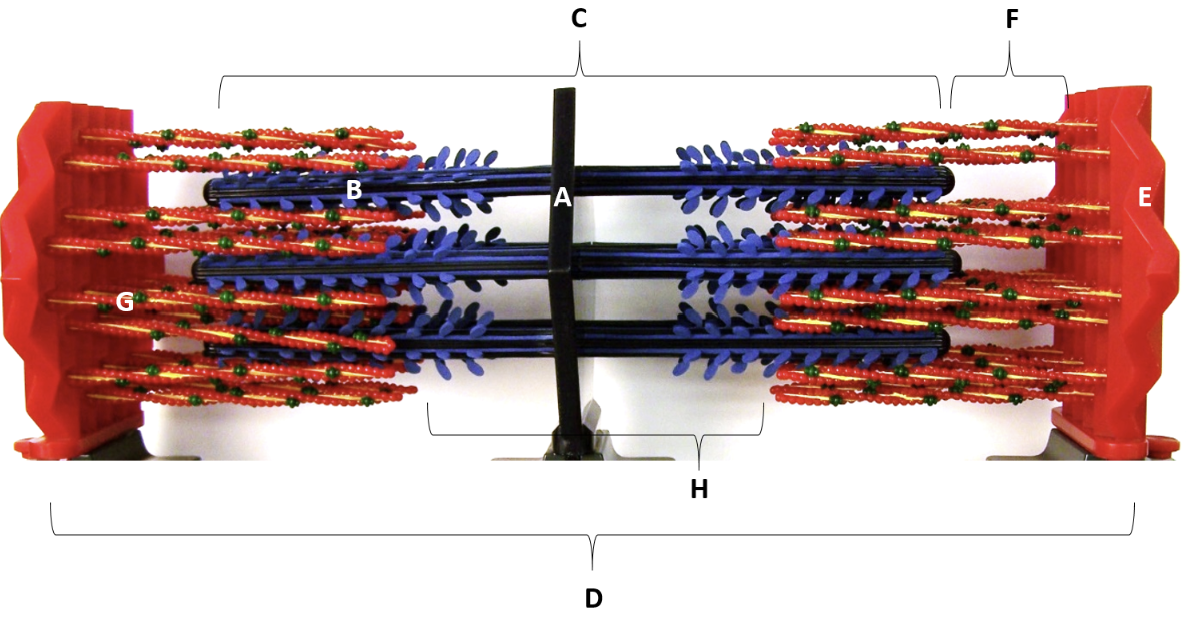
Name the sarcomere model?
A. M line
B. thick filament
C. A band
D. sarcomere
E. Z line (disk)
F. I band
G. thin filament
H. H zone
Think filaments are made of the protein ____________________
myosin
Thin filaments are made of the protein __________ (small, red spheres) and _________ (the yellow proteins), and ______________ (the green proteins).
1.Actin
2.Tropomyosin
3.Troponin
The dark lines in muscle striations are called ___________ bands
A band
The light lines in muscle striations are called _________bands
I band
True or False: When the sarcomere shortens, the H zone also shortens
True
True or False: When the sarcomere shortens, the I band also shortens
True
True or False: When the sarcomere shortens, the A band also shortens
False

Match the letter from the picture below with the appropriate muscle.
A. platysma
B. orbicularis oculi
C. zygomaticus
D. frontalis belly of epicranius
E. orbicularis oris
F. buccinator
G. sternocleidomastoid

Match the letter from the picture below with the appropriate muscle.
A. temporalis
B. occipitalis belly of epicranius
C. masseter
D. platysma
E. sternocleidomastoid
F. splenius capitis
G. frontalis belly of epicranius
H. buccinator
I. orbicularis oculi
J. zygomaticus
K. orbicularis oris

Match the letter from the picture below with the appropriate muscle.
A. sternocleidomastoid
B. splenius capitis
C. temporalis
D. masseter (cut)

Match the letter with the appropriate muscle.
A. sternocleidomastoid
B. orbicularis oculi
C. orbicularis oris
D. buccinator
E. masseter
F. zygomaticus
G. frontalis belly of epicranius
H. temporalis

Match the letter in the picture below with the appropriate muscle.
A. erector spinae
B. occipitalis belly of epicranius
C. splenius capitis
Name the correct muscle: Compresses cheeks so you may blow air from your mouth or suck liquid through a straw
buccinator
Name the correct muscle: closes lips and shapes lips as during speech
orbicularis oris
Name the correct muscle: rotates head, laterally flexes neck when one contracts and extends neck when both contract
splenius capitis
Name the correct muscle: is the main muscle used for chewing because it elevates and protracts mandible
masseter
Name the correct muscle: assists the masseter in chewing because it elevates and retracts mandible as in closing the mouth and pulling the jaw in under the upper jaw
temporalis
Name the correct muscle: elevates eyebrows and furrows the brow (wrinkles the forehead)
epicranius (frontalis and occipitalis)
Name the correct muscle: elevates corner of mouth for smiling
zygomaticus
Name the correct muscle: depresses lower lip and angle of mouth
platysma
Name the correct muscle: is the main muscle used to laterally flex the neck to the same side, rotate head to the opposite side, and flex neck when both contracts. Also aids in forceful inhalation
sternocleidomastoid