Week 10 Peds GI
 Call Kai
 Learn
 Practice Test
 Spaced Repetition
 Match
 Flashcards
 Knowt Play
1/52

There's no tags or description
Looks like no tags are added yet.
53 Terms
Pediatric differences
frequent feedings
frequent bowel movements
faster peristalsis
breast fed stools and frequency
formula fed stools and frequency
How to assess for dehydration in children?
assess skin turgor
fontanels
lack of tearing
dry mucus membranes
thirst
skin temperature
activity level
S/S GI disorders in infants/children
vomting/regurgitation
irritability/fussiness
abdominal pain/distention
Failure to thrive
weight lost
stool changes
Subjective assessment Peds GI
family hx
diet
gaining/losing weight
through hx feeding pattern
allergies (lactose intolerant, celiac dx)
spitting up
elimination pattern
I/Os
encorpresis/constipation
Objective assessment Peds GI
inspect distention, symmetry, bulges or masses, umbilicus
auscultate hyper/hypo bowel sounds
percuss tympany vs dullness
palpate light vs deep, rebound tenderness, McBurney’s point
Disorders of the GI system include
structural defects
disorders of motility
inflammatory disorders
disorders of malabsorption
hepatic disorders
injuries to the GI system
Structural defects
cleft lip and cleft palate
esophageal atresia and tracheoesophageal fistula
pyloric stenosis
intussusception
abdominal wall defects
anorectal malformations
umbilical hernia
Cleft lip and cleft palate is a
congenital anomaly that occurs as a result of failure of soft tissue or bony structure to fuse during weeks 6-12 gestation
Characteristics Cleft lip and Cleft palate
may appear by itself or together
cleft lip can be unilateral or bilateral
most common craniofacial deformities in the US
multifactorial causes
Complications with CL/CP
feeding problems (ability to suck, swallow, and breath without distress)
speech development
otologic
dental and orthodontic
developmental delays
Cleft lip management
special feeding techniques until surgery
Haberman feeder
ESSR method
What is the Haberman feeder technique used for infant with cleft lip?
hold infant in upright position
stimulate sucking by rubbing nipple to allow child to get food into back of throat without strong sucking
allow time to swallow and burp frequently
What is the ESSR method for cleft lip?
enlarge nipple
stimulate sucking
swallow rest
Cleft lip repair
surgery usually done at 1-3 months
z shape suture line
Post op cleft lip repair
logan bar over child’s mouth to reduce tension on suture line
clean sutures, use saline to prevent crusting, antibiotic ointment on suture line
elbow restraints (release every 2 hours)
breck feeder technique
position on back or side lying
Cleft palate is repaired in stages between
6 months and 2 years of age
Repairing cleft palate protects against
altered dentition and speech dysfunction
frequent ear infection (otitis media) d/t open nasopharynx
need to be able to use cup to drink
Cleft palate repair post op
maintain airway, O2 sat monitor
no bottles, straws, pacifiers, spoons for at least 7-10 days
elbow restraints and mittens
clears to soft diet
all feedings followed by rinsing mouth with water to clean suture line
pain med
no brushing teeth 1-2 weeks
Esophageal Atresia (EA) & Tracheoesophageal Fistula (TEF)
associated with maternal polyhydramnios
may occur alone or together (usually tgt)
Esophageal Atresia (EA) is a
congenital disruption of upper and lower portions of esophagus
surgical emergency
Tracheoesophageal Fistula (TEF) is a
abnormal communication b/t trachea and esophagus
S/S Esophageal Atresia (EA) and Tracheoesophageal Fistula (TEF)
immediate newborn period
respiratory distress
difficulty feeding
excessive drooling
choking, coughing
cyanosis
Pre-op EA and TEF
maintain airway
NG tube to suction
prevent aspiration (HOB increase, NPO)
IV fluids, IV abx
G tube may be placed to drain stomach content/allow air to escape
surgical repair single or staged surgery depending on age, size, length of gap
Post-op EA and TEF
initally NPO
TPN
g tube feeds
feeds start with clears then advance over several days
complications: tears, stricture, reflux, infection
family teaching
Pyloric stenosis characteristics
etiology unknown but often affects first born males
present at birth
food causes irritation, progressive edema and further narrowing
Pylroic stenosis is diagnosed by
ultrasound
Pyloric stenosis occurs
between stomach and duodenum
Pyloric stenosis is
hypertrophy of the circular muscles of the pylorus hat causes narrowing of the pyloric canal between the stomach and duodenum
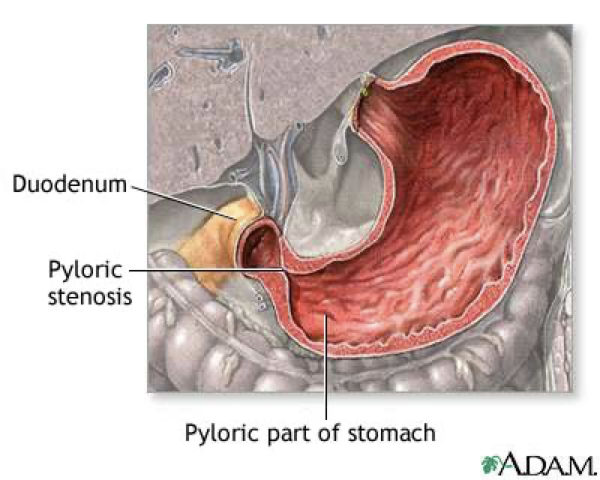
Physical assessment of pyloric stenosis
vomiting progresses from mild regurgitation to projectile vomiting
vomiting occurs shortly after meals
vomiting is forceful (2-4feet)
constant hunger, fussiness, crying
decrease in size and number of stools
failure to gain or lose weight
dehydration & electrolyte imbalance
olive shaped mass sometimes palpable on abdominal exam
How is pyloric stenosis treated?
surgery= pyloromyotomy
Pre-op Pyloric stenosis surgery
NPO
IVFs for fluids/electrolyte management
NG tube
Post-op Pyloric stenosis surgery
maintain IVF, analgesics, NG tube
start feeds
Gastroschisis & Omphalocele are
Abdominal wall defects
Gastroschisis & Omphalocele
a congenital defect of the ventral abdominal wall, characterized by herniation of abdominal visceral outside the abdominal wall
gastroschisis occurs
to the side of umbilicus

omphalocele occurs
through the umbilical cord
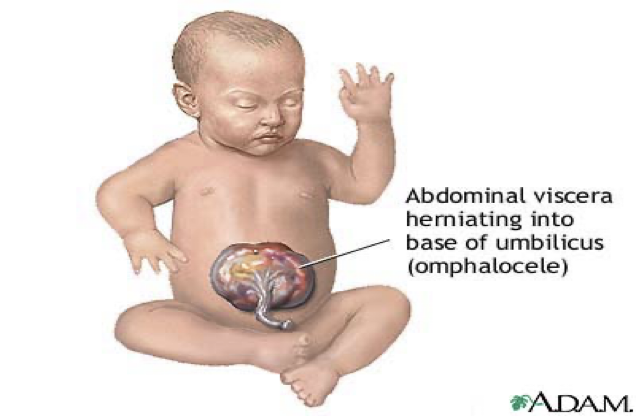
Nursing management for Gastroschisis & Omphalocele
prevent infection by covering sac with sterile gauze soaked in NS, then sterile plastic
monitor VS closely; assess temperature
NPO, maintain IVFs, TPN
parental support
Anal stenosis & Anal atresia are
Anorectal malformations
Anal stenosis is
thickened & constricted anal wall (produce ribbon-like stools
Anal atresia (imperforated anus)
failure to pass meconium
exam reveals absent anal opening
What would you see in anal stenosis & anal atresia?
stool in urine or vagina due to fistulas
Treatment for Anorectal malformations depends on
where it is located and if it is low/high defect
Treatment for low defect Anorectal malformations
anoplasty and serial digital dilations are effective
Treatment for high defect anorectal malformations
2 step procedure that may involve a temporary colostomy
Umbilical hernia is
hernia protrusion of an organ or part of an organ through the muscle wall of the cavity that normally contains it
Umbilical hernia results from
imperfect closure of the umbilical muscle ring and often associated with separation of the abdominal muscles
Clinical manifestations Umbilical Hernia
herniated umbilicus protrudes with coughing, crying, or straining
hernia can be reduced by pushing contents back into fibrous ring
most defects spontaneously resolve by 3-4 years old, as muscular ring closes
surgery indicated in cases of strangulation, increased protrusion after 2 years of age or no improvement in large defect after 4 years