SCH4U - Atomic Structure - II
 Call Kai
 Learn
Learn Practice Test
 Spaced Repetition
 Match
Match Flashcards
 Knowt Play
1/35

There's no tags or description
Looks like no tags are added yet.
Name | Mastery | Learn | Test | Matching | Spaced | Call with Kai | Chat |
|---|
No analytics yet
Send a link to your students to track their progress
36 Terms
What is the definition of an orbital in chemistry? (1)
A three - dimensional region of space around an atom’s nucleus where an electron has a high probability (about 95 percent) of being located

What is the definition of quantum numbers? (1)
Numbers that describe the quantum mechanical properties of orbitals
What is the definition of “quantum mechanical properties”? (1)
The unique physical behaviors and characteristics that matter and energy display at the atomic and subatomic scales.
How do classical physics and quantum physics differ? (2)
Classical physics is deterministic and describes large objects/models
Quantum physics is probabilistic and describes atoms and particles
Describe the difference between deterministic and probabilistic systems (2)
A deterministic system is where the same input always produces the same output, and is repeatable. Thus, outcomes can always be predicted (there is no input)
A probabilistic system is where the same input may or may not yield the same output. Rather, there is a range of possibilities in outcomes based on the same input, which introduces the element of chance/randomness.
What are the 4 main known quantum mechanical properties of orbitals? (4)
Size
Shape
Spatial Orientation (how is a shaped orbital oriented in 3D)
Spin
How were quantum numbers developed? (1)
Derived from the solutions to Schrodinger’s wave equation
What do the quantum numbers allow us to do? (2)
They act as “addresses” for locating the position of an electron; they allow us to locate the position and describe the behaviour of electrons in atoms.
What letter represents the Principal Quantum Number?
n
What does the term “n” refer to in context to quantum numbers?
The Principal Quantum Number
What does the principal quantum number describe in reference to an atomic orbital? (2)
Size
Energy
What does a higher value “n” value mean in terms of the electron - nucleus relationship?
a higher n value mean that an electron is further away from the nucleus
Can there be decimal valued principal numbers? why? (2)
No
What does the secondary quantum number (l) describe in an atomic orbital? (2)
Shape
Energy
What values/range may the secondary quantum number (l) take on? (1)
0 to n -1
To identify a type of orbital, which 2 values must you combine?
n
the “letter” value of the secondary quantum number, l (s, p, d, f or g)
What does the magnetic quantum number (ml) describe?
The ORIENTATION of orbitals in space relative to other orbitals in the atom.
What values/range may the magnetic quantum number (ml) take on?
Whole numbers between -I , 0 and l
What does the spin quantum number (ms) describe? (1)
It describes the spin of the electron
What values does the spin quantum number (ms) take on? what do they mean?
Only the values +1/2 or -1/2
These 2 values mean that the electron can spin in one of 2 opposite directions.
What does the Pauli exclusion principle state?
In a given atom, no two electrons can have the same set of four quantum numbers
An orbital can hold only two electrons, which MUST have opposite spins
Who formulated the Pauli exclusion principle? when? (2)
Wolfgang Pauli
1925

What is electron configuration?
A shorthand notation that shows the number and arrangement of electrons in its orbitals
What does the Aufbau principle state?
an atom is “built up” by the addition of electrons which fill orbitals starting at the LOWEST available energy orbital before filling higher energy orbitals
What is an orbital diagram? (1)
A visual diagram that represents the relative energies of the electrons in an atom
Who formulated the aufbau principle? when?
Niels Bohr
1921

What is the step - by - step method of drawing orbital diagrams?
What does Hund’s rule state?
"In a particular set of orbitals that have the same energy, the lowest energy configuration for an atom is the one with the maximum number of unpaired electrons."
How do we apply Hund’s rule when drawing orbital diagrams?
Fill each orbital with a single electron before you start pairing.
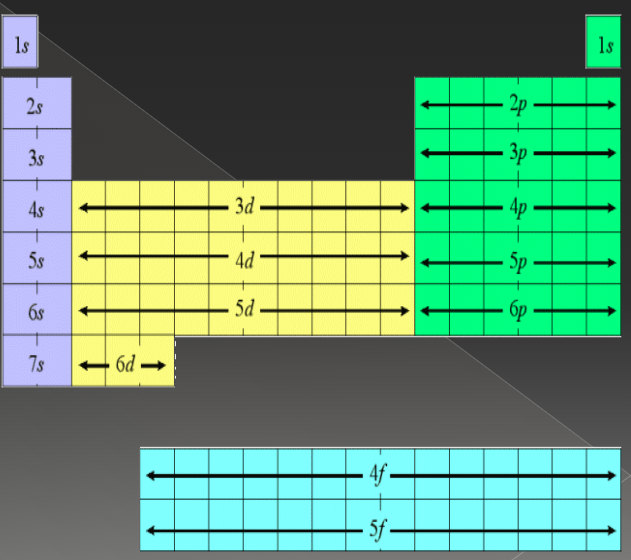
What are 2 ways electron configuration explains the structure of the periodic table?
elements in the same group have the same VALENCE electron configuration
REPRESENTATIVE ELEMENTS: the atom of every member in each group have the same electron configuration
Attempt to recall the orbital blocks of the periodic table. Then, turn over the flashcard and verify your proposed answer. (1)
Describe the trends of atomic radius when analyzing the periodic table.
Atomic radius INCREASES as you go down a group
Atomic radius DECREASES as you go across the period (because more protons, while the added electrons are still the same distance from the nucleus), pull the electrons closer in inadvertently.
Why does atomic radius increase as you go down a group?
Increasing n means the electrons are further away from the nucleus
Why does atomic radius decrease as you go across the period?
As the effective nuclear charge increases, the electrons are more attracted to the nucleus
What is the definition of atomic radius?
The size of an atom - it is calculated by measuring the distance between the center of the atom (the nucleus) to the outer boundary of the surrounding electron shell
Describe the trends of ionization energy when analyzing the periodic table (2)
Ionization energy