Plant Pathology Exam 2
 Call Kai
 Learn
 Practice Test
 Spaced Repetition
 Match
 Flashcards
 Knowt Play
1/51

There's no tags or description
Looks like no tags are added yet.
Name | Mastery | Learn | Test | Matching | Spaced | Call with Kai | Chat |
|---|
No analytics yet
Send a link to your students to track their progress
52 Terms
+ssRNA genome arrangement
+ssRNA acts like mRNA and is immediately translated
Tobacco mosaic virus (TMV)
Sharka Disease, caused by Plum pox virus (PPV)
Papaya ringspot virus (PRSV)
Zucchini yellow mosaic virus (ZYMV)
Cucumber mosaic virus (CMV)
-ssRNA
The –ssRNA needs to be transcribed into mRNA first before
translation
Tomato spotted wilt virus (TSWV
ssDNA
ssDNA viruses act like plasmids.
African cassava mosaic virus (ACMV)
dsDNA
dsDNA viruses are like retroviruses in that they are replicated
via an RNA intermediate.
Cauliflower mosaic virus (CaMV)
Banana streak virus (BSV)
dsRNA
Rice dwarf virus (RDV)
Replication strategies of +ssRNA (Positive-Sense Single-Stranded RNA) Viruses
Positive-sense single-stranded RNA can be translated immediately into viral proteins because it acts as mRNA.
They rely on an RNA-dependent RNA polymerase (RdRP) that is immediately translated inside the host cell.
Replication strategies of -ssRNA (Negative-Sense Single-Stranded RNA) Viruses
-ssRNA cannot be translated directly and needs to be transcribed into mRNA first before translation.
They package a viral RdRP directly within the virion to initiate this transcription upon entry.
Monopartite genome
A monopartite genome consists of a single continuous segment of nucleic acid.
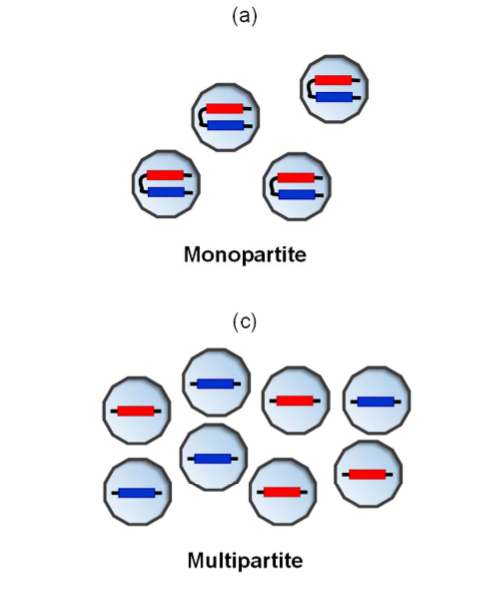
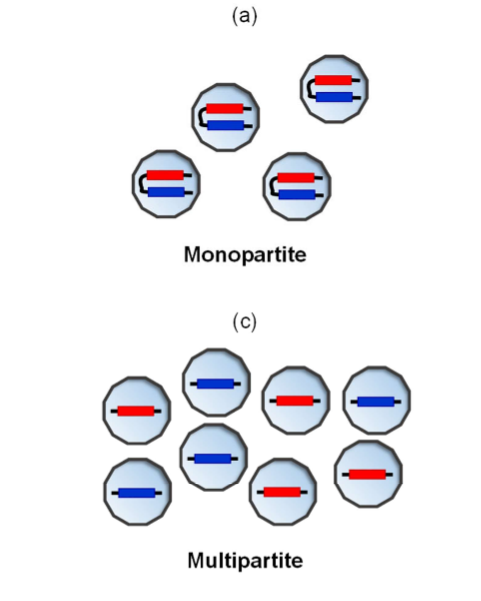
Multipartite genome
A multipartite genome is divided into multiple distinct genomic regions or segments.
These separate segments are packaged into multiple individual virus particles rather than a single capsid.
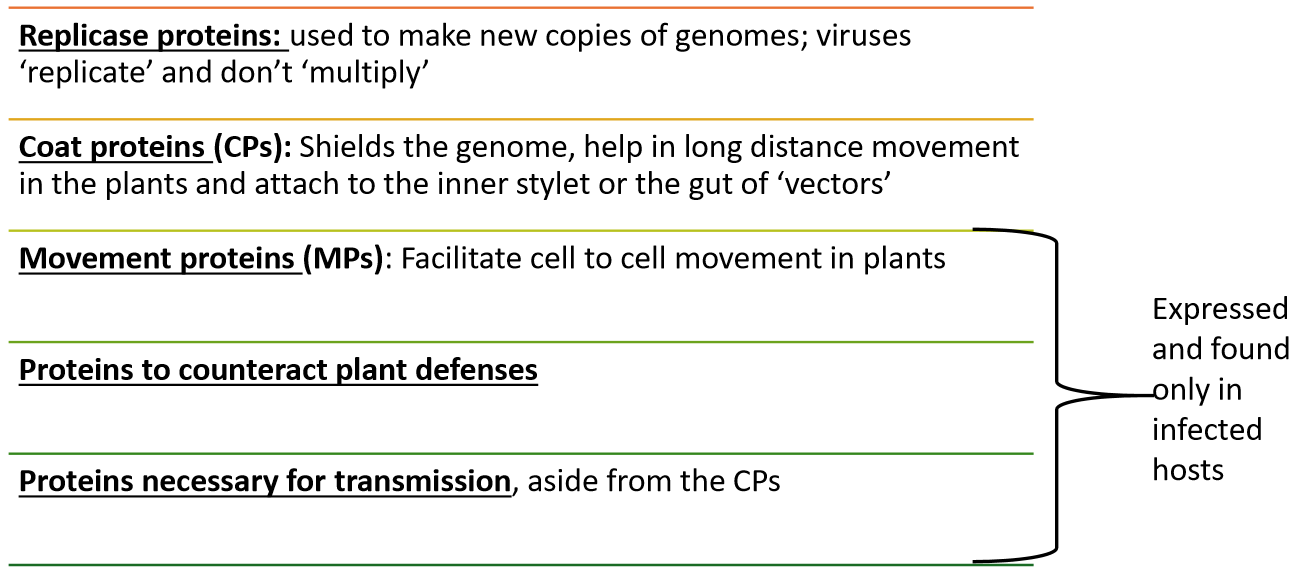
Core plant virus proteins (indicate which proteins are only expressed and found in infected plants)
Systemic movement of viruses within plant hosts
Step 1: Local Replication and Cell-to-Cell Movement: After entering the plant, the virus replicates in the inoculated leaf and moves from cell to cell (through epidermal and mesophyll cells) via microscopic cytoplasmic channels called plasmodesmata. This local movement is facilitated by viral movement proteins (MPs).
Step 2: Entry into the Phloem Vasculature: The virus and its movement complexes enter the plant's vascular parenchyma and companion cells, allowing them to access the sieve elements of the phloem for long-distance movement.
Step 3: Long-Distance Transport: Once inside the phloem, the virus moves systemically throughout the plant via bulk flow and translocation, traveling along with sugars and nutrients from source tissues (such as mature leaves) to sink tissues (such as roots and developing leaves).
Step 4: Exit and New Infection Sites: The virus exits the phloem vasculature into surrounding tissues to establish new infection sites in upper parts of the plant.
Meristem Exclusion: Despite spreading systemically through the rest of the plant, viruses are usually excluded from the root and shoot meristems (undifferentiated, stem-like cells).
Tracking Systemic Spread: Researchers can track the progression of systemic infection in real time using fluorescent proteins
Modes of viral transmission
Insect vectors
Mechanical damage and Contact
Seeds and Pollen
Propagative Material and Grafts
Soil and Water
Insect vectors
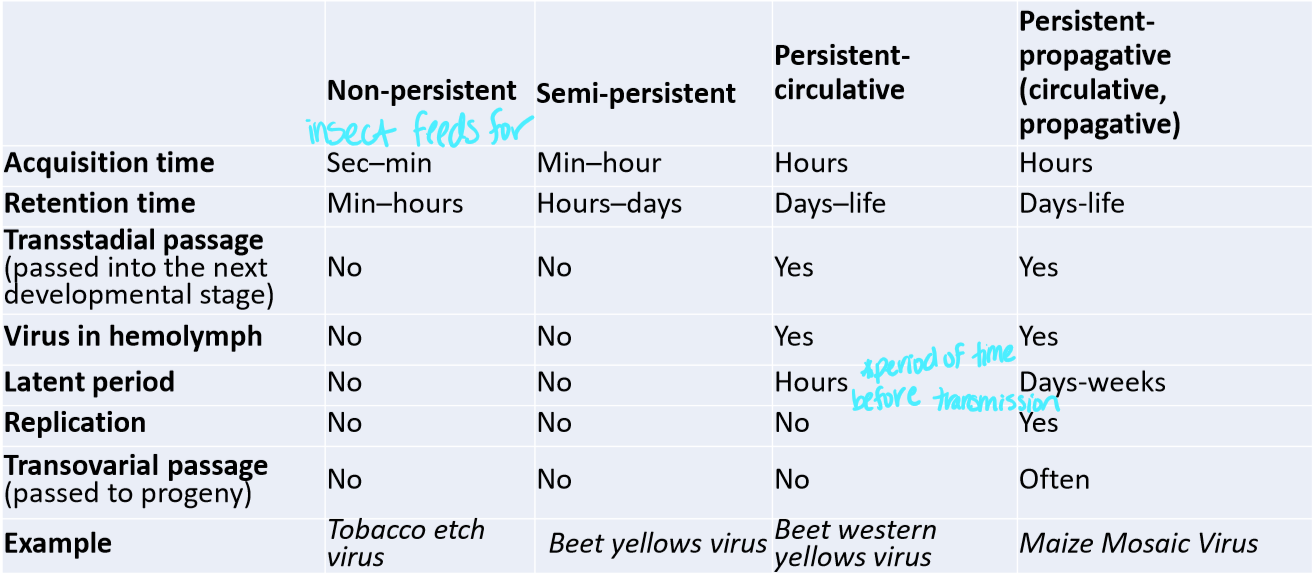
Non-persistent: Viruses are acquired and transmitted in seconds to minutes, remaining retained on the stylet tips for a short time (minutes to hours) without circulating in the insect's body or replicating.
Semi-persistent: Acquired in minutes to hours and retained in the foregut for hours to days
Persistent-circulative: Viruses circulate through the insect's hemolymph and can be passed to subsequent developmental stages, taking hours to weeks before transmission
Persistent-propagative (circulative-propagative): Viruses both circulate and actively replicate within the insect vector often passing to progeny
Mechanical Damage and Contact
Can be Easily transmitted mechanically through physical contact, rubbing between leaves, handling, contaminated clothing, or tools like cutting and pruning implements and watering hose nozzles.
Seeds and Pollen
Many plant viruses can be transmitted through infected seed coats, infected seeds, or through pollen from a virus-infected blooming tree into a healthy tree.
Propagative Material and Grafts
Viruses can be spread through infected vegetative cuttings, rootstocks, and grafting procedures (such as budding and grafting in fruit trees).
Soil and Water
Viruses can also move or persist through soil and water environments.
Insect vector transmission (non-persistent, semi-transmission, persistent circulative, and persistent-propagative)
Co-infection of viruses and how they can result in synergistic viral diseases.
Co-infection: When more than one microorganism is infecting a plant
Synergistic effect: When a co-infection of microorganisms causes worse disease symptoms
ELISA
used to detect viruses in plants

Virus detection methods
Viruses can be detected via visual inspection, immunoassays,
protein-binding assays, nucleic acid amplification, and sequencing
Sandwich ELISA
Most used because it has high sensitivity and specificity
Important points:
High sensitivity and specificity.
Limitation: antibody optimization can be difficult.
Anatomy of fungi

septate versus coenocytic hypae
septate: cross walls within hyphae
coenocytic: hyphae without septa

how fungi are dispersed from plant to plant
Fungi are dispersed by spores. Spores can germinate and form new hyphae, allowing the fungus to establish a new mycelium
rain
wind
animals
moving water
Anamorph vs teleomorph
Anamorph = asexual stage of a fungus, where it produces asexual spores (conidia).
Teleomorph = sexual stage of a fungus, where it produces sexual spores
Life cycle of ascomycetes

general fungal life cycle
Germination
Mitosis
Plasmogamy
Karyogamy
Meiosis

Anastomosis
A process in which hyphal branches fuse, forming
networks that enable communication and material exchange
Lifecycle of basiomycetes

Ascomycetes
produce a sack-like ascus (asci) that contains eight ascospores
lifecycle includes both sexual and asexual cycles and the haploid (n) stage dominates
Ascocarps are sexual reproductive structures of ascomycetes,
including cleistothecia (chasmothecia), perithecia, and apotheciasexual spores are called ascospores
make asexual spores
most have septate hyphae
Basidiomycetes
has a dominant dikaryotic stage and
does not include an asexual cycleclamp connections are needed for each cell to
be bi-nucleate as the hyphae elongateAll vegetative hyphae and visible structures are dikaryotic
(n+n) and sexual recombination occurs in the gillsBasidiomycete fruiting bodies are diverse
Basidiomycete fungi can cause pseudo-anthers and
pseudoflower formation which produce spores
Cryptic species
Cryptic species are species that are difficult to distinguish based on morphology but can be identified by their DNA sequences and sometimes hosts.
cryptic species often make up a species complex
Species complex
a group of closely related organisms that are so similar in appearance that it is hard to distinguish them apart
Forma specialis
The term “Forma specialis” denotes taxonomic groups with a specialized host range within a fungal species
Definition of a fungal race
a subdivision within a forma specialis that differs in its ability to infect particular varieties of a host plant.
race
is defined as a population (within a species) of which all individuals carry the same combination of virulence genes
Alternate vs alternative host
Alternate host: The other plant host the pathogen needs to infect and cause disease to complete its life cycle
Alternative host: Another host a pathogen could infect and cause disease but is not necessary to complete its life cycle
Macrocyclic
Macrocyclic rusts produce all five spore types
Demicyclic
Demicyclic rusts produce four spore types because they lack urediniospores
Microcyclic
Microcyclic rusts produce only teliospores and basidiospores.
Endomycorrozae (AMF)
Penetrate root cells and colonize within the cells.
Also called Arbuscular Mycorrhizal Fungi (AMF).
Form arbuscules (tree-like hyphal structures) inside plant cells.
Found in 85%–90% of the world's plant species.
The fungus grows inside root cells as a highly branched arbuscule
Ectomycorrhizae
Colonize the root surface and the apoplast.
Never penetrate plant cell walls and often form symbioses with tree roots.
Occur on the roots of about 5% of the world's plants.
Nutrient exchange occurs through the cell membranes and cell walls of both the plant and fungus
Potyvirus replication (explain the special characteristics of this genus of viruses)
The +ssRNA genome encodes a large polyprotein that is then
cleaved into smaller proteins during infection
Main protein components of potyvirus
Helper component proteinase (HC-Pro): helper component for aphid transmission and RNA silencing suppressor
Coat protein (CP): necessary for virion protection, viral movement, and aphid transmission
Nuclear inclusion protein b (Nib) replicase: necessary for replication (from +ssRNA/-ssRNA) (intermediate form that cannot be used directly to synthesize proteins)/progeny +ssRNA)
Cylindrical inclusion (CI): part of replicase, necessary for pinwheel formations, and movement.
What is a diagnostic feature of potyvirus infection?
Pinwheel-shaped inclusion bodies are a diagnostic feature of potyvirus infection
Insect vector transmission and how that will impact acquisition time, latent period, and retention of virus particles inside of the insect.
As a virus and its insect vector becomes more persistent, acquisition time increases, a latent period appears, and retention of the virus inside the insect becomes longe

Example of when a plant virus was successfully eradicated or controlled and what occurred to achieve that outcome.
Papaya ringspot virus (PRSV) causes papaya ringspot disease
Typical management practices were not effective at stopping
the papaya ringspot disease epidemic in Hawaii.Scientists created transgenic plants by inserting the PRSV CP
gene sequence into the papaya genome.The bombardment of nanoparticles covered with CP genes
from a gene gun was used to transform papaya plant.The gene is tagged with GFP and transformed cells will fluoresce green.
Example of when a fungal race caused a devastating epidemic and the circumstances that led to the epidemic.
Example: Rice blast, caused by the fungus Magnaporhe oryzae (which has a broad host range in Poaceae, though individual isolates are host-limited). it is a Hemi-biotroph.
Devastating Impact: It is a devastating disease of rice—a staple crop—resulting in an annual 30% global loss, which is equivalent to affecting 60 million people.
Circumstances Leading to the Disease Cycle and Severity:
Inoculum and Spread: The fungus primarily survives on infected seed and residue from previous years, and its spores spread widely to current-year plants via air and wind.
Environmental Triggers: Favorable environmental conditions required for infection include high humidity and moderate temperatures (around 24 °C or 75 °F), and drought stress specifically increases the severity of the blast.
Specialized Infection Mechanism: The fungus uses conidia that attach to the plant using mucilage, germinate, and form a specialized structure called an appressorium. The appressorium develops a melanin layer that builds up immense hydrostatic pressure to drive a penetration peg through the plant cell wall.
Biotrophic to Necrotrophic Transition: During the infection cycle, the fungus first secretes molecules to inhibit plant detection and defense during the biotrophic stage, and later releases toxins during the necrotrophic stage.
Corn smut spore types
Teliospores and Basidiospores
Teliospores and Basidiospores. what are they and what disease are they found in?
Teliospores
found in galls
overwinter in soil or plant debris
Basidiospores
infect growing tissue
direct penetration
germinate, compatible, (+ and -) hyphae fuse to form dikaryotic mycelium
mycorrhizae symbiosis: how both plants and mycorrhizae benefit from each other
How plants benefit from mycorrhizae:
Enhanced uptake of essential nutrients and minerals, such as phosphorus, nitrogen, potassium, and zinc.
Improved water access and absorption.
Greater overall growth and physical development.
How mycorrhizae benefit from plants:
Acquisition of carbon, carbohydrates, and sugars produced by the plant via photosynthesis (with up to 10% of plant sugars going to the fungi)