cell bio exam 2 study set
 Call Kai
 Learn
Learn Practice Test
 Spaced Repetition
 Match
Match Flashcards
 Knowt Play
1/53

There's no tags or description
Looks like no tags are added yet.
Name | Mastery | Learn | Test | Matching | Spaced | Call with Kai | Chat |
|---|
No analytics yet
Send a link to your students to track their progress
54 Terms
Transcription
DNA-dependent RNA synthesis.
Central Dogma
Flow of genetic information from DNA to RNA to protein.
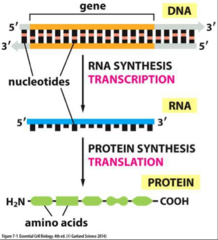
RNA polymerase primer requirement
RNA polymerase initiates synthesis without a primer.
RNA single-stranded folding
Single-stranded RNA folds into diverse 3D shapes via base-pairing.

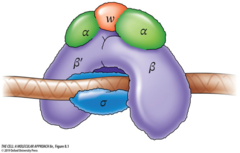
Sigma factor role
Directs bacterial RNA polymerase to bind specifically to promoter sequences.
Bacterial transcription termination signal
GC-rich inverted repeat forming a stem-loop followed by seven U residues.

TATA box recognition
Recognized by the TATA-binding protein component of TFIID.
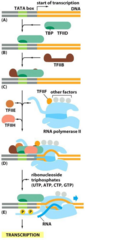
TFIIH dual functions
Unwinds promoter DNA and phosphorylates the RNA polymerase II C-terminal tail.

5' Cap structure
Methylated guanine nucleotide attached to the 5' end of pre-mRNA.

3' Poly-A tail synthesis
Poly-A polymerase adds 50-250 adenines after cleavage downstream of AAUAAA.

Exons vs Introns
Exons are coding sequences retained in mRNA; introns are excised sequences.

GU-AG rule
Introns typically start with a 5' GU and end with a 3' AG.

Spliceosome intermediate
Excised intron forms a looped lariat structure via branch point A.

U1 snRNP function
Binds specifically to the 5' splice site during initial spliceosome assembly.
U2 snRNP function
Binds to the branch point sequence in pre-mRNA.
Promoter function
Binds RNA polymerase and correctly orients the enzyme upstream of the transcription start site.
Transcription regulator structural motifs
Helix-turn-helix, zinc finger, leucine zipper, and basic helix-loop-helix.

Operon
A cluster of prokaryotic genes transcribed together under a single promoter into one mRNA.
CAP activation mechanism
Low glucose increases cAMP, which binds CAP so it can bind DNA and recruit RNA polymerase.
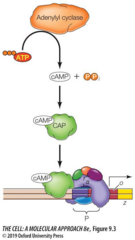
Lac operon maximal expression conditions
Glucose must be absent (high cAMP/active CAP) and lactose must be present (inactive repressor).

Histone acetyltransferases (HATs)
Add acetyl groups to histone lysines, reducing positive charge to loosen chromatin for transcription.

Histone deacetylases (HDACs)
Remove acetyl groups from histone lysines, increasing positive charge to condense chromatin and repress transcription.

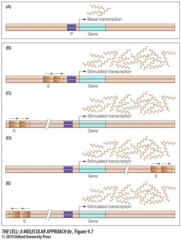
Eukaryotic enhancer function
DNA sequences that bind activator proteins to stimulate transcription from a distance.
Codon
A group of three nucleotides in mRNA specifying a single amino acid.

Start codon
AUG; signals translation initiation and specifies methionine.

Stop codons
UAA, UAG, and UGA; signal translation termination.
Anticodon
A three-nucleotide sequence on tRNA that base-pairs with an mRNA codon.
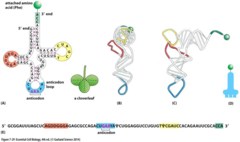
Aminoacyl-tRNA synthetase
Enzyme that covalently attaches the correct amino acid to its tRNA using ATP.

Ribosome small subunit role
Binds mRNA and matches tRNAs to mRNA codons.

Ribosome large subunit role
Catalyzes peptide bond formation between amino acids.

Ribosomal tRNA binding sites
A site (aminoacyl-tRNA), P site (peptidyl-tRNA), and E site (exit).
Peptidyl transferase function
Ribozyme activity of rRNA that forms peptide bonds between amino acids.

Initiator tRNA site
Binds directly to the P site of the small ribosomal subunit.

Shine-Dalgarno sequence
Bacterial mRNA sequence that recruits the small ribosomal subunit to start codons.

Polycistronic mRNA
Bacterial mRNA containing coding sequences for multiple distinct proteins.

Polyribosome (Polysome)
Multiple ribosomes simultaneously translating a single mRNA molecule.

Translation directionality
mRNA is read 5' to 3'; protein is synthesized N-terminus to C-terminus.
Translation termination mechanism
Release factors bind stop codon in A site, adding water to release polypeptide.

Chaperone proteins
Assist proper polypeptide folding and prevent improper aggregation during translation.

Protein disulfide isomerase (PDI)
Enzyme that catalyzes the formation and rearrangement of disulfide bonds.
GPI anchor
Glycolipid attached to the carboxy terminus anchoring proteins to outer cell membrane.
Ubiquitin-proteasome pathway
Ubiquitin tags target proteins for degradation inside the multisubunit proteasome.
Signal sequence (Sorting signal)
Continuous stretch of amino acids directing a protein to its specific cellular compartment.
Nuclear localization signal (NLS)
Specific amino acid sequence on a protein that targets it for import into the nucleus.

Importin function
Nuclear import receptor that binds to a cargo protein's NLS and mediates transit through nuclear pores.

Ran-GTP role in nuclear import
Binds importin inside the nucleus, triggering the release of the imported cargo protein.

Ran-GAP location and function
Cytoplasmic protein that stimulates Ran to hydrolyze GTP to GDP, releasing importin.
Ran-GEF location and function
Nuclear chromatin-associated factor that catalyzes exchange of GDP for GTP on Ran.
Nuclear export signal (NES)
Amino acid sequence that targets cargo proteins for export out of the nucleus.

Exportin complex assembly
Binds cargo containing an NES together with Ran-GTP in the nucleus for export.
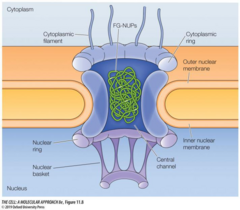
Nuclear pore complex (NPC)
Large aqueous channel structure in the nuclear envelope allowing selective and nonselective macromolecular transport.
Euchromatin vs Heterochromatin localization
Euchromatin is dispersed throughout the nucleus; heterochromatin concentrates near the nuclear envelope and nucleolus.

Ribosomal protein translation site
Cytosolic ribosomes translate mRNAs encoding ribosomal proteins before import into the nucleus.
Effect of removing NLS from nuclear protein
The protein fails to enter the nucleus and remains in the cytoplasm.