Tests for hepatic & pancreatic function & integrity
 Call Kai
 Learn
 Practice Test
 Spaced Repetition
 Match
 Flashcards
 Knowt Play
1/50

There's no tags or description
Looks like no tags are added yet.
51 Terms
What physiological factors can you test in the liver in general?
Hepatocellular injury
Leakage of enzymes from damaged hepatocytes
Cholestasis
Reduced bile excretion- induction of synthesis of enzymes
Hepatic function
Decr prod / catabolism of substances
Hepatic portal circ
Decr extraction of substances absorbed in intestine
Where are liver enzymes primarily located?
Inside the cells
When does the activity of the enzyme in serum incr?
When rate of enzyme entering blood exceeds rate of inactivation / removal
How is enzyme measurement expressed?
International unit of enzyme activity (IU) = amount that catalyses conversion of 1µmol of subtrate per min
What are liver leakage enzmes indicative of?
Hepatocellular damage
They fluctuate in chronic hepatitis / hepatopathy
Declining trend indicates either improvement or potentially reduction in liver mass
What 'leakage enzymes' are routinely measured and what is the difference between them?
ALT (alanine aminotransferase)
Liver specific but may incr w/ severe m. damage (e.g. rhabdomyolysis)
more clinically significant in cats due to shorter half life cf to dogs
AST (aspartate aminotransferase)
Not so liver specific as found in liver, muscle and RBCs
Shorter half life in cats cf to dogs for both
Some others: LDH (not liver specific), GLDH (liver specific, useful in large animals) , SDH (liver specific but unstable, can't measure in serum)
What are liver induction enzymes?
Enzyme production via modifications in physiological processes like transcription & translation
Induction triggered by endogenous substances like bile acids / exogenous substances e.g. drugs
What is the activity of induction enzymes increased by?
Cholestasis
Bile acid accum in hepatocytes incr enzyme prod
Some drugs
E.g. glucocorticoids & phenobarb
What are the liver 'induction' enzymes that you can measure?
ALP
GGT
What are the two isoenzymes of ALP?
Intestinal-ALP
Tissue non specific
Bone ALP
Liver ALP
Corticosteroid ALP (unique to dogs)
Compare ALP diagnostic value in dogs vs cats
More sens for cholestasis in dogs
More specific for cholestasis in cats
What are the main causes of incr ALP?
Cholestasis
Drugs
Glucocorticoids (only dogs)
Phenobarb (mostly dogs, only minimally sporadic incr. in cats)
Bone lesions
Mammary neoplasms
In what organs is GGT present in the highest conc.?
Kidney, pancreas, liver
Only liver GGT contributes to serum
Kidney & pancreas lost in urine & pancreatic secretions
How does GGT importance differ between species?
Preferred over ALP to detect cholestasis in horse, ruminants, birds & poss cats
What should be measured in dogs vs cats if you cannot measure both ALP & GGT together?
ALP in dogs
GGT in cats
What can cause an incr. GGT?
Cholestasis (biliary hyperplasia)
Drugs (only dogs)
Glucocorticoids, phenobarb
Colostrum ingestion
How can we differentiate between cholestasis & drugs causing an incr in liver enzymes?
ALP>GGT = probably drug if disproportionately higher
GGT> ALP = unlikely to be drug
What are the different causes of hyperbilirubinaemia?
Prehepatic = 2° to haemolysis
Check for anaemia
Hepatic = decr bilirubin uptake, conjugation & excretion (liver dysfunction —> intrahepatic cholestasis)
Posthepatic —> 2° to obstruction of extrahepatic bile duct
With a post hepatic hyperbilirubinaemia, other than incr bilirubin what else can confirm this?
Often cholestatic enzymes (ALP & GGT) much higher than leakage enzymes (ALT & AST)
Serum cholesterol often high
U/S very helpful
What aetiology causes hyperbilirubinaemia?
Haemolysis
Obstructive cholestasis
Functional cholestasis (sepsis)
Liver insufficiency
Fasting/ anorexia (mostly in horses, minimal in dogs & cats and only if prolonged)
How is bilirubin measured?
Total or conjugated
Conjugated = direct
Unconjugated = can be calculated
(total bilirubin - direct bilirubin)
What is the diagnostic value of measuirng both direct and indirect BIL?
Not generally useful for cause of hyperbilirubinaemia
Exception is horses w/ fasting hyperbilirubinaemia (mostly due to indirect BIL)
How can you test liver function?
Decr uptake & excretion
Incr bilirubin & bile acids
Decr syntehsis (bc prod by liver)
Decr Albumin, glucose, cholesterol, coagulation factors & inhibitors
Decr conversion
Incr ammonium (ammonia)
How can you measure alterations in portal circulation?
Incr bile acids due to decr. uptake & excretion of bile acids
Incr ammonia due to decr. conversion of ammonia to urea
What are the general features of bile acids?
Produced in hepatocytes
Excreted into bile then back into intestine
Only 10% excreted in faeces, 90% reabsorbed, then 95% goes back to liver & only 5% goes back into systemic circulation
How can you measure bile acids dynamically?
Bile acid stimulation test
Fasting sample (12hrs fast) —> baseline amount that escapes enterohepatic ciruclation
2nd sample 2 hours after giving small meal containing protein & fat
What are the possible causes of an incr. in bile acids?
Hepatic dysfunction (can't uptake bile acids)
Cholestasis (Decr excretion)
Decr portal blood flow
Postprandial (after meal = normal to see incr.)
When is there no point in measuring bile acids?
If there is hyperbilirubinaemia → cholestasis = cause of incr. bile acid conc.
How do you need take a blood sample for ammonia?
EDTA or heparin plasma:
Must be harvested immediately after collection & measured within 30-60 mins w/ minimal exposure to air
If not processed properly —> ammonia may wrongly incr. / decr.
Why does ammonia increase in liver dysfunction?
In urea cycle liver converts ammonia → urea
If liver dysfunctioning this does not happen
What causes inc ammonia?
Hepatic dysfunction
Decr portal flow
Post prandial
What secondary hepatopathies can also cause incr liver enzymes?
Endocrinopathies —> diabetes , Cushings, hyperthyroidism (cats)
Reactive (pancreatitis, enteritis, systemic inflam)
Hypoxia (e.g. severe anaemia)
Incr typically mild (less than 5x upper ref limit)
Bile acids usually normal (or mild incr)
What haematological findings are ass. w/ liver dx?

transferrin = transfers iron
coag factors produced by liver
prolonged PT & PTT
Summarise the typical clinical biochem values look like in liver dx

What are the typical findings of urinalysis in liver dx?
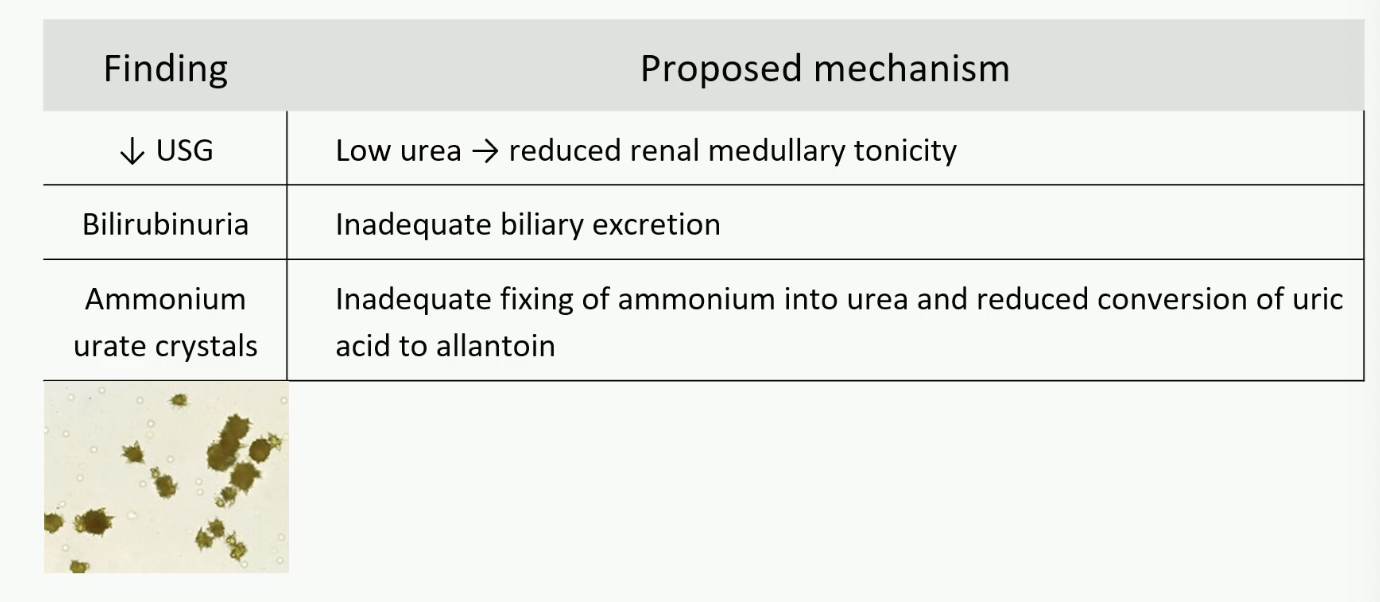
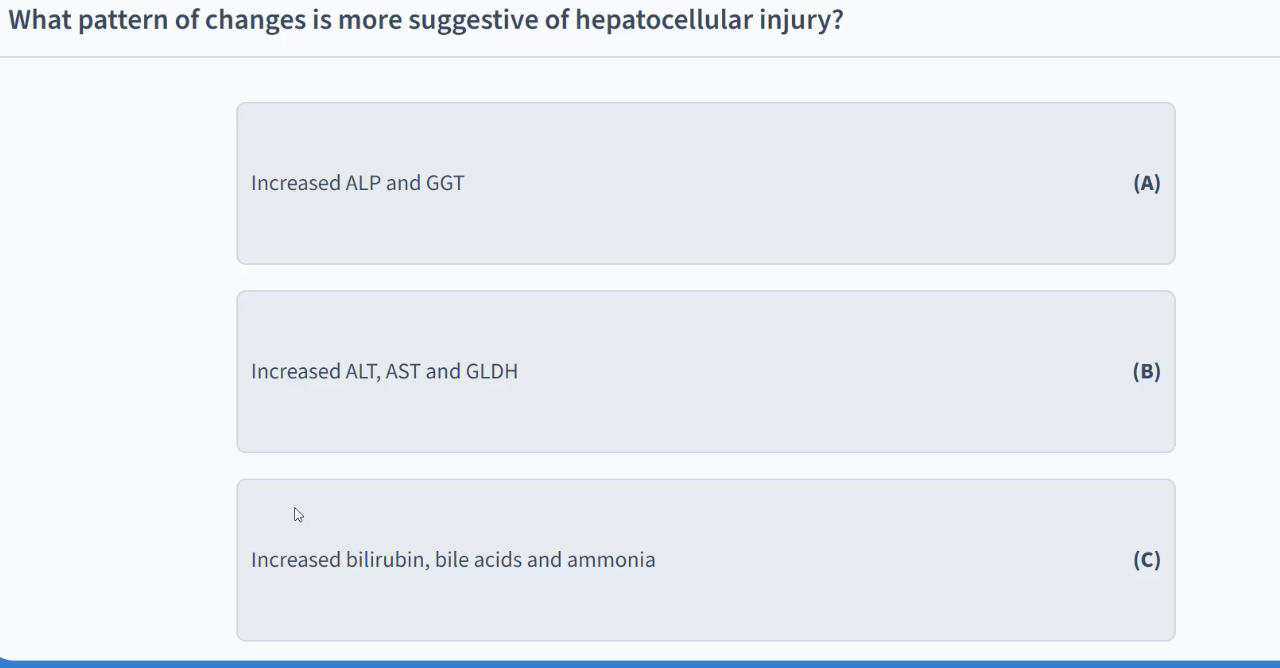
B
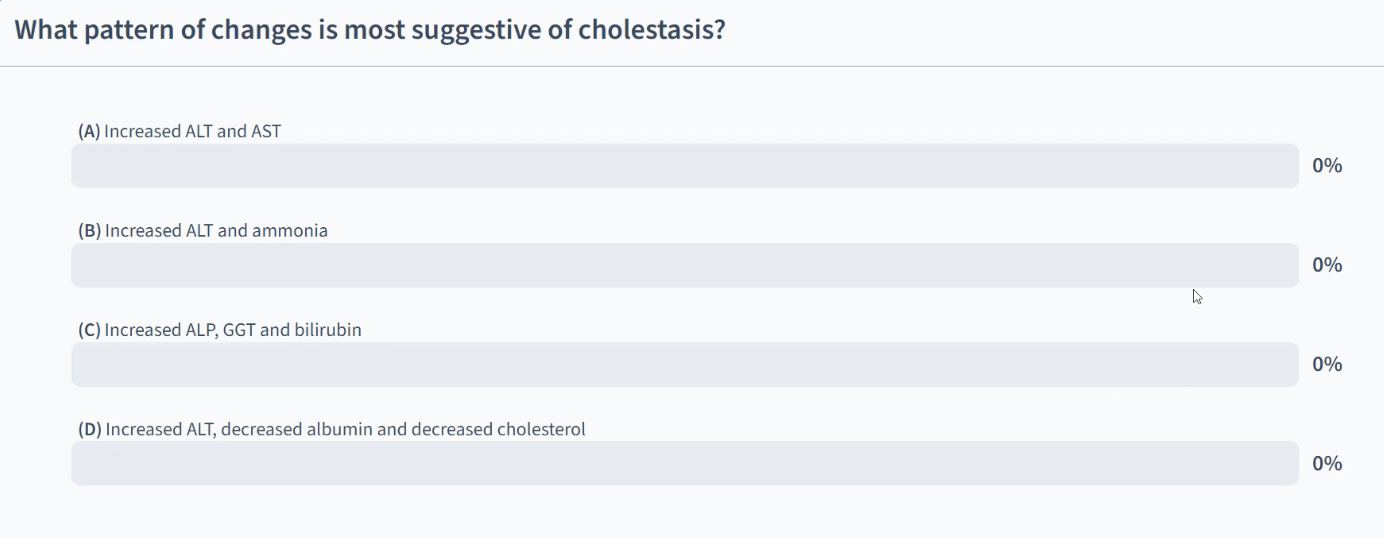
C
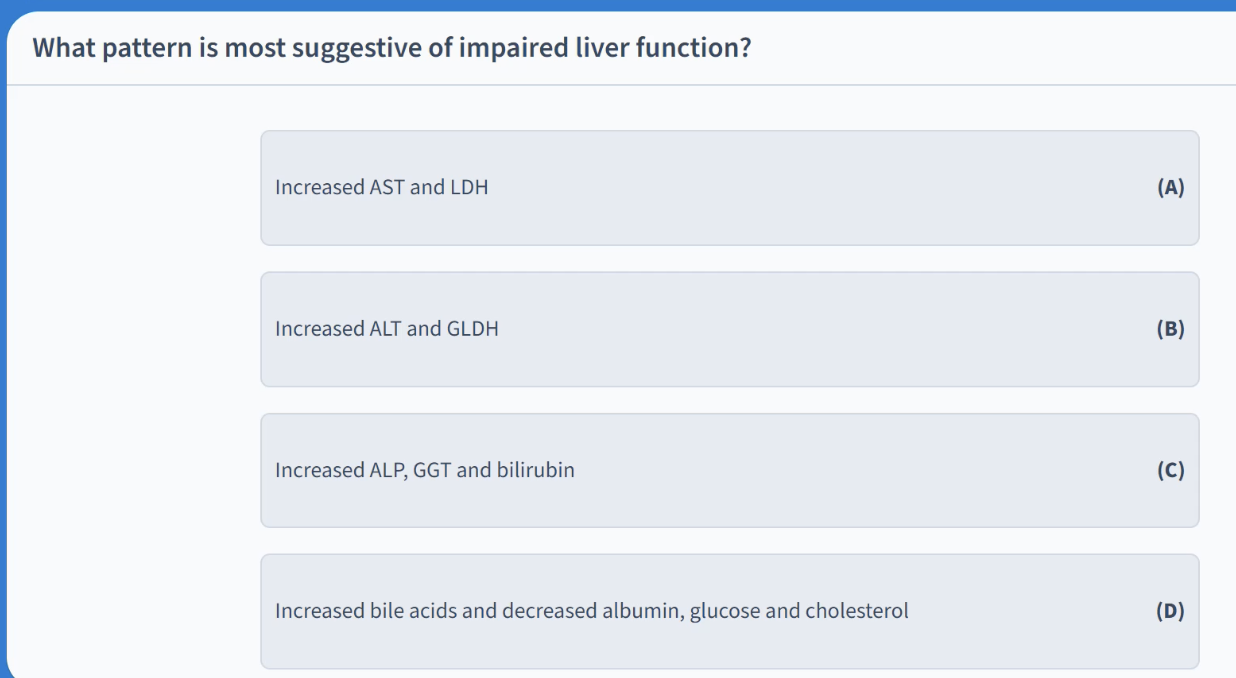
D
D
What tests can you do for exocrine pancreas integrity? (detects pancreatitis)
Amylase (not actually recommended for pancreatitis)
Lipase
Markers of injury to pancreatic cells (diagnosis cannot be made solely on this due to sens & spec of test) —> correlate w/ clin signs, imaging findings, cytology, histopath
Where are amylase & lipase excreted?
Kidneys —> so can incr due to decr GFR
(amylase better in dogs than in cats, but generally not v. useful —> if pancreatitis suspected, don’t measure amylase)
With an incr amylase & lipase activity what are the major causes?
Pancreatic inflam (pancreatitis)
Renal dx (mild, up to x3-4)
Liver & intestinal dx (only amylase, minimal/mild incr.)
Glucocorticoids (only lipase, mild up to x2)
What are some more specific assays used to measure lipase (more specific than traditional assay)?
(Traditional assay not specific enough)
DGGR lipase (more specific to pancreatitis)
spec depends on applied cut-off value → sent to ext. lab to test
can be incr. because of renal dx / glucocorticoid admin
PLI (aka specific pancreatic lipase) —> best test for pancreatitis but £££ & sent to ext. lab (equiv. SNAP test for in-house)
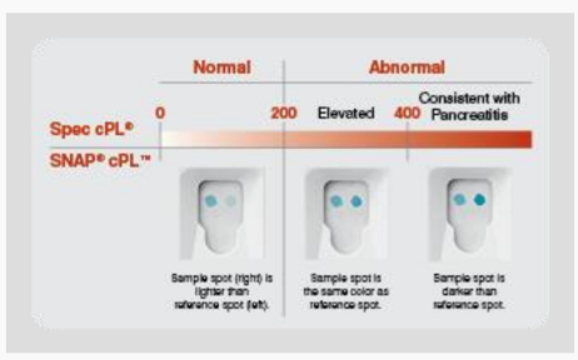
How is canine specific PL test interpretted?

What other lab findings are supportive of pancreatitis?

damage of beta cells of pancreas → diabetes mellitus
What is the test of choice for exocrine pancreatic insufficiency (EPI)?
Trypsin-like immunoreactivity
Detects trypsinogen, trypsin & trypsin bound to protease inhibitors
Species-specific assays required
Highly sens & spec test for diag EPI → decr. TLI
Incr. TLI has poorer performance cf. PLI for pancreatitis
How is canine TLI interpretted?


A+B

D
DO NOT test for amylase / lipase if pancreatitis suspected
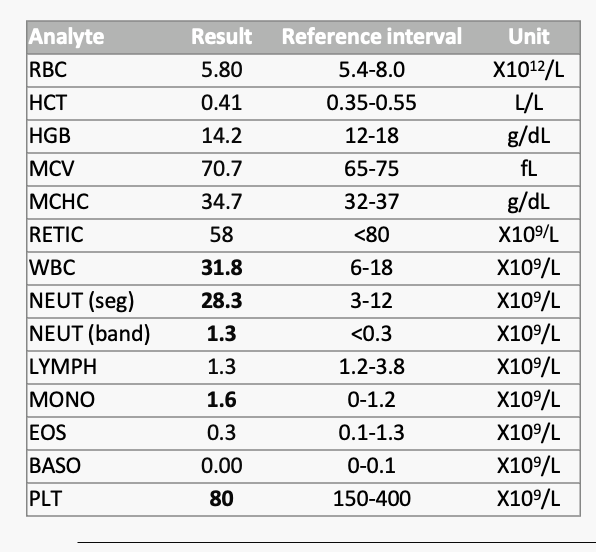
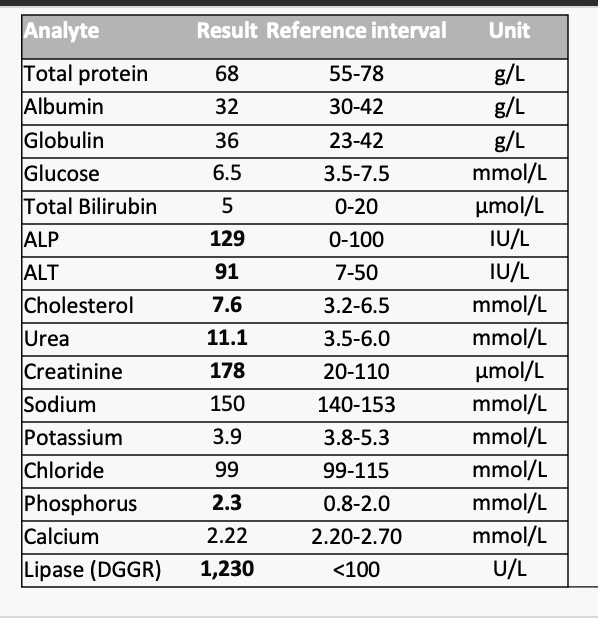
Case 1:
Hx: anorexia, lethargy, acute vomiting
Physical examination: quiet, pain on abdominal palpation
USG = 1.042
Mod neutrophilia w/ band neutrophils (L shift), mild monocytosis, mod thrombocytopenia
changes in leukogram → acute / active inflam
genuine thrombocytopenia —> no platelet clumping on blood smear, incr. consumption/destruction / decr. production?
Further tests due to genuine thrombocytopenia:
prolonged PT & PTT, incr. D dimers, decr. ATIII = DIC (disseminated intravascular coag)
Mild incr ALP, ALT, incr cholesterol, creatinine & urea, incr P, incr DGGR lipase
Marked DGGR incr → pancreatitis
Incr ALT, ALP & cholesterol → hepatocellular injury & cholestasis → 2° reactive hepatitis probs
USG = Prerenal azotaemia (due to decr. GFR → dehydration)
urine well conc. = pre-renal
incr. P, urea & creatinine
Imaging / cytology of pancreas probably next step
Case 2:
10yo MN Lab
Hx: weight loss, lethargy, PUPD
CE: quiet, fluid thrill on abdo palp
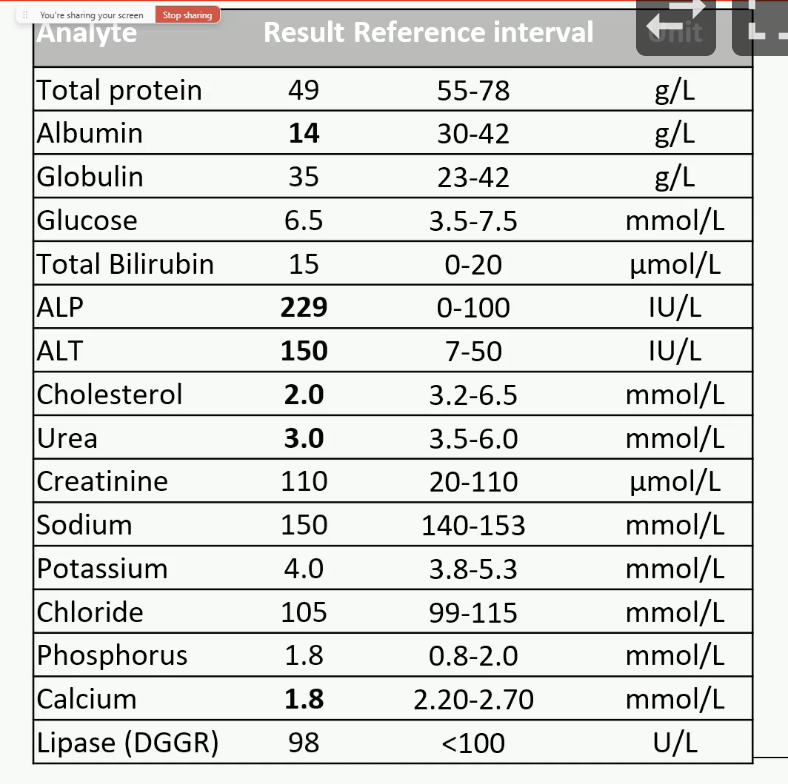
Discuss & what further test would you do here?
Mild incr ALP, ALT incr
ALT incr = hepatocellular damage only (nothing to do with liver dysfunction)
ALP incr = cholestasis
Low cholesterol, Ca, Urea, albumin
Liver dysfunction
Further tests —> bile acids + cytology of liver to investigate hepatopathy
Incr. bile acids so chronic hepatitis
mild lipidosis