Bio 120 Exam 2 (10/14)
 Call Kai
 Learn
Learn Practice Test
 Spaced Repetition
 Match
Match Flashcards
 Knowt Play
1/136

There's no tags or description
Looks like no tags are added yet.
Name | Mastery | Learn | Test | Matching | Spaced | Call with Kai | Chat |
|---|
No analytics yet
Send a link to your students to track their progress
137 Terms
What is a gene?
A. A length of DNA that turns into protein
B. A length of DNA that makes your eyes a specific color
C. A length of protein that makes your eyes a specific color
D. A length of DNA that codes for a protein sequence
A length of DNA that codes for a protein sequence
What is the sum of all an organism’s DNA/chromosomes called?
A. Gene
B. Genome
C. Proteome
D. Cellulome
Genome
What is the function of DNA replication?
A. This process enables proteins to be made
B. When cells divide, each new cell gets a copy of all the genes
C. So the nucleus has something to do
D. So scientists can change the genetic sequence of an organism
When cells divide, each new cell gets a copy of all the genes
There are 3 types of RNA that are involved in protein synthesis. Which is NOT on the list?
A. Messenger
B. Transfer
C. Ribosomal
D. Transcriptional
Transcriptional
Which type of RNA moves from the nucleus to the cytoplasm?
A. Messenger
B. Transfer
C. Ribosomal
D. Transcriptional
Messenger
Which type of RNA is involved in transcription?
A. Messenger
B. Transfer
C. Ribosomal
D. Transcriptional
Transcriptional
Which type of RNA is involved in translation?
A. Messenger
B. Transfer
C. Ribosomal
D. All of the above
Messenger
Transfer
Ribosomal
What is the difference between DNA polymerase and RNA polymerase?
A. One makes the nucleus, the other the cytoplasm
B. One reads the sequence of DNA in the genome, the other reads the sequence of amino acids in all the proteins
C. One is involved in replication the other the processes of the central dogma
D. One polymerizes DNA the other depolymerizes DNA
E. One is made of DNA the other is made of protein
One is involved in replication the other the processes of the central dogma
What is a transcription factor?
A. A protein that binds to a promotor and initiates transcription
B. A protein that binds to a promotor and initiates translation
C. A length of DNA that codes for a protein
D. A length of DNA that binds to protein
A protein that binds to a promotor and initiates transcription
What is a promotor?
A. A protein that binds to a promotor and initiates transcription
B. A protein that binds to another promotor and initiates translation
C. A length of DNA that when bound by transcription factors get transcription going
D. A length of DNA that when bound by translation factors get translation going
A length of DNA that when bound by transcription factors get transcription going
What is a codon?
A sequence of nucleotides that code for a particular amino acid
B sequence of nucleotides that code for a particular protein
C. It is another name for a gene
D. the pore in the nuclear membrane through which mRNA moves
sequence of nucleotides that code for a particular amino acid
There are 2 methods researchers use to introduce novel DNA into cultured plant cells. What are they?
A. Using a bacterium to infect the cells, and using UV lasers
B. Using a bacterium to infect the cells, and biolistically
C. Using UV lasers, and biolistically
D. Using UV lasers, and using Infrared lasers
Using a bacterium to infect the cells, and biolistically
We can put any gene in a plant from any organism and know the correct protein will be made because the code from DNA to RNA to amino acid sequence is universal to all organisms on the planet.
A. True
B. False
True
Plants can do both sexual and asexual reproduction. What is the key advantage of sexual reproduction?
A. Offspring are genetically varied
B. Offspring are identical
C. It is rapid
D. It only uses mitosis
Offspring are genetically varied
Plants can do both sexual and asexual reproduction. What is the key advantage of asexual reproduction?
A. Offspring are genetically varied
B. It is rapid
C it allows a species to adapt to environmental change over time
D. It only uses meiosis
It is rapid
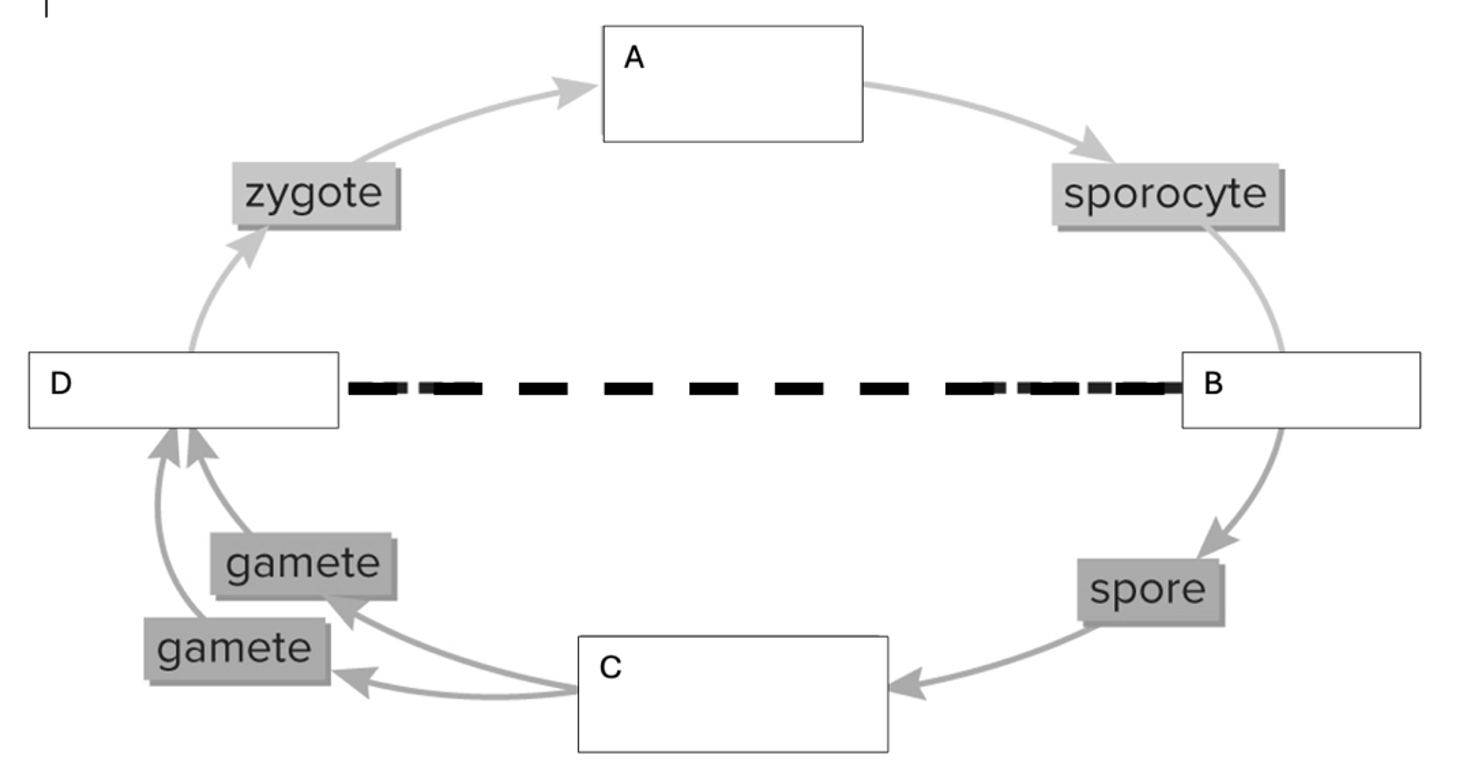
Which are stages are 2n?
A. Below the line
B. Above the line
C. The sporocyte and spore
D. The gametes and zygote
Below the line
Which stages are multicellular?
A. Gametes and spores
B. Zygote and gametes
C. A & B
D. A
D or none

What principle is the diagram is showing?
A. A generalized plant life cycle
B. Alternation of generations
C. Plants are multicellular at both the 1n and 2n stages of the life cycle
D. All of the above
All of the above
Where is the plant body does mitosis happen?
A. Everywhere
B. Meristems
C. Only in the sporophytes
D. Only in the gametophytes
Meristems
In addition to crossing over, another factor in meiosis contributes to the 4 daughter cells being genetically different. What is this called?
A. Crossing-under
B. Independent assortment
C. Prophase
D. Cytokinesis
Independent assortment
When 2 gametes fuse and result in a zygote, a third factor contributes to genetic variation of the offspring. What
is this process called?
A. Crossing under
B. Haploid
C. Diploid
D. Random fertilization
Random fertilization
What does polyploidy mean?
A. Cells with more than 1 set of chromosomes
B. Cells with more than 2 sets of chromosomes
C. Organisms that are infertile
D. Cells in which the chromosomes have polymerized into one giant chromosome
Cells with more than 2 sets of chromosomes
What is an allele?
A. A gene that makes a plant tall
B. A gene that makes a plant short
C. An alternate version of a gene
D. A synonym for gene
An alternate version of a gene
The dihybrid crosses conducted by Mendel were critical in what aspect of his understanding of genetics.
A Unit character
B Dominance
C Segregation of alleles of a gene
D Independent assortment of different genes
Independent assortment of different genes
A geneticist determined that for 2 different genes the traits did not follow the law of independent assortment of different genes. For example, all pink flowers were found on tall plants. What does that mean about the genes for the 2 traits.
A. The genes are on different chromosomes
B. The genes are close together on the same chromosome
C. The traits are not encoded by genes
D. The plant is hexaploid
The genes are close together on the same chromosome
Why does cytoplasmic inheritance occur?
A. Some cellular proteins made by the cell are not encoded by DNA
B. The DNA that codes for certain proteins is in the chloroplasts or mitochondria, not the nucleus
C. When no genetic material is passed from parent to offspring
D. because during asexual reproduction inheritance is cytoplasmic only, the nucleus is not involved
The DNA that codes for certain proteins is in the chloroplasts or mitochondria, not the nucleus
People often mistakenly confuse the terms gene and allele. Image someone looking at the pea plants in their garden. They only see purple flowers (although they know from their neighbor’s yard the other possible phenotype is white). Which statement is correct about what they see?
A. None of my plants have the white flower gene
B. My plants only have the purple flower gene
C. The phenotypes of my plants are purple, although there could be white alleles out there
D. My plants are all homozygous, they all have both purple genes
E. My plants are much better than my neighbors
The phenotypes of my plants are purple, although there could be white alleles out there
Humans have used plant products for fuel for a very long time. Which of the following is not a category of plant products used?
A. Wood
B. Coal
C. Biodiesel
D. Secondary metabolites
Coal
Humans have used plant products for fiber/clothing for thousands of years. Which of the following is not a plant we use for this purpose?
A. Cotton
B. Corn
C. Hemp
D. Flax
Corn
Humans have used plants for medicinal / spiritual purposes for thousands of years. But when did we first start to
isolate/purify the active ingredients in the plants?
A.1500s
B.1800s
C.1900s
D. 2000s
1800s
Sugars from plants are the basis for making most alcoholic beverages. Which of following ancient beverages also needs the assistance of bees?
A. Mead
B. Beer
C. Wine
D. Cider
Mead
The relationship between humans and the crops we have domesticated can be considered a form of mutualism.
Which statement about the organisms and the relationship is not true?
A. Domesticated plants need humans to complete their life cycles
B. The human population needs domesticated crops to survive
C. Plants that have been domesticated are still natural/ the same as their wild progenitors
D. Domestication started around 10,000 years ago
E. Domestication of different crops happened in many places around the world
Plants that have been domesticated are still natural/ the same as their wild progenitors
What combination of crops that were domesticated early provides a balance of all amino acids?
A. Cereal and legumes
B. Rice and wheat
C. Potatoes and tomatoes
D. Apples and oranges
Cereal and legumes
Which statement about the transition from hunter gathering to agricultural societies is NOT true?
A. It happened gradually
B. It first happened in the fertile crescent and then those farmers sailed around the world to spread their ideas
C. Evidence suggests that in some cases early farmers were less well-off than hunter gatherers
D. It changed the structure of societies in many ways
It first happened in the fertile crescent and then those farmers sailed around the world to spread their ideas
There are just a handful of staple crops that provide most of our calories. Which is not on the list?
A. Rice
B. Maize
C. Wheat
D. Quinoa
E. Potato
Quinoa
What kind of fertilizers were used in neolithic farming?
A. Nitrates and phosphates from the farm store
B. Animal feces and compost
C. Pellets from the organic farm store
D. Fertilizers were not used until the green revolution
Animal feces and compost
What does traditional subsistence agriculture mean?
A. Raising enough food to feed your family/ a small community
B. Not having enough food to eat, so heavy reliance on government assistance
C. Growing crops to sell at market
D. Not using any fertilizers
Raising enough food to feed your family/ a small community
Intensive subsistence agriculture still has one key things in common with traditional subsistence agriculture.
What is it?
A. Most of the community is still involved in growing/harvesting
B. It can only support a small population
C. There is no irrigation
D. Fertilizers are not used
Most of the community is still involved in growing/harvesting
Before WWII there were many developments in the industrialization of agriculture. Which statement is incorrect about this period of agricultural development?
A. Use of fossil fueled machinery (tractors etc.)
B. Development of high yield highly bred crops
C. Farms got bigger as less people were needed
D. More land was converted from wild to agricultural
Development of high yield highly bred crops
After WWII the green revolution drove further developments in the industrialization of agriculture. Which statement is incorrect about this period of agricultural development?
A. High yield highly bred grain crops
B. Development of modern inorganic fertilizers
C. Increased use of modern herbicides and pesticides
D. Less farmland needed to feed the population as crop growth became more efficient
Less farmland needed to feed the population as crop growth became more efficient
Humans have been altering plant characteristics and hence their genetic make-up since…
A. The neolithic revolution
B. The industrial revolution
C. The green revolution
D. The development of GMOs
The neolithic revolution
Early in plant domestication humans were not deliberately making decisions about which individuals to propagate. What is the name of this step?
A. Conscious selection
B. Marker assisted breeding
C. Outcrossing
D. Unconscious selection
Unconscious selection
What kind of traits were NOT associated with unconscious selection?
A. Lack of seed shattering
B. Reduced pod splitting
C. uniform seed germination
D. Increased drought tolerance
Increased drought tolerance
As early farmers became more intentional about collecting, saving and sowing seeds they started selecting specific traits to re-sow each year. Which is NOT on the list of conscious selection?
A. Bigger fruit
B. increased chemicals that deter herbivory
C. Bigger seeds
D. Reduced day length requirements
increased chemicals that deter herbivory
What does self-pollinating mean?
A. Two genetically identical individuals can be crossed successfully
B. A plant will only be fertilization and develop seed successfully if the pollen comes from the same flower
C. The anther of a flower directly places pollen on the stigma
D. Flowers rely on bees or humans to transfer pollen from one flower to another
The anther of a flower directly places pollen on the stigma
What does pure line selection mean?
A. Only plants that have never been crossed are used
B. Only wild plants are used, so they are untainted by human interference
C. It focuses on finding individual lineages with the most desirable trait, over many generations
D. Only plants that have do asexual reproduction are used
It focuses on finding individual lineages with the most desirable trait, over many generations
What is an advantage of mass selection over pure line selection?
A. Less genetic diversity in the population
B. It is guaranteed all the plants will be identical
C. it is simpler
D. Only professional breeders can do it, but the product is always superior
it is simpler
In introgressive back-crossing what 2 kinds of plant are used?
A. Two wild, related species
B. Two cultivars that are genetically identical
C. The wild progenitor or relative and a cultivar
D. a plant and a bacterium
The wild progenitor or relative and a cultivar
Introgressive back-crossing is most commonly used to do what?
A. Improve fertilizer uptake by the plant
B. Reduce the crop yield to a more wild-type level
C. Introduce disease resistance from a wild relative into a cultivated line
D. Eliminate the ability of a cultivated line to cross with a wild relative
Introduce disease resistance from a wild relative into a cultivated line
Why it is important to buy new seed each year if F1 lines are the best way to produce a high yielding crop with all the traits you desire?
A. if you use seed from the next generations the plants will not be as optimal
B. so you can ensure the seed companies still stay in business
C. if you use seed from subsequent generations, you will get a different species
D. if you use seed from subsequent generations you will end up with wild plants
if you use seed from the next generations the plants will not be as optimal
What are heirloom varieties?
A. Plants that are the same as the wild plant
B. Plants that have not gone through the most recent modern breeding techniques
C. Plants that are less susceptible to pests/diseases
D. Plants your Grandma gave you
Plants that have not gone through the most recent modern breeding techniques
There are several possible strategies to continue to improve our crops and feed the human population. Which is
NOT a viable/realistic option?
A. Using germplasm collections to find useful traits in collected wild lineages
B. Developing perennial crop plants to reduce fertilizer needs and soil erosion
C. Considering alternate / ancient plants
D. Going back to just eating wild food
E. Introduce useful traits from other species or artificially hybridizing species
Going back to just eating wild food
What is triticale an example of?
A. An ancient grain
B.A relative of maize
C. An artificial / man-made hybrid with traits for 2 different species
D. A GMO with improved drought tolerance
E. A plant improved by using marker assisted breeding
An artificial / man-made hybrid with traits for 2 different species
The green revolution resulted in crops that produce higher yields than before WWII, but there are long term sustainability concerns for many reasons. What is NOT on the list of requirements these modern lines need for optimal production that are connected with sustainability?
A. Increases irrigation
B. Increased pesticides
C. Increased fertilizer
D. Increased technology required
E. Increased genetic diversity
Increased genetic diversity
What idea did Malthus have that influenced Darwin’s reasoning?
A. Competition for resources leads to the death of many individuals
B. An individual can change its shape to best fit its environment
C. He suggested that the Earth was much older than previously thought.
D. He suggested that humans have bred dogs to have many different sizes and colors
Competition for resources leads to the death of many individuals
Which of the following is not a key component of evolution by natural selection?
A. Individuals choose to pass on just their best alleles to their offspring
B. The number of offspring produced are more numerous than an ecosystem can sustain
C. Competition for resources means than many offspring will die before they can reproduce
D. Individuals with traits that are best adapted to the particular environment are more likely to survive and produce
offspring
Individuals choose to pass on just their best alleles to their offspring
What kinds of information/research would be the least helpful to understand evolution?
A. Looking at the fossil record in many different geological layers
B. DNA sequence comparisons
C. Observing the development of pesticide resistance in insects
D. Studies of embryo development in many organisms
E. Studying the behavior of one individual organism
Studying the behavior of one individual organism
What type of information can the fossil record provide us?
A. Some organisms have become extinct
B. Changes in groups over time
C. Extinct organisms have homology to organisms that are present today
D. All of the above
All of the above
According to Darwinian evolutionary theory what is the smallest group that can evolve
A. An individual
B. A genus
C. A species
D.A population
A population
From which field did Darwin take the concept of gradualism that he incorporated into his theory of evolution?
A. Taxonomy
B. Geology
C. Paleontology
D. Population genetics
Geology
Following Lamarck’s theory of evolution, the daughter of two champion weight-lifters will be…
A. Very strong even without working out
B. Very strong as long as she works out
C. Weaker than average
D. Unlikely to be born due to the use of anabolic steroids
Very strong even without working out
What connection did Darwin make when he was thinking about the finches and tortoises on the Galapagos
A. Species on the islands were not related to any other species on Earth
B. Species do not change
C. Species change over time
D. Species were put on the different islands to best fit the environment
Species change over time
How is artificial selection different from natural selection?
A. Humans do the selecting rather than the environment
B. Artificial selection requires DNA cloning and test tubes and genetic transformation to make it happen, natural
selection doesn’t
C. Plants evolve by artificial selection, animals evolve by natural selection
D. Natural selection happened early in Earth’s history, but doesn’t happen anymore, now there is only artificial
selection
Humans do the selecting rather than the environment
What is the best definition of natural selection?
A. Survival in nature of organisms who produce the most offspring
B. Survival in nature of organisms who produce the largest offspring
C. Survival in nature of offspring that are best adapted to the environment
D. Human breeding of plants and animals selecting for particular traits over each generation
Survival in nature of offspring that are best adapted to the environment
In evolutionary biology the term “fitness” refers to…
A. The ability to escape from predators
B. Organisms efficiency in harvesting energy for growth
C. The age of organisms
D. The ability of organism to produce offspring
The ability of an organism to produce offspring
In biology what is analogy?
A. Similarity based on convergent evolution which is adaptation to similar environmental conditions
B. Similarity based on looking like a cactus
C. Similarity based on shared ancestry
D. Similarity based on someone designing 2 things for the same purpose
Similarity based on convergent evolution which is adaptation to similar environmental conditions
In biology what is homology?
A. Similarity based on convergent evolution which is adaptation to similar environmental conditions
B. Similarity based on the ability to fly
C. Similar based on shared ancestry
D. Similarity based on someone designing 2 things for the same purpose
Similar based on shared ancestry
Why is camouflage an example of evolutionary adaptation?
A. If a predator cannot see you they cannot eat you, you have a higher likelihood of survival and can pass on those alleles to offspring if you are better camouflaged than your relatives.
B. If a predator cannot see you, you can tell your family members to disguise themselves in a similar manner so the
whole family survives
C. Changing the genetic code of an individual so it cannot be seen by predators is a classic example of natural
selection
D. Humans choose which animals look better, and don't let the other types breed
If a predator cannot see you they cannot eat you, you have a higher likelihood of survival and can pass on those
What process plays an important role in long term evolution by being the only one that leads to completely new alleles and genes being generated?
A. Mutation
B. Sexual reproduction
C. Meiosis
D. Asexual reproduction
Mutation
How does sexual reproduction enhance the speed of evolution?
A. It generates more individuals more rapidly than asexual reproduction
B. It prevents inbreeding
C. It leads to entirely new alleles evolving
D. It leads to new combinations of existing genetic variation within a species
It leads to new combinations of existing genetic variation within a species
BLANK is the sum total of all the alleles of all the genes in a population of an organism.
A. A species
B. The genotype
C. The gene pool
D. The swimming pool
E. Population genetics
gene pool
If a genetic mutation happens in the mesophyll cells in a leaf, will it be passed on to the next generation?
A. yes
B. no
No
If for some reason, most of a population of an organism dies, and the survivors have different frequencies of alleles. What specific terms refers to this?
A. Genetic drift
B. Gene flow
C. Natural selection
D. Non-random mating
genetic drift
When a beneficial characteristic evolves within a population it is likely to increase in frequency as a result of___
A. Genetic drift
B. Gene flow
C. Non-random mating
D. Natural selection
natural selection
On what is the biological species concept based?
A. Morphological characteristics
B. Reproductive isolation
C. Geographic isolation
D. DNA sequence
Reproductive Isolation
In a population, outbreeding_____
A. Reduces genetic variability between offspring
B. Promotes genetic variability between offspring
C. Eliminates the less fit offspring
D. Reduces the potential for a population to adapt
E. B&D
Promotes genetic variability between offspring
Plants employ many different mechanisms to prevent in-breeding. Which is NOT on the list?
A. Single sex plants
B. Timing of male/female part maturity is different
C. Seeds don’t germinate in the same location as the parent plant
D. Biochemical recognition of self-pollen by the female structures
Seeds don’t germinate in the same location as the parent plantNo
If you notice two plants of the same species have differences in their physical characteristics, can you know for sure they are genetically different?
A. Yes, the only that matters about how a plant looks is its genome
B. No, acclimation to the environment can cause differences in appearance
No
Who originally developed the binomial system for naming species
A. Linneaus
B. Hutton and Lyell
C. Darwin
D. Cuvier
Linnaeus
In contrast the simple classification, the goal of phylogenetics is not only to name organisms but also___
A. Show evolutionary relationships between organisms
B. Focus on reproductive characteristics
C. Provide detailed descriptions of species
D. Represent geographic distribution of species
Show evolutionary relationships between organisms
The diversity of tarweed plants on different Hawaiian Islands is an example of
A. Polyploidy
B. Sympatric speciation
C. Weeds
D. Adaptive radiation
Adaptive radiation
If 2 populations of one species evolve into separate species over time because of geographic isolation this is
called..
A. Sympatric speciation
B. Allopatric speciation
C. Phylogeny
D. Allopolyploidy
Allopatric speciation
If 2 populations of one species evolve into separate species over time in the same location this is called..
A. Sympatric speciation
B. Allopatric speciation
C. Phylogeny
D. Allopolyploidy
Sympatric speciation
Wheat is an interesting example of polyploidy and its name is Triticum aestivum. What is NOT true about this name and the biology of wheat?
A. This system of naming was invented by Carl Linnaeus
B. Triticum is the genus
C. Aestivum is the specific epithet
D. Polyploidy means it only has one copy of each chromosome
Polyploidy means it only has one copy of each chromosome
Which of the following is true of the genome of bread wheat?
A. It is a sterile hybrid
B. It is an autopolyploid with 4 sets of chromosomes
C. It is a 3n, with a set of chromosomes from 3 separate species
D. It is a 6n autopolyploid, with 3 diploid sets of chromosomes from a single species
E. It is a 6n allopolyploid, combining the diploid genomes of 3 separate species
It is a 6n allopolyploid, combining the diploid genomes of 3 separate species
Tragopogon is a local example of related but different species which hybridized, and the offspring then became
what?
A. New species
B. New genus
C. New crop
D. New autopolyploid
New species
Fireweed is an example of….
A. Many species that look the same
B. a new genus formed by allopolyploidy
C. a new crop formed by allopolyploidy
D. subspecies that has undergone autopolyploidy
subspecies that has undergone autopolyploidy
Phytophthora is a genus of water molds that has caused trouble in agriculture, in history and more recently. Which statement is incorrect about this type of protist?
A. It is a fungus
B. It is a eukaryote
C. It caused the Irish potato famine of the 1800s
D. It is responsible for sudden oak death in California
It is a fungus
Some protists are isomorphic/ What does that mean?
A. The sporophyte and gametophyte look different
B. The sporophyte and gametophyte look the same
C. The life cycle includes alternation of generations
D. The leaves are different from the roots
The sporophyte and gametophyte look the same
Protists have a huge variety of lifestyles. Which statement is incorrect about this diverse group protists?
A. Some are photosynthetic some are consumers
B. Multicellularity first evolved in the protists
C. They are eukaryotic which means they do not have organelles
D. Meiosis/sex first evolved in the protists
E. They live in diverse habitats, in water and on land
They are eukaryotic which means they do not have organelles
Marine algae don’t have roots, but some have a structure to anchor to rocks. What is it called?
A. Rhizoid
B. Hold fast
C. Hold strong
D. Hold on
hold fast
Some marine algae have bladders. What is their function?
A. They contain fertilized eggs that are released when the tide is high
B. They keep the blades high in the water to receive more sunlight
C. They contain the waste material
D to entertain kids on the beach with popping fun
They keep the blades high in the water to receive more sunlight
Humans make use of algae for various purposes. What is NOT something we do with seaweeds?
A. Sushi wrappers
B. Gel for growing bacteria in petri dishes
C. Beer additive
D. Food thickener
E. source of antibiotics
source of antibiotics
As with all protists there is diversity among green algae. Which is NOT true?
A. Some green algae are single-celled, some are multicellular
B. Some live in marine environments, some in fresh water
C. Some do photosynthesis, some eat other organisms
D. Some have alternation of generations in their life cycle
Some do photosynthesis, some eat other organism
There are many lines of evidence suggesting plants evolved from the green algae group charophytes. Which is NOT part of the evidence?
A. The structures that synthesize microfibrils are the same
B. The chloroplasts are very similar
C. The DNA similarities are low
D. Some aspects of cell division are more similar compared to other algae
The DNA similarities are low

Which process reads one kind of nucleotide and makes another kind of nucleotide
B. Transcription

Which structure is made of polymerized amino acids?
d.Protein

Which cell part is only found in eukaryotes?
A Nucleus

Which process involves ribosomes?
c.Translation

Which process converts double stranded to single stranded structures?
B. Replication fork opening/ DNA helicase