Bio Unit 7 - Digestive System
 Call Kai
 Learn
 Practice Test
 Spaced Repetition
 Match
 Flashcards
 Knowt Play
1/612

Earn XP
Description and Tags
550+ record..lets see
613 Terms
What do all living organisms need to survive?
Nutrients
How do plants obtain the energy required for cellular function?
Through photosynthesis.
How do animals obtain nutrients?
Consumption of other organisms.
At the cellular level, what biological molecules are necessary for animal function?
Amino acids, lipid molecules, nucleotides and simple sugars.
What are the three major macromolecules found in food?
Protein, fats, and complex carbohydrates.
Why must animals convert the major macromolecules found in food into simple molecules?
To maintain cellular function and so the body can use them.
What is digestion?
The breakdown of food into smaller components that are later absorbed and used by cells in the body.
What are the two types of digestion?
Mechanical digestion and chemical digestion.
What are three things the body must balance in nutrition.
Food intake, energy storage and energy expenditure.
What occurs when energy intake exceeds energy expenditure?
Excess energy is stored as fat?
What is obesity associated with?
An increased risk of diseases such as type 2 diabetes.
What are the three names for the digestive system?
Alimentary canal, digestive tract or gastrointestinal tract or GI tract.
How long is the digestive tract?
Approximately 9 meters or 29 feet in length.
Where does the digestive tract begin and end?
Extends from the mouth to the anus.
What are the MAIN functions of the digestive system?
Digestion, absorption and metabolism of nutrients.
What are the main organs of the digestive system?
Mouth, pharynx, esophagus, stomach, small intestine, large intestine, rectum and anal canal.
What are the accessory organs of the digestive system?
Teeth, tongue, salivary glands, liver, gallbladder, pancreas and vermiform appendix.
What are all of the functions of the digestive system?
Ingestion, mastication, mechanical digestion, propulsion, peristalsis, chemical digestion, segmentation, absorption and elimination.
What is mechanical digestion?
Physical breakdown of food into smaller pieces without changing its chemical composition.
What is chemical composition?
Large non-absorbable molecules of nutrients are broken down into smaller chemical building blocks by enzymes and chemicals contained in digestive juices.
What organs contribute to mechanical and chemical digestion?
Mouth, stomach and intestines.
Where does most digestion occur?
Duodenum of the small intestine.
What is ingestion?
Entry of the food into the digestive tract through the mouth meaning food is taken into the body.
What organs contribute to ingestion?
Mouth
What is mastication?
Organs in the mouth use chewing and tongue movements to break down food into smaller pieces and mix it with saliva.
What organs contribute to mastication?
The teeth and tongue in the mouth.
What is propulsion?
Movement of food through the digestive tract.
Which part of the digestive system is voluntary and involuntary?
Swallowing is voluntary, but the rest is involuntary.
What are the organs involved in propulsion?
Mouth, pharynx and esophagus.
What is peristalsis?
Involuntary, wave-like muscle contracts that push food forward through the digestive tract.
What organs are involved in peristalsis?
Esophagus, stomach, small intestine and large intestine.
What is segmentation?
Sections of the small intestine contract their circular muscles to move food back and forth, mixing it with digestive juices.
What organs are involved in segmentation?
Small intestine.
What is absorption?
Digested nutrients that are small enough to pass through the wall of the small intestine enter the blood stream.
What organs are involved in absorption?
Mostly small intestine and large intestine.
What is elimination?
Indigested materials are removed from the body as feces through defecation.
What organs are involved in elimination?
Large intestine, rectum and anus.

What is 1?
Mouth

What is 2?
Teeth

What is 3?
Tongue

What is 4?
Uvula

What is 5?
Palate
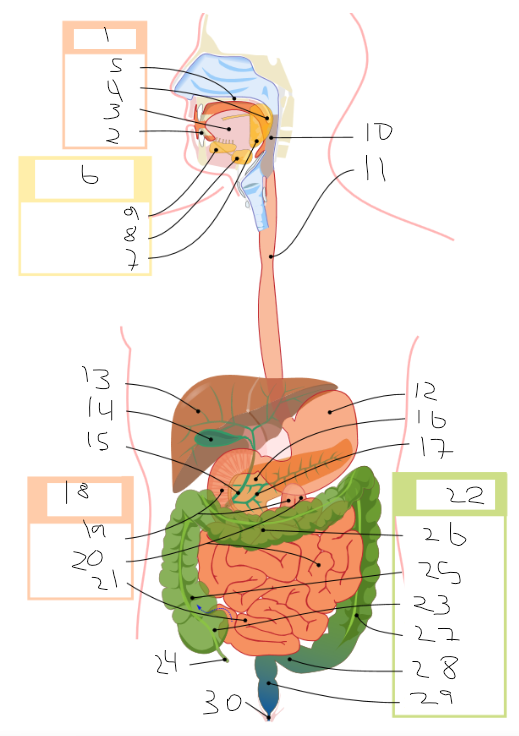
What is 6?
Salivary glands

What is 7?
Parotid salivary gland

What is 8?
Submandibular salivary gland

What is 9?
Sublingual salivary gland

What is 10?
Pharynx
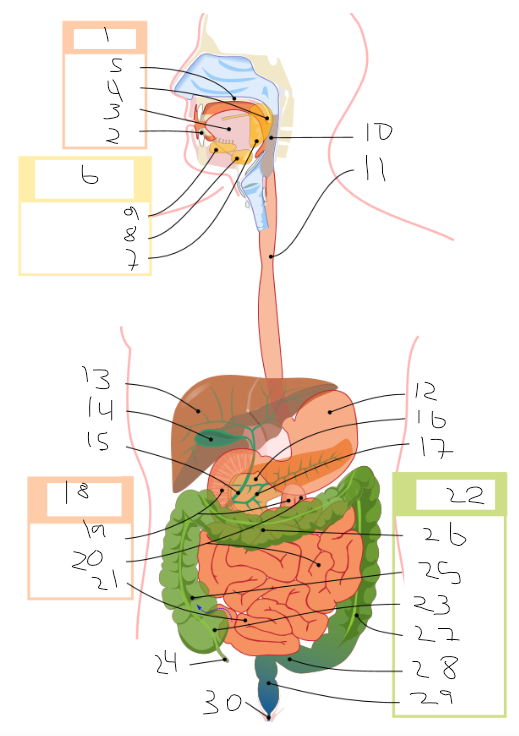
What is 11?
Esophagus

What is 12?
Stomach

What is 13?
Liver

What is 14?
Gallbladder

What is 15?
Common bile duct

What is 16?
Pancreas

What is 17?
Pancreatic duct

What is 18?
Small intestine

What is 19?
Duodenum

What is 20?
Jejunum

What is 21?
Ileum

What is 22?
Large intestine
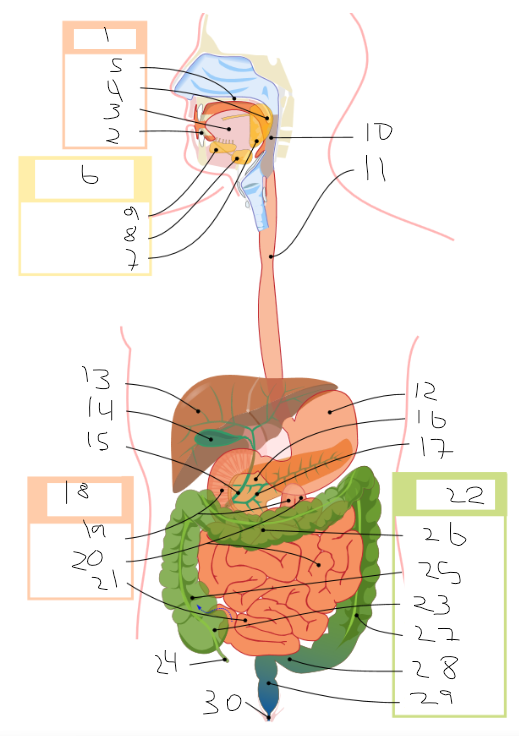
What is 23?
Cecum

What is 24?
Appendix
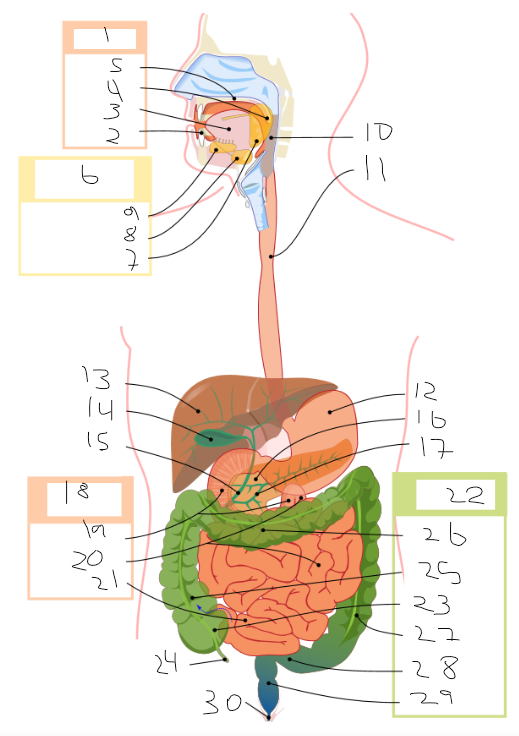
What is 25?
Ascending colon

What is 26?
Transverse colon

What is 27?
Descending colon
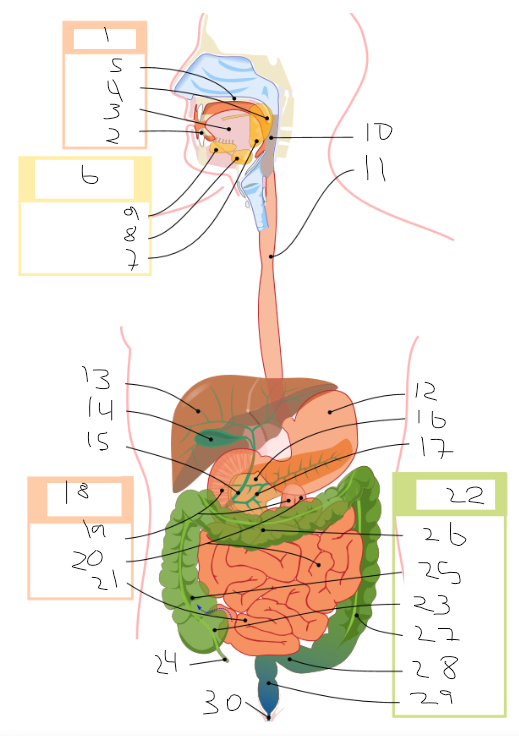
What is 28?
Sigmoid colon
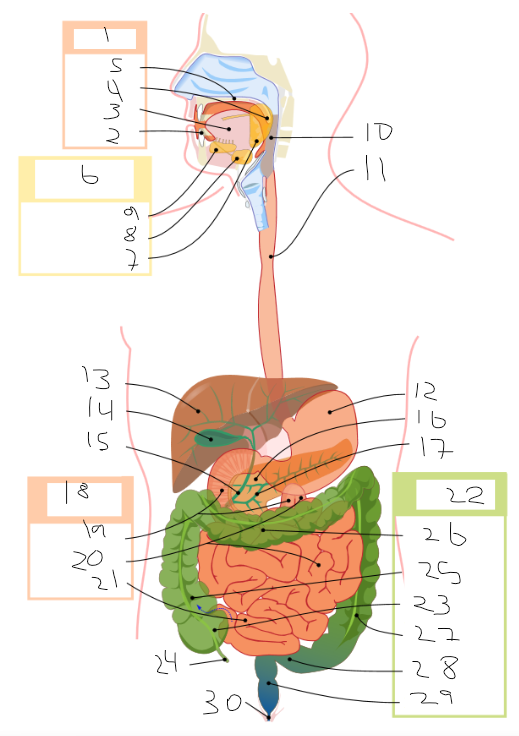
What is 29?
Rectum

What is 30?
Anus

What is 1?
Tongue
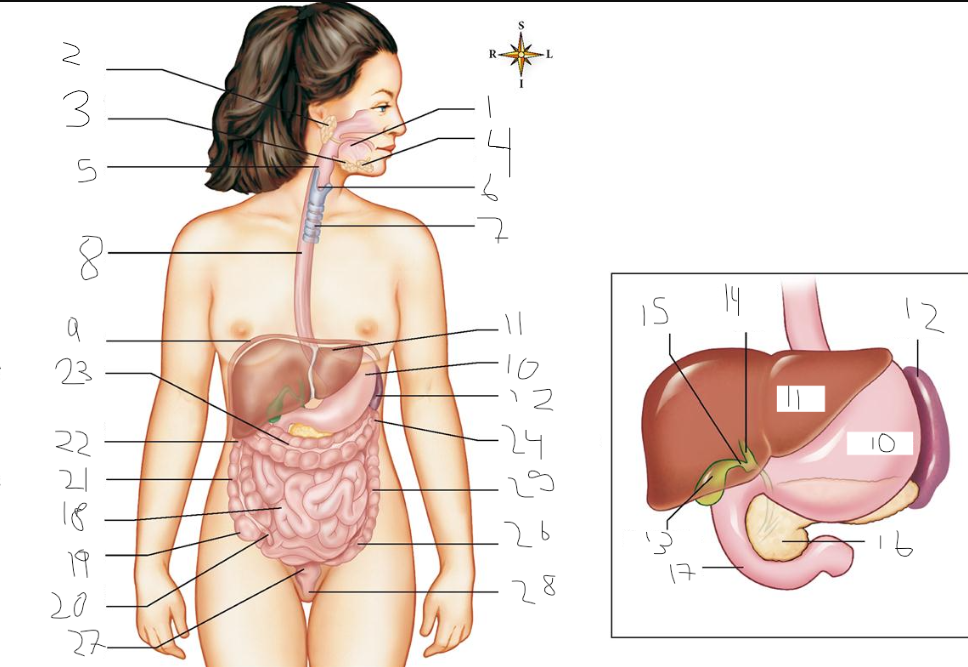
What is 2?
Parotid salivary gland

What is 3?
Submandibular salivary gland

What is 4?
Sublingual salivary gland
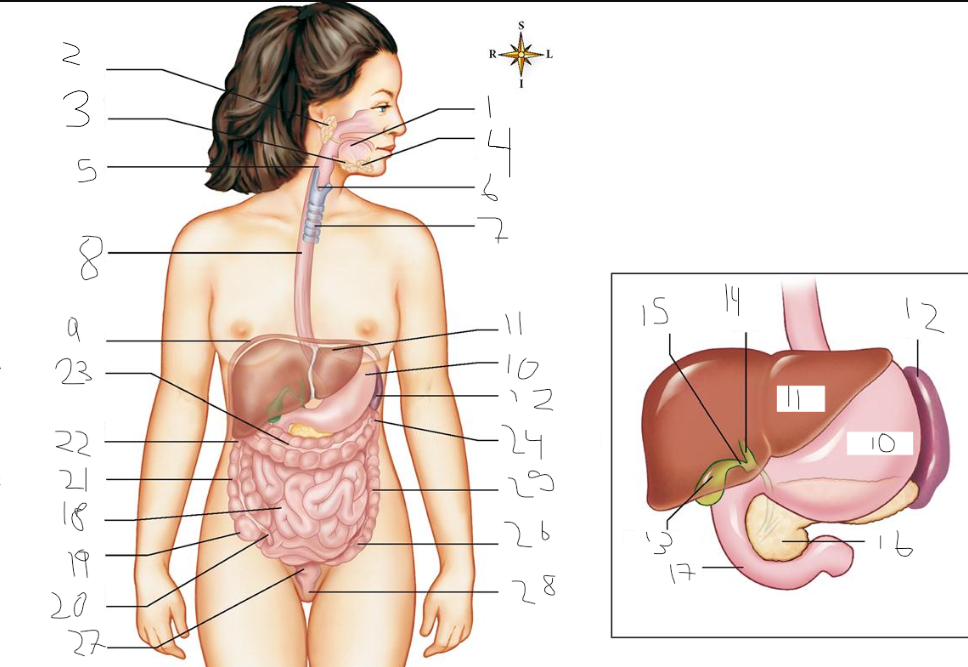
What is 5?
Pharynx

What is 6?
Larynx

What is 7?
Trachea

What is 8?
Esophagus

What is 9?
Diaphragm

What is 10?
Stomach

What is 11?
Liver

What is 12?
Spleen

What is 13?
Gallbladder

What is 14?
Common hepatic duct

What is 15?
Cystic duct

What is 16?
Pancreas

What is 17?
Duodenum

What is 18?
Ileum
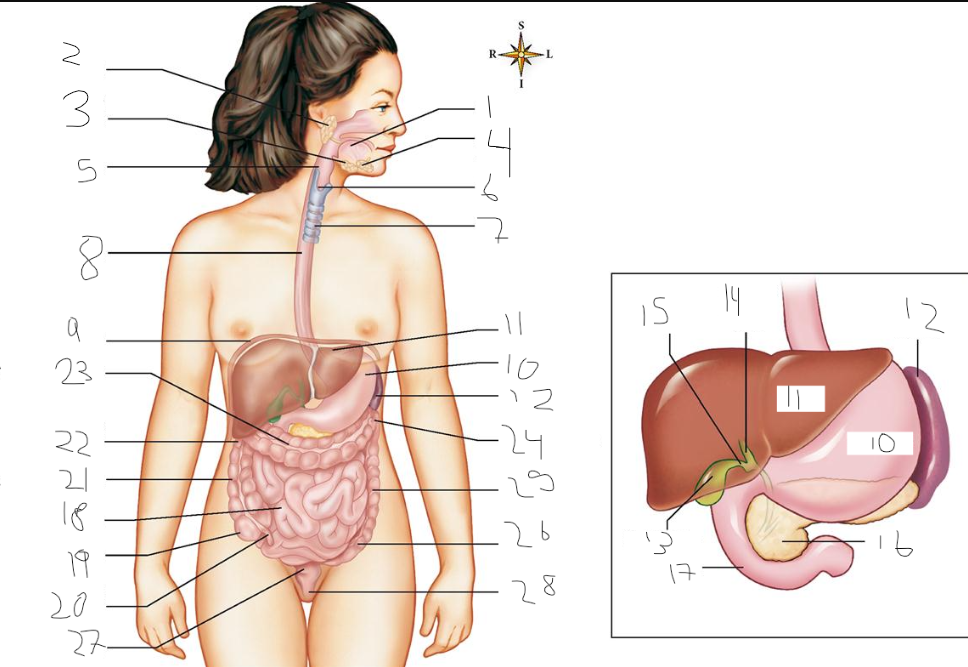
What is 19?
Cecum
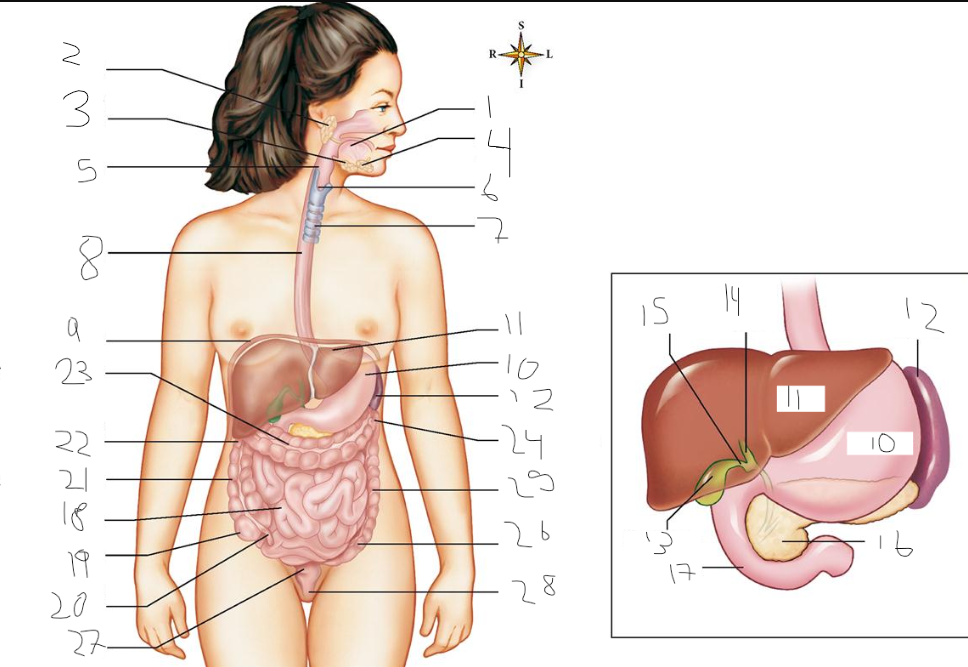
What is 20?
Vermiform appendix

What is 21?
Ascending colon

What is 22?
Hepatic flexure of colon
What does the spleen do?
FIlters blood and supports the immune system.
Does the spleen directly digest food?
No
What is the hepatic flexure of the colon?
The bend near the liver where the ascending colon turns into the transverse colon.
What is the splenic flexure of the colon?
The bend near the spleen where the transverse colon becomes the descending colon.

What is 23?
Transverse colon

What is 24?
Splenic flexure of the colon

What is 25?
Descending colon

What is 26?
Sigmoid colon

What is 27?
Rectum

What is 28?
Anal canal
Where does swallowing occur?
Oropharynx