EEMB 3 MIDTERM 2 BIG IDEAS
 Call Kai
 Learn
 Practice Test
 Spaced Repetition
 Match
 Flashcards
 Knowt Play
1/8

There's no tags or description
Looks like no tags are added yet.
9 Terms
Why are plants considered primary producers? How do they support other organisms in ecosystems?
Plants are considered primary producers because they produce organic matter (sugars) from inorganic carbon dioxide through photosynthesis. They use sunlight for energy, water as an electron source, and CO₂ as their carbon source.
Plants support other organisms by forming the foundation of food webs. Herbivores consume plants for energy, and carnivores obtain that energy by eating other organisms. Plants also release oxygen during photosynthesis.
Remember: Plants convert sunlight into chemical energy that other organisms can use.

Explain how plants influence atmospheric carbon dioxide concentrations and Earth's climate.
Plants influence atmospheric CO₂ concentrations through carbon fixation, which is the process of taking inorganic CO₂ from the atmosphere and converting it into organic molecules such as sugars.
During photosynthesis, plants remove CO₂ from the atmosphere and store carbon in their tissues as biomass. Because CO₂ is a greenhouse gas, removing it helps limit atmospheric warming.
When plants die and decompose, some of their stored carbon returns to the atmosphere. Other carbon can be stored for longer periods, including in soils and geological deposits.
Remember: More carbon fixation means more CO₂ is removed from the atmosphere, which can help reduce warming.

Plants include some of the tallest, heaviest, and longest-lived organisms on Earth. What examples were discussed in lecture, and what do they illustrate?

Coastal redwood- Over 100 m
Pando- 6,600 tons
Bristlecone pine- 4,600 years
Pando clone- 80,000 years
What is the difference between an autotroph and a heterotroph? Where do most plants obtain their carbon?
Autotroph: An organism that uses inorganic carbon (CO₂) to produce its own organic molecules.
Heterotroph: An organism that obtains organic carbon by consuming or absorbing organic material produced by other organisms.
Most plants are photoautotrophs, meaning they use sunlight as their energy source and obtain carbon from atmospheric CO₂ through photosynthesis.
Autotroph | Heterotroph |
|---|---|
Uses CO₂ as carbon source | Uses organic compounds as carbon source |
Example: Redwood tree | Example: Animal or nonphotosynthetic parasitic plant |
Remember: Auto = uses inorganic carbon to build organic matter; hetero = obtains organic carbon from other organisms.
Explain why a parasitic plant that no longer photosynthesizes is still considered a plant.
A parasitic plant that no longer photosynthesizes is still considered a plant because organisms are classified based on their evolutionary relationships and genetic ancestry, not just their ability to photosynthesize.
For example, Rafflesia is a parasitic plant that does not photosynthesize. Instead, it obtains nutrients from a host.
Even though it lost its ability to photosynthesize, it still evolved from plant ancestors and belongs to the plant evolutionary lineage.
The lecture also mentions exceptions such as:

Why is a phylogenetic tree more informative than grouping organisms by whether they photosynthesize?
Answer: A phylogenetic tree is more informative because it shows the evolutionary relationships and common ancestry between organisms.
Grouping organisms by photosynthetic ability can be misleading because unrelated organisms can both photosynthesize, while closely related organisms may differ in this ability.
For example:
Brown algae photosynthesize but are not classified as plants in the lecture.
Rafflesia does not photosynthesize but is still a plant.
A phylogenetic tree uses genetic relationships rather than just physical characteristics or ecological functions to classify organisms

.
Why are most photosynthetic plants classified as photolithoautotrophs?
Answer: Most photosynthetic plants are classified as photolithoautotrophs because they use sunlight for energy, inorganic water molecules as their electron source, and carbon dioxide as their carbon source.
Break down the word:
Part | Meaning | In plants |
|---|---|---|
Photo | Energy from light | Sunlight |
Litho | Electrons from inorganic substances | Water (H₂O) |
Auto | Carbon from inorganic carbon | Carbon dioxide (CO₂) |
Plants use sunlight to generate ATP and NADPH, obtain electrons from water, and fix CO₂ into sugars.
Exam trick: Don't confuse the electron source with the carbon source!
Electron source = H₂O
Carbon source = CO₂
Energy source = sunligh
Imagine photosynthetic primary producers suddenly disappeared from Earth. Predict at least three major consequences.
Answer: If photosynthetic primary producers disappeared, Earth's ecosystems would experience major consequences.
1. Food webs would collapse. Primary producers create organic matter that supports consumers. Without them, herbivores would lose their major food sources, followed by predators that depend on herbivores.
2. Atmospheric CO₂ would increase over time. Photosynthetic producers would no longer remove CO₂ through carbon fixation, while processes such as respiration and decomposition would continue releasing carbon. This could intensify global warming.
3. Oxygen production would dramatically decrease. Photosynthetic organisms release oxygen. Without their continued oxygen production, atmospheric oxygen would eventually decline as it is consumed by respiration and other processes.
4. Biomass production would decline. Less inorganic carbon would be converted into new organic matter, leaving ecosystems with much less energy and material to support life.
Key idea: Photosynthetic primary producers maintain food webs, influence the carbon cycle, and produce oxygen. Their loss would threaten most existing ecosystems.
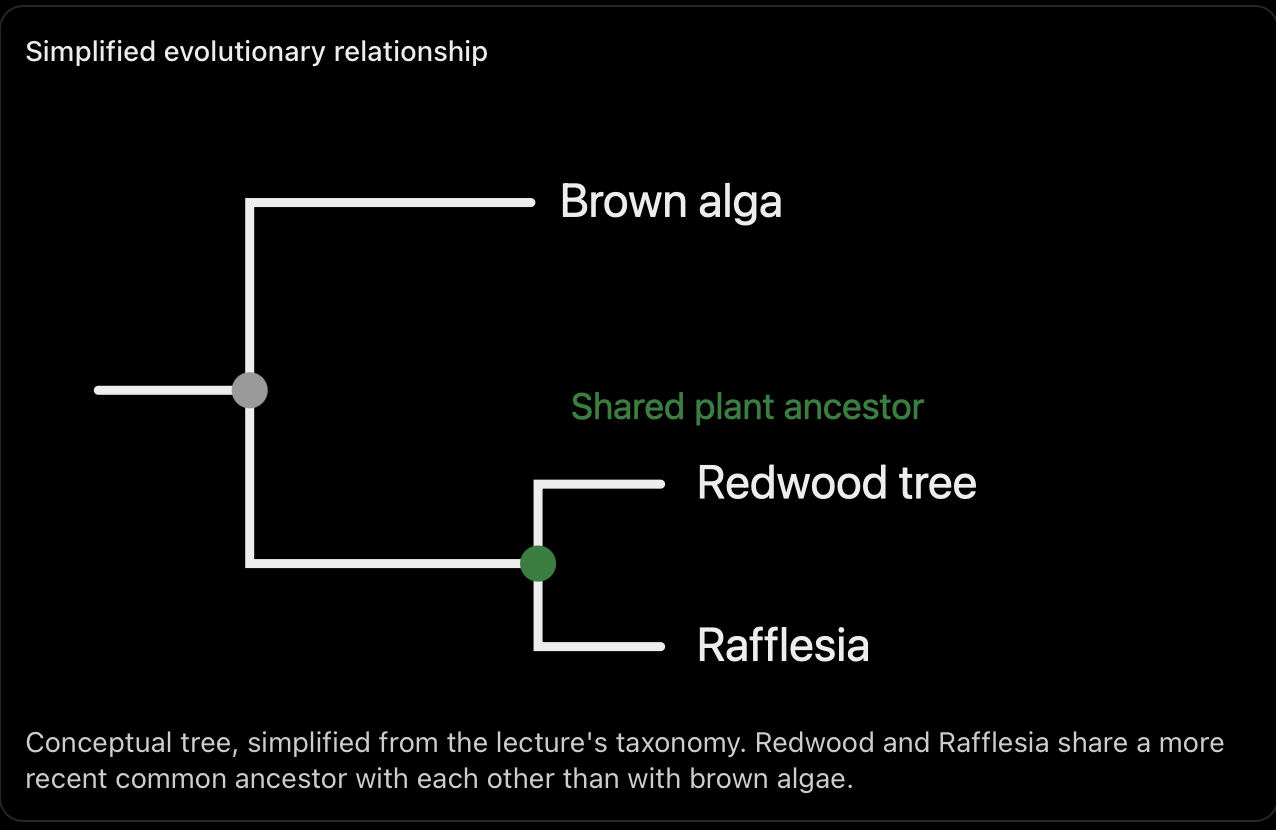
Redwood tree, Rafflesia, and brown alga: Which two are most closely related?
The photosynthetic redwood tree and nonphotosynthetic Rafflesia are most closely related because both belong to the plant lineage.
Although a redwood photosynthesizes and Rafflesia does not, they share more recent plant ancestry than either does with brown algae.
Brown algae photosynthesize, but they belong to the Stramenopiles group within SAR, not the plant group shown in the lecture's phylogenetic tree.
Why classifying by photosynthesis is misleading: If we grouped organisms solely by whether they photosynthesize, we would incorrectly group the redwood tree with brown algae and separate Rafflesia from other plants.
This would not accurately represent their evolutionary history.
Remember: Shared ancestry matters more than shared photosynthetic ability when determining evolutionary relationships.