Studying for College Math 101
 Call Kai
 Learn
 Practice Test
 Spaced Repetition
 Match
 Flashcards
 Knowt Play
1/172

There's no tags or description
Looks like no tags are added yet.
173 Terms
Parallel lines always/never have the same slope
Parallel lines always have the same slope
Two points on a line are (2,2) and (3,1). Find the y-intercept of the line.
The y intercept is (0,4)
In the equation y = mx + b, m stands for _____ and b stands for _____
m = slope and b = y-intercept
The line y = -x + 4 will/will not enter the third quadrant
The line y = -x + 4 will not enter the third quadrant
The equation for the line shown below is _____

y = 3x+2
If a line is completely horizontal, that line has a(n) undefined/zero slope.
If a line is completely horizontal, that line has a zero slope
Find the slope and y-intercept of the following equation: 2y = 4x + 5
m = 2
y-intercept = (0,5/2)
The slope of the line shown below is _____

The slope of the line is 3 (m=3)
The line y = 3/4x + 5 will be parallel/perpendicular to the line y = -4/3x -3
These lines will be perpendicular
Two points on a line are (2,2) and (3,1). Find the slope of the line.
The slope of the line is -1 (m = -1)
Solve this system of equations
2x + y = 4
x + 2y = 2
(2,0)
The x and y intercepts of 4x + 2y = 8 are _____
x-intercept = (2,0) and y-intercept = (0,4)
If a line is completely vertical, that line has a(n) undefined/zero slope.
If a line is completely vertical, that line has an undefined slope
The three main ways to solve a system of equations are _____, _____ , and _____ .
Graphing, substitution, and elimination are the three main ways to solve a system of equations
The method to evaluate an absolute value expression.
Evaluate as usual. Treat the Absolute Value symbols as parentheses and use PEMDAS.
x|2+y|- z when x=2, y=-5 and z=3
(2)|2+ (-5)| - 3
(2) |2-5| -3
2|-3| -3
2(3) -3 {absolute value of -3 is 3}
6-3 = 3
The process of finding a determinant with matrices larger than 2x2.
Calculate multiple smaller determinants first and combine them by alternating subtraction and addition of the determinants.
The process of multiplying matrices.
M=matrix, R=row, C=column, A=answer
M1R1 x M2C1; Add products = 1st entry R1A
M1R1 x M2C2; Add products = 2nd entry R1A
M1R2 x M2C1; Add products = 1st entry R2A
continue
The part of an absolute value equation that tells you the graph will shift vertically.
When adding or subtracting outside the absolute value sign:
y = |x| + 3 (shifts up 3 places)
The importance of Square Matrices.
You can only calculate a Determinant on a square matrix.
Absolute Value
The magnitude of a number (distance from 0) regardless of sign.
Add:
|3 4| + |-2 5|
3+-2 = 1
4 + 5 = 9
thus;
|1 9|
Transformation (in absolute value graphs)
Anything that changes the way an absolute value graph looks.
Translation (in graphing)
Operations that move the graph of an absolute value equation horizontally or vertically.
The three things that will occur in the graph of this equation.
y=-4|x-3|-3
Reflected due to the absolute value being multiplied by -4.
Translated right 3 places due to the -3 in the absolute value.
Translated down 3 places due to the -3 outside the absolute value.
Find the solution to -t/8 > 3
The solution is t < -24
Write the inequality shown below.

The inequality is y > -x/4 - 2.
Write the inequality shown below.
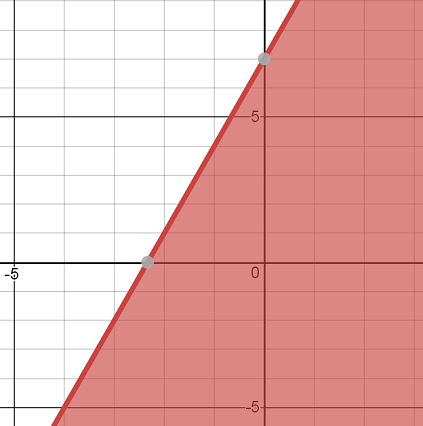
The inequality in slope-intercept form is: y <- 3x + 7
Find the solution to 2n - 9 > 1
The solution is n > 5
Find the solution.
|x + 5| < 9
The solution is all x-values such that x > -14 and x < 4.
Find the solution to the following inequality.
6x - 3 < - 15
The solution is: x < - 3
Find the solution to 4 - 3x < 10
The solution is x > -2
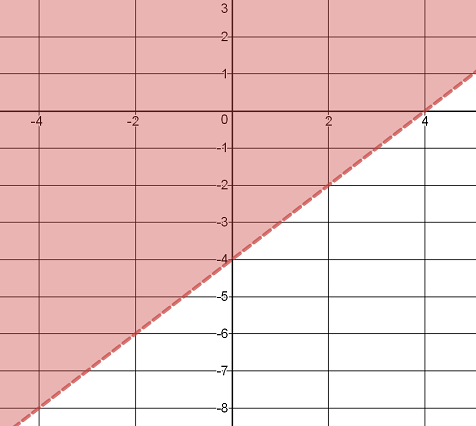
How do you graph the inequality y > x - 4?
Find the solution to -4x/5 < 4
The solution is x > -5
Represent the following in interval notation.
x > -3 and x < 5
The interval notation is (-3, 5).
Find the solution.
|x - 9| > - 7
The solution is: x < - 2 or x > - 16
A dashed line is used to graph any two-variable inequality that contains either of these symbols.
When a two-variable inequality contains either less than (<) or greater than (>), a dashed line will be used to graph the boundary line.
Find the solution to x + 4 < 12
The solution is x < 8
Solve using complete the square:
x2 + 2 = 6x - 2
1. Standard form: x2 - 6x + 4 = 0
2. (b/2)2 = (-6/2)2 = 9
3. to make c = 9 add 5 to both sides
4. x2 - 6x + 9 = 5
5. factor perfect square and solve (x - 3)(x - 3) = 5
x - 3 = 5
x = 8
Process to factor quadratics, using x2 + 7x + 6 as an example.
Factor constant term (6): 6*1, 2*3, -6*-1, -2*-3
Add factors to find middle term number (7x): 6 + 1 = 7
Separate factors into product of binomials
(x + 6)(x + 1)
Process of completing the square
Change the c (using algebraic rules) so that it equals (b/2)2.
Use the quadratic formula to determine the discriminant of: x2 - 3x +1
Discriminant of Quadratic Formula is b2 - 4ac
-32 - 4(1)(1) = 5
Factor: x2 - 4
constant factors: 2 * -2
sum of factors=0=middle term of (0x)
use factors in binomials
(x + 2)(x - 2)
Maximum of a Parabola
Highest point on the U shaped graph.
Quadratic Formula
The quadratic formula:
x = -b+- v-b2 - 4ac/2a
Find the solutions:
x2 - 3x + 2 = 0
Factor into binomials:
(x - 2)(x - 1) = 0
x - 2 = 0
x - 1 = 0
x = 2 and x = 1
Perfect Square Binomial
A binomial that is squared: (x - h)2.
The graph of which of these equations are parabolas:
a. y = x + 1
b. y = x5 - 1
c. y = x2 - 6
d. y = 2x2
Quadratics with squared terms only lead to parabolas, so c. and d. are parabolas.
Leading Coefficient
The coefficient (number being multiplied) of the first term in a polynomial.
Product
Answer to a multiplication problem.
Factor: 3x2 - 14x - 5
+ = -14
* = (3 * -5) = -15
numbers are 1 and -15
factor -15 (3 * -5)
final: (3x + 1)(x - 5)
Type of equation that leads to a parabola graph.
Quadratics with squared terms such as x2.
Purpose of completing the square
To change a standard form equation into a vertex form equation.
Identify the parts of the graph in this vertex form equation.
y= -5(x + 1)2 - 2
-5 = concave down
y-intercept = -7 (substitute x = 0)
axis of symmetry x = - 1 (from equation)
Discriminant of the Quadratic Formula
Inside the sqrt sign: b2 - 4ac
FOIL
A binomial (expression with two terms) is multiplied by a binomial.
Multiply: First terms in each binomial, Outside terms, Inside terms, then Last terms.
Axis of Symmetry
Line at which a graph could be folded and it would be the same on both sides. It goes straight down the middle.
Process to solve quadratics that are not in standard form.
Use algebraic rules to rewrite the equation in proper standard form, then solve with the zero product property or the quadratic formula.
Solve:
(x+2)2 = 8 + 4x
Expand and solve for standard form:
x2 + 4x + 4 - 8 - 4x = 0
x2 - 4 = 0
Solve with zero product
(x - 2)(x + 2) = 0
x = 2 or -2
Zero Product Property
Solving quadratics by factoring into a product of binomials equal to zero. This offers two binomials to set equal to zero in order to get solutions to the original quadratic.
Give the roots of this function:
f(x) = x2 - 4x + 4
The roots are both 2.
(x - 2)(x - 2) = 0
x - 2 = 0
x = 2
The process of factoring non-1 leading coeffecient trinomials.
Need 2 numbers whose sum is the middle coefficient.
Product of the numbers =product of the constant and the leading coefficient.
Work backwards to get correct coefficients for each binomial.
A trinomial can be factored into a Perfect Square when...
ax2 + bx + c
and
(b/2)2 = c
The Standard Form of a Quadratic Equation
y = ax2 + bx + c
Root of a Function
A solution when the function equals 0. The roots of a function are the numbers, which when multiplied together give the original function.
Identify the parts of the graph in this standard form equation:
y = ax2 + bx + c
y = ax2 + bx + c
a = concave up (pos) or down(neg)
y-intercept = c
axis of symmetry: x = -b/2a
vertex: sub x = -b/2a in to get y value for coordinate point (x,y)
Find the vertex of: y = 3x2 + 6x +1
Axis of sym: x = -(6)/2(3) = -1
Sub: y = 3(-1)2 + 6(-1) + 1 = -2
Vertex point (-1,-2)
Values that when multiplied together give an original number.
Ex: the factors of 15 are 5 and 3 (5*3=15)
Factors
Characteristics of a Parabola:
Looks like a U shape
Has 1 vertex
Always symmetrical
Shape of the path of a thrown object
Multiply:
(x - 5)(x + 2)
F: x * x = x2
O: x*2=2x
I: -5 * x = -5x
L: -5 * 2 = -10
x2 - 3x - 10
Vertex of a Parabola
The point at which a parabola changes direction.
Concave down it is the maximum.
Concave up it is the minimum.
Cube root is the same as
raising to the power of 1/3
Exponent Property:
Product of Powers
Add
x2 * x4 = x2+4
x6
Parts of a Rational exponent
x2/3
Denominator of the fraction is the ROOT
Numerator is the exponent used on the variable inside the root symbol
Cube root of x2
Divide:
(x3 - 1) divided by (x2 + 1)
Step 1: x2 + 0x + 1 into x3 + 0x2 + 0x - 1
Step 2: x3/x2 = x (first ans. term)
Step 3: x(x2 + 0x + 1) = x3 + 0x2 + x
Step 4: sub. & bring down= -x - 1
Step 5: x2 doesn't go into -x
Ans: x + (-x - 1)/(x2 + 1)
Simplify:
3×5y5/6×2y7
Break it up to simplify each part.
3/6 = 1/2
x5/x2 = x3
y5/y7 = 1/y2
answer: x3/2y2
Simplify a math expression
Reduce to lowest terms
Adding Polynomials
Collect like terms
Five Main Exponent Properties
Product of Powers
Power of Powers
Quotient of Powers
Power of a Product
Power of a Quotient
Convert to Rational exponents:
fourth root of the square of 3x
(3x)2/4
Exponent Property:
Power of a Quotient
Distribute the exponent:
(x/y)3 = x3/y3
Subtracting Polynomials
Change the sign of the terms in the second (subtracted) polynomial and collect like terms.
Synthetic division works for
dividing by first degree binomial only
Anything raised to the power of zero
Equals 1.
Exponent Properties:
Quotient of a Power
Subtract:
x5 / x3 = x5-3
x2
Simplify:
3(p2/3) 2 (q1/2) 2/3/3p
Use exponent rules to simplify: 3p4/3q2/6/3p = 3/3 x p4/3/p x q2/6/1 = p1/3q2/6
Rational Number
Numbers written as a fraction
Simplify:
92/3
cube root of 9 squared=
cube root of 81= 4.33
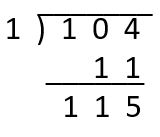
Use synthetic division:
x2 + 4 / x - 1
1 | 1 0 4 (opposite of constant in the divisor divided into coefficients in order in the dividend)
bring down 1.
1 * 1 = 1, 0 + 1 = 1
1 * 1 = 1, 4 + 1 = 5
ans 1 1 5
dividend is 2nd degree; ans is 1st degree
x + 1 R5
Add:
(2x3 + 3x2 -1) + (x2 - 1)
2x3 + 3x2 + x2 - 1 - 1
2x3 + 4x2 - 2
Synthetic division
method of dividing polynomials by using only the coefficients of the terms
Deal with negative exponents
By flipping them to a positive:
x-2 = 1/x2
1/x-2 = x2
Steps to divide polynomials with long division
Same as any other long division:
Divide the first terms.
Multiply the result from the divisor, then subtract it from the dividend.
Repeat!
Matching functions to graphs of cubics, quartics, quintics and beyond
Step 1: substitute 0 for x to find y-intercept
Step 2: find values for x = 1 and -1
Step 3: plot more points (opposite matches is great 2 and -2 etc) until sketch becomes clear
Exponent Property:
Power of a Product
Distribute the exponent:
(xy)2
x2y2
Exponent Property:
Power to Power
Multiply
(x2)5 = x2*5
x10
Subtract:
(x3 - x2 + 1) - (x3 - x2 + x)
step 1: x3 - x2 + 1 - x3 + x2 - x
step 2: 1 - x (add like terms and simplify)
Function
A relation in which each input value gives only one possible output value. The graph of a function passes the Vertical Line Test.
For the function g(x) =x2 - 3, find g(4).
g(4) = 13
Using f(x) = 3x and g(x) = x + 4, find the composite function f(g(x)).
The composite function is:
f(g(x)) = 3(x + 4) = 3x + 12
Vertical Line Test
The Vertical Line Test is a way to test whether the points on a graph represent a function. If any vertical line passes through more than one point of the graph, the relation graphed is not a function.