physics unit 1
 Call Kai
 Learn
Learn Practice Test
 Spaced Repetition
 Match
Match Flashcards
 Knowt Play
1/193

There's no tags or description
Looks like no tags are added yet.
Name | Mastery | Learn | Test | Matching | Spaced | Call with Kai | Chat |
|---|
No analytics yet
Send a link to your students to track their progress
194 Terms
How is motion described
moving relative to something else
ex. the treadmill belt is moving and you are stationary
What is speed
distance covered per amount of travel time (distance/time)
What is instantaneous speed
speed at any instant (like a snapshot)
ex, speedometer that police use to see your mph
What is velocity
instantaneous speed and direction
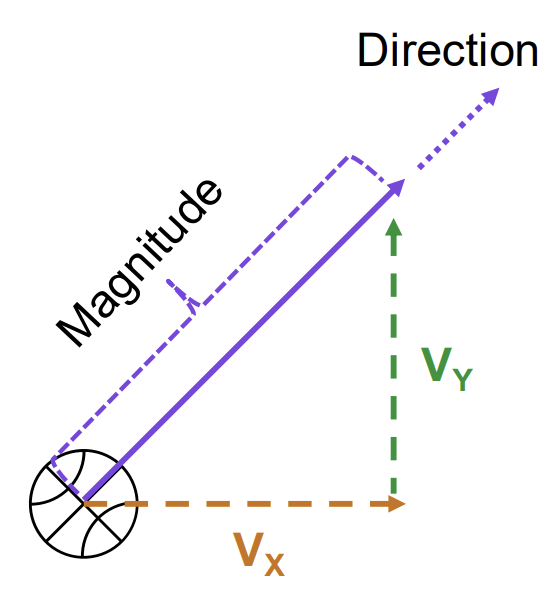
How is velocity represented?
a vector quantity: magnitude (speed) is represented by length of vector and direction is represented by where vector points
What is acceleration and what can it involve?
rate at which velocity changes over time (change in velocity/time interval)
it can involve either a change in speed, direction or both
What does a steeper incline lead to and why?
greater acceleration because a greater portion of gravity points along the ramp so more of gravity is used to pull downhill
What does a vertical incline lead to and why?
max acceleration (falling object) because gravity is not split, so all of it is downhill
What happens when air resistance is negligible
all objects fall with the same acceleration because there is no air to push back differently on objects depending on size, weight, etc.
What is free falling
falling with gravity and no air resistance; falling in space/vacuum
What is acceleration on Earth
9.8 m/s²
What is velocity starting from rest
acceleration x time
What is Newton’s first law of motion
an object at rest tends to stay at rest unless acted upon by an outside force (inertia)
What is net force
sum of all forces acting on an object

What does the net force depend on
magnitude (strength) and direction of forces

Explain what is happening in this photo
different angles —> different rope tensions will occur in each side
Girl is hanging in equilibrium: tensions add to equal and opposite her weight
tension in the right hand is greater than tension on the left side

What forces are acting on the girl?
gravity, tension (left), tension (right)

What’s happening in this photo
two forces acting on the bag: string tension acts upward and gravity acts downward
both force are equal in magnitude and opposite in direction so when added, they cancel to zero and the bag of flour remains at rest
What is support force?
upward force on an object opposite to gravity; balances an object's weight and keeps it from falling or moving through the surface
example: book on a table
gravity pulls book downward
atoms in the table are compressed
pushes upwards against a compressive force
provides a support force
What is equilibrium
a state of no change with no net force acting
What is static equilibrium
a physical state where an object is completely at rest and all the forces and turning forces acting on it are perfectly balanced
ex. hockey puck at rest on slippery ice
What is dynamic equilibrium
a state of a reversible process where the forward and reverse reactions happen at the exact same rate, causing no overall change to the system
ex. hockey puck sliding at constant speed on slippery ice (no acceleration and no friction/air resistance to slow it down)
What is the equilibrium test?
whether something undergoes change in motion
What causes acceleration
force; the amount you accelerate is proportional to net force
What does the force of friction depend on?
kind of materials and how they’re pressed together. this is due to tiny bumps on the surface and atoms attracting each other.
What is mass? (kg)
how much material
measure of inertia independent of gravity: more mass = more inertia
What is Newton’s Second Law of Motion
Newton's second law of motion states that the acceleration of an object is directly proportional to the net force acting on it and inversely proportional to its mass (F = ma)
What does an object falling through air experience?
force of gravity (downwards) and force of air resistance (upwards)
When does non free fall happen?
when air resistance is non-negligible
What does non free fall depend on
speed and surface area
What happens when air resistance equals gravity
terminal velocity; no more acceleration
What is Newton’s third law of motion?
Every action has an equal and opposite reaction
What is momentum?
property of moving objects; inertia in motion (mass x velocity)
What is impulse
overall effect of a force acting on an object over a period of time; force x time
What does impulse change
momentum; More impulse exerted = more change in momentum
How to increase momentum (ex. launching/striking an object)?
increase time of contact while pushing as hard as possible to maximize impulse
How to decrease momentum (ex. want slow)
increase time so impact force is smaller
What is the conservation of momentum
as long as there is no external forces, total momentum of interacting objects cannot change
What are elastic collisions
colliding objects rebound without lasting deformation or generating heat (not an everyday occurence)
What are inelastic collisions
colliding objects result in deformation and/or generation of heat (everyday occurences)
What is energy
Quantifies a system’s ability to do Work
Observed when being transferred or transformed (always conserved)
What is work
Distance over which force is applied (joule)
What two things occur when work is done?
A force acts on an object
The object subject to the force moves
What is power
Measure of how fast Work is done (watt)
What is mechanical energy
total energy due to motion, position, or both
What are two forms of mechanical energy
kinetic energy and potential energy
What is potential energy
stored energy that has the potential to do work; due to relative position, electric charge, or internal stress
what is gravitational potential energy
due to an elevated position; work required to lift object (weight x height)
what is kinetic energy
Energy of motion of an object; Work required to bring from rest up to speed
What is thermal energy
kinetic energy of particles
What is mass-energy
form of potential energy
what is the work energy theorem
Any change in KE is the result of work
what is the conservation of energy
Energy cannot be created or destroyed; it may be transformed from one form to another, but the total amount of energy in the Universe stays the same
What is circular motion
Object rotates around an axis that passes through object
What kinds of speed is circular motion characterized by
tangential (linear) & rotational (angular)
what is tangential speed
The distance travelled by a point on a rotating object divided by the time taken to travel that distance
What points have higher tangential speed
points closer to the edge
What is rotational speed
the number of rotations or revolutions per unit of time
What is rotational inertia
Tendency to resist change to rotation
What does rotational inertia depend on
mass + distribution of mass; object’s shape + position of rotational axis
When is rotational inertia higher
objects with mass that is far away from axis of rotation
Greater the rotational inertia….
harder it is to change its rotational state
What is angular momentum
inertia of rotation
What is the conservation of angular momentum
If no external net torque acts on a rotating system, the angular momentum of that system remains constant.
What is torque
force used to change angular momentum; changes the rotational speed and momentum of an object
What does torque depend on
magnitude of force, direction of force, and where on object is force applied
What is centripetal force
Force directed towards center of a rotating object’s rotation (aka rotation axis)
depends on: mass of object, tangential speed of object, radius of circle
What is centrifugal force
Away from center; Outward force we feel when rotating; push outwards
can be used to simulate gravity
What is the universal law of gravitation
Every body attracts every other body
Directly proportional to the product of their masses
Inversely proportional to the square of the distance separating them
Inverse square law of gravity
gravitational force between two masses decreases as the distance squared between objects increases
How does gravity cause tides
stronger gravity = closer to the ☾
weaker gravity = farther from the ☾
☾ physically stretches earth; earth is slightly elliptical because of the ☾’s gravitational pull
tidal bulge away and towards the ☾ (idk look at the slides for this)
how do the earth, ☾, and ☼ interact gravitationally without touching and being very far apart
through gravitational fields (region of influence)
What are gravitational fields at the center of a planet
Pull of the mass beneath partially counteracted by the pull from the mass above you
Gravitational pull outside of a planet?
Gravitational pull decreases as distance-squared
What is spacetime? (Einstein’s theory of General Relativity)
A gravitational field is a warping of space-time by any mass; warped space-time affects the motion of other object
Blackhole structure?
mass is contained at the very center in a singularity
infinite density
infinitely small
finite mass
Black hole event horizon?
force of gravity strong enough that light cannot escape; outside light escapes while inside light is trapped
What is a projectile?
Any object that moves through air/space, experiencing gravity, continuing motion via inertia; combination of horizontal and vertical motion
What happens to projectile motion without gravity
straight path
What happens to projectile motion with gravity and no forward motion
fall straight down
What happens to projectile motion with gravity and forward motion
curved path
What is projectile motion if an object is only launched horizontally
the only force is downward gravitational force if you assume air drag is negligible. so the object will travel horizontally in equal distances in equal time periods
What is a parabola
Curved path with Constant acceleration in vertical and Moving horizontally at a constant speed
What happens when something is launched at different angles with the same force
horizontal motion will be the same but vertical motion will be different
Projectile motion at different angles regarding horizontal distance
the same horizontal distance will be achieved if the angles add up to 90
maximum horizontal distance achieved when thrown at a 45 degree angle (with air resistance)
maximum height without air resistance
the time for a projectile to reach maximum height is the same as the time for it to return to its initial level.
What is a satellite
a projectile that falls around Earth rather than onto it
A satellite in circular orbit regarding speed
speed must be greater enough to ensure that its falling distance matches Earth's curvature
speed is constant; only direction changes
speed is unchanged by gravity
Positioning of circular satellite orbits
beyond Earth's atmosphere, where air resistance is almost totally absent
Motion of circular satellite orbits
moves in a direction perpendicular to the force of gravity acting on it
What does launching a payload into orbit require control over
direction of rocket: fired vertically and then tips horizontally
speed of rocket
What type of orbital path are most satellites
ellipses
What is Kepler’s first law of planetary motion
The path of each planet around the Sun is an ellipse with the Sun at one focus
What is Kepler’s second law of planetary motion
The line from the Sun to any planet sweeps out equal areas of space in equal time intervals
What is kepler’s third law of planetary motion
The square of the orbital period of a planet is directly proportional to the cube of the average distance of the planet from the Sun (for all planets)
PE and KE in circular orbit
steady speed and constant PE and KE because distance between the satellite and center of the attracting body does not change and no component of force acts along the direction of motion
PE and KE in elliptical orbit
KE is least when PE is the most and vice versa
PE is greatest when the satellite is farthest away (apogee)
PE is least when the satellite is closest (perigee).
What is all matter made up of
atoms
structure of atoms
neutrons, protons, and electrons in electron cloud
What is the probability cloud
general area of probability having an electron