Perio 17 - Periodontal Powered Instruments (Dr. Ogata)
 Call Kai
 Learn
 Practice Test
 Spaced Repetition
 Match
 Flashcards
 Knowt Play
1/114

There's no tags or description
Looks like no tags are added yet.
115 Terms
Manual
___________ instrumentation was the only method available for the removal of supra and subgingival calculus until the ultrasonic devices were introduced in dentistry in the 1950s.
Power-driven (sonic and ultrasonic)
___________ instruments/scalers generate high frequency vibrations. They are used for deplaquing, supragingival scaling, and subgingival scaling.
- Increased efficiency in removing heavy calculus deposits
- Reduced time for the procedure
- Less fatigue to the clinician, more ergonomic
- Water lavage and cavitation
- Greater access in furcation areas and narrow/deep defects (with thin tips)
- No need to sharpen
- Less tissue trauma
What are all of the advantages of power-driven instrumentation?
- Aerosol production
- Patient discomfort (water, noise, and increased root sensitivity)
- Need for constant suction
- Less tactile sensation
- More precautions and limitations
- Inability to root plane
- (More equipment costs)
What are all of the disadvantages of power-driven instrumentation?
- Magnetostrictive
- Piezoelectric
What are two examples of ultrasonic instruments?
Sonic scaler
What type of power scaler is composed of a handpiece and tips?
Sonic scaler
What type of power scaler is driven by compressed air?
Sonic scaler
What type of power scaler has 2,000-6,500 vibration cycles per second?
Sonic scaler
What type of power scaler's movement of the tip is elliptical or orbital?
Sonic scaler
What type of power scaler has surfaces that are all effective?
Sonic scaler
What type of power scaler is portable?
Sonic scaler
What type of power scaler is less expensive?
Sonic scaler
What type of power scaler has a power that is NOT adjustable?
Sonic scaler
What type of power scaler is rather noisy?
sonic scaler
What type of power scaler generates minimal heat - needs water?
Ultrasonic scaler
What type of power scaler is driven by electricity and generates heat?
piezoelectric
What type of ultrasonic scaler?
- Linear motion
- Only active on lateral sides
magnetostrictive
What type of ultrasonic scaler?
- Elliptical motion
- All sides active
Ultrasonic scaler
What type of power scaler has 18,000-50,000 vibration cycles per second?
Ultrasonic scaler
What type of power scaler's movement of the tip is elliptical OR linear?
Ultrasonic scaler
What type of power scaler has adjustable power?
ultrasonic scalers
What type of power scaler mechanically disrupts and removes biofilms, calculus, endotoxin, and stains through mechanical action?
Piezoelectric scaler
ID the instrument:

Magnetostrictive scaler
ID the instrument:

Ultrasonic
While the _________ instrument is operating, a flow of
cooling water (or antibacterial mouthwash) passes over the vibrating tip, reducing heat
Ultrasonic scaler
What type of power scaler you must adjust the water to a fine mist?
Ultrasonic scaler
this type of power scaler has coolant options (water or antibicrobial) which passes over the vibrating tip, reducing heat
sonic scaler
These are advantages of what type of scaler?
- Inexpensive
- Portable
ultrasonic scaler
These are advantages of what type of scaler?
- Adjustable power
- Higher power
- Adjustable water
- Coolant options (water, antimicrobial)
sonic scaler
These are disadvantages of what type of scaler?
- Less power for calculus removal
- Non-adjustable power
- Noisy
- Mechanical vibration
- Lavage
- Cavitation
- Acoustic microstreaming/turbulence
What are the 4 modes of action of an Ultrasonic scaler?
Mechanical vibration
What is the primary mode of action of an Ultrasonic scaler?
Lavage
What mode of action provides a...
- Constant flushing of the sulcus or periodontal pocket during instrumentation
- Can disrupt and flush away bacterial biofilm, and is is believed to be of therapeutic benefit
Cavitation
What mode of action...
- Refers to the formation of pulsating minute bubbles that are generated in cooling water around the scaler
- Studies have suggested that the "_________ effect" can break up colonies of bacteria and destroy a spirochaete cell membrane
Acoustic microstreaming
What mode of action refers to the unidirectional fluid flow generated by ultrasonic waves?
Acoustic turbulence
What mode of action is created when the movement of the tip causes the coolant to accelerate, producing an intensified swirling effect? This continues until cavitation occurs.
Magnetostrictive ultrasonic scaler
What type of ultrasonic unit is this?
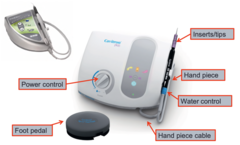
Magnetostrictive Ultrasonic scaler
What type of ultrasonic scaler has magnetized metal stacks in the handpiece convert electrical impulses into mechanical vibrations?
Magnetostrictive Ultrasonic scaler
What type of ultrasonic scaler's tip moves in elliptical pattern?
Magnetostrictive Ultrasonic scaler
All surfaces are active on what type of ultrasonic scaler?
Lateral surface
ID #1 of the magnetostrictive ultrasonic scaler:

Convex back surface
ID #2 of the magnetostrictive ultrasonic scaler:

Point
ID #3 of the magnetostrictive ultrasonic scaler:

Lateral surface
ID #4 of the magnetostrictive ultrasonic scaler:

Concave front surface
ID #5 of the magnetostrictive ultrasonic scaler:

True
T/F: The decision of which instruments to use is based on
type and location of calculus, health or disease status of
the patient, and root anatomy
- Straight
- Curved
What are the two shapes of the tip of an ultrasonic scaler?
- Standard
- Slim
- Ultra slim
What are the three diameteres of the tip of an ultrasonic scaler?
- #10 universal
- #1000 triple bend
- Original prophy
What ultrasonic scaler tips are the following?
- Light to moderate calculus deposits
- Heavy deposits orthodontic cement
- Tenatious subgingival deposits
Swivel XT
What ultrasonic scaler tip is the following?
- Tenatious subgingival deposits
#3 Beavertail
What ultrasonic scaler tip is the following?
- Heavy deposits orthodontic cement
After five inserts (left, straight, right)
What ultrasonic scaler tip is the following?
- Light to moderate deposits in periodontal pockets
- Furcation areas
- Developmental concavities
#10 (Universal thick)
the number ___ tip has a single bend, standard diameter
#100 (Universal thin)
the number ___ tip has a double bend, standard diameter
#1000
the number ___ tip has a triple bend, standard diameter
Universal design
What type of tip is this?

Site-specific design insert
What type of tip is this?

#10 (Universal thick)
What # tip should you use on heavy/large deposits and tenacious subgingival deposits?
Supragingivally
Where should the #10 (universal thick) tip should mainly be used?
#100 (Universal thin)
What # tip should you use on light to moderate deposits and subgingival- periodontal pockets?
subgingival
what is the main area of use for a #100 Universal thin tip?
40%
The universal thin tip is ____% thinner than the standard #10
Probe Sized Tip
What type of tip should be used deep periodontal pockets with improved adaptation in interproximal areas, furcation areas and developmental concavities?
Implant Tip
What type of tip is used for implant maintenance: gently removes light to moderate plaque and calculus without damaging implant titanium abutment surfaces?
Implant tip
What type of tip is this?

Piezoelectric Ultrasonic scaler
What type of ultrasonic scaler has ceramic discs or quartz crystals located in the handpiece converts electrical energy into mechanical vibrations?
Piezoelectric Ultrasonic scaler
What type of ultrasonic scaler's tip moves in linear pattern?

Piezoelectric Ultrasonic scaler
Only the lateral surfaces are active on what type of ultrasonic scaler?
Piezoelectric Ultrasonic scaler
Which type of ultrasonic scaler is more technique sensitive?
Piezoelectric Ultrasonic scaler
Which type of ultrasonic scaler is the most expensive of all powered scalers?
Piezoelectric Ultrasonic scaler
which type of ultrasonic scaler requires a wrench to screw into handpiece?
Piezoelectric Ultrasonic scaler
which type of ultrasonic scaler is more light weight and ergonomic?
Piezoelectric Ultrasonic scaler
which type of ultrasonic scaler is more quiet?
Piezoelectric Ultrasonic scaler
which type of ultrasonic scaler is more powerful?
Magnetostrictive Ultrasonic scaler
which type of ultrasonic scaler less technique sensitive?
Magnetostrictive Ultrasonic scaler
which type of ultrasonic scaler generates more heat and thus requires more water?
true
t/f: There is no difference in the efficacy of subgingival debridement using ultrasonic/sonic scalers versus hand instruments in the treatment of single-rooted teeth
false, no differences in outcomes
t/f: there are big differences in outcomes between sonic, magnetostrictive and piezoelectric scalers
true
t/f: Hand instrumentation and ultrasonic debridement provided comparable clinical results.
- Respiratory disease (COPD, asthma, emphysema, cystic fibrosis, pneumonia)
- Patient with difficulty in breathing
- Patients with difficulty in swallowing (dysphagia) and sensitive gag reflexes
- Patients with unshielded cardiac pacemakers
- Communicable disease that can be transmitted by aerosols (TB, hepatitis, HIV)
- Patients susceptible to infection (immunosuppression from disease, chemotherapy, uncontrolled diabetes, debilitation, and kidney or other organ transplants)
What are the general health contraindications when using an electric scaler?
- Demineralized teeth
- Exposed dentinal surfaces- tooth sensitivity
- Margins of restorations (porcelain, amalgam, composite, gold)
- Primary teeth and newly erupted permanent teeth
- Surfaces of titanium implant
What oral conditions is use of an electric scaler contraindicated on certain teeth or the full mouth?
50
Aerosol refers to fine, airborne particles (liquids and solids) less than ____ um in size
True
T/F: A universal precaution with aerosol production is to use personal protective equipment (clinic gown, mask, gloves, face shield, safety glasses)
True
T/F: With aerosol production, you should use a high-speed evacuation device
Antimicrobial pre-procedural rinse: One-minute swishing with an antimicrobial rinse prior to ultrasonic debridement
How can you significantly reduce the bacterial count in a dental aerosols of a patient?
Aerosol control
The following are for control of what?
- Funnel-shaped autoclavable attachments are available at the dispensaries.
- Attach this to the high-speed evacuation "snake" and position it against the chin of the patient as close as you can.
- Use the second high-speed evacuation line intraorally .
At least 2 minutes
how long should your flush the waterline of the Cavitron® at the beginning of the day?
30 seconds
how long should your flush the waterline of the Cavitron® between patients?
fine mist without signficiant droplets
when setting up your ultrasonic (cavitron), you will place a sterilized insert into the handpiece with water in the handpiece, set power to desired setting, and want to adjust the water and create a ________ of water dripping off the tip
- Grasp
- Pressure
- Angulation
- Adaptation to tooth morphology
- Stroke
What are the 5 factors affecting instrumentation efficacy?
Pen grasp: The index finger and thumb hold the instrument handle. The middle finger rests on the instrument shank.
how should you hold to ultrasonic handpiece?
extraorally
when holding the ultrasonic handpiece, where should you find a fulcrum?
light lateral
when holding the ultrasonic handpiece, use _______ pressure for optimal efficacy and patient comfort.
point of tip
what is the #1 most powerful part on an ultrasonic tip?
concave surface
what is the #2 most powerful part on an ultrasonic tip?
convex surface
what is the #3 most powerful part on an ultrasonic tip?
lateral surfaces
what is the weakest (and #4 most powerful) part on an ultrasonic tip?
Parallel
Regarding angulation of ultrasonic instrumentation, you want to keep side of the tip _________ to the long axis of the tooth
90°
Regarding angulation of utlrasonic instrumentation, the tip of the blade of the insert should never be applied at _____° to the tooth surface except when cleaning calculus from the enamel grooves on the occlusal surfaces of posterior teeth
7-15°
when holding the ultrasonic handpiece, apply working end at no more than a ____-____° angle to tooth surface.