physics - astronomy (7.1 - 7.19)
 Call Kai
 Learn
 Practice Test
 Spaced Repetition
 Match
 Flashcards
 Knowt Play
1/33

There's no tags or description
Looks like no tags are added yet.
34 Terms
7.1 weight is... acting on you
weight is force of gravity acting on you
7.1 what does gravitational field strength on surface of body (e.g. planet/moon) depend on?
mass of body
its radius (distance from its centre to its surface)
(greater mass & smaller radius = greater surface gravity)
7.2 what does our solar system consist of?
sun (our star)
8 planets & their natural satellites
dwarf planets
asteroids & comets
7.3 names & order (distance from sun) of the 8 planets
Mercury (closest to sun)
Venus
Earth
Mars
Jupiter
Saturn
Uranus
Neptune (furthest from sun)
mnemonic for remembering order of planets
My
Very
Excellent
Mother
Just
Serves
Us
Noodles
7.4 how have ideas about structure of solar system changed over time?
Ptolemy: geocentric model - earth at centre
Copernicus: heliocentric model - sun at centre
Galileo Galilei: discovered 4 of Jupiter’s moons - not everything orbits earth
more discoveries: Uranus; Neptune; Pluto; asteroids; comets
current model: 8 planets, 5 dwarf planets, thousands of comets, millions of asteroids - all move in elliptical orbits around sun; many planets have natural satellites (moons) orbiting them
7.5 orbits of moons, planets, comets & artificial satellites
elliptical orbits
7.5 orbits of artificial satellites
type of orbit depends on use
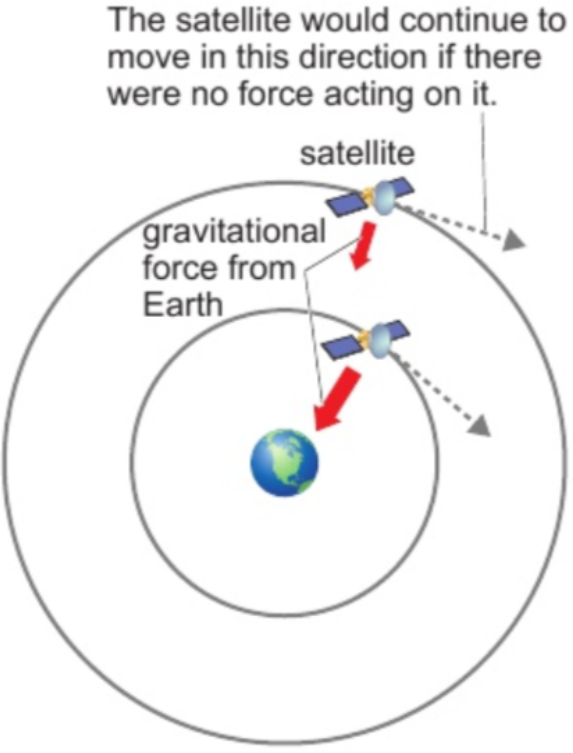
7.6 circular orbits - force of gravity leads to changing velocity of planet but unchanged speed
satellite/planet/moon in circular orbit:
constant speed as travels
constantly changing direction
velocity is vector quantity - orbiting body has constantly changing velocity (due to constantly changing direction)
moving object continues moving in straight line unless force acting on it to make it change speed/direction
gravitational force between earth & satellite in orbit at right angles to direction of movement - force changes its direction, not its speed
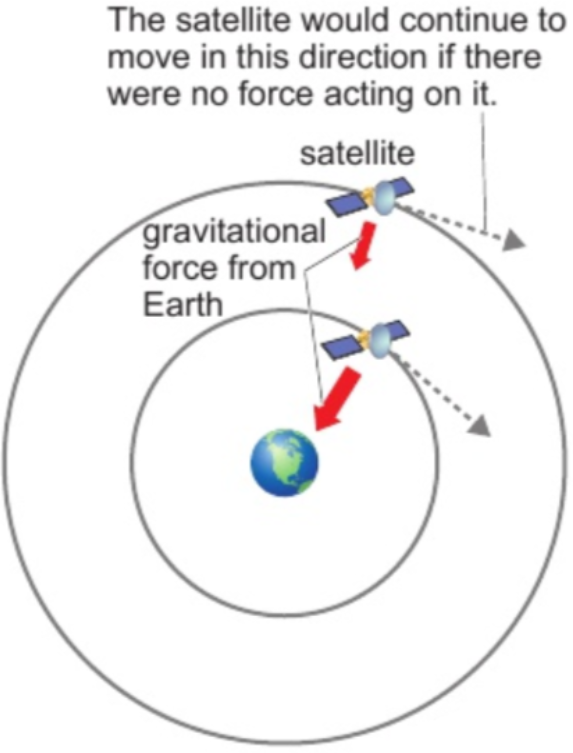
7.7 stable orbit - radius changes if orbital speed changes
satellite in lower orbit = gravitational force on satellite higher
satellite in low orbit moving much faster to stay in its orbit
satellite slows down → falls to earth → gains speed as falls until moving fast enough to stay in new, lower orbit
satellite goes low enough to encounter top of atmosphere → contact with air slows it down → eventually falls to earth
7.8 steady state theory
universe always existed
universe expanding
new matter continuously created as it expands
7.8 big bang theory
whole universe & all matter in it started as tiny point of concentrated energy
universe expanded from this point
universe still expanding
as universe expanded, gravity made matter clump together to form stars
7.9 evidence supporting big bang theory - red-shift
measure red-shift of galaxies & other distant objects - shows more distance objects moving away faster than closer ones
explained if universe expanding (BBT)
7.9 evidence supporting big bang theory - cosmic microwave background (CMB) radiation
BBT: huge amounts of radiation released at beginning of universe
universe expanding → wavelength of this radiation increased → now only detectable as microwave radiation
called cosmic microwave background (CMB) radiation
7.10 which model for origin of universe accepted & why?
more evidence supporting BBT than SST
BBT currently accepted model for origin of universe
7.11 wave source is moving relative to an observer - what happens to frequency & wavelength?
there will be change in observed frequency & wavelength
wave source moving away from observer: frequency decreases; wavelength increases
wave source moving toward observer: frequency increases; wavelength decreases
7.12 red-shift in light received from galaxies at diff. distances from earth
visible light spectrum from stars contains patterns of dark lines
star moving away from us → wavelength increases → pattern of lines red-shifted (move towards red end of spectrum)
greater red-shift = star moving away from us faster
red-shift is measure of how far along spectrum lines moved
7.13 how does red-shift of galaxies provide evidence for universe expanding?
greater red-shift = star moving away from us faster
red shift shows space between galaxies is expanding - wavelengths increased due to space expanding
7.14 how do BBT & SST of origin of universe account for red-shift of galaxies?
both theories: universe is expanding
observations of red-shift in light from other galaxies supports both theories
7.15 how did discovery of CMB radiation lead to BBT becoming currently accepted model?
CMB radiation is from radiation released at beginning of universe
SST: universe always existed - cannot explain CMB radiation
protostar
stage before main sequence
7.16 evolution of stars of similar mass to sun - nebula
cloud of dust & gas (mainly hydrogen)
materials pulled together by their own gravity
collapses due to gravitational attraction
cloud contracts - becomes denser
hydrogen becomes hotter
more mass attracted - cloud’s gravitational pull gets stronger & heats material even more
eventually temps. & pressures in centre of protostar high enough - hydrogen nuclei fuse together, form helium
fusion reactions release lots of energy as EM radiation
outward pressure from hot gases balances compression due to gravity
7.16 evolution of stars of similar mass to sun - star (main sequence)
remain stable for about 10 bil. years
fused most of hydrogen into helium - core not hot enough to withstand gravity & collapses
outer layers expand - form red giant (much larger than o.g. star)
7.16 evolution of stars of similar mass to sun - red giant
other fusion reactions happen inside red giants - e.g. combining helium nuclei to form heavier elements
star remains as red giant for about 1 bil. years
star then throws off shell of gas
rest of star pulled together by gravity
collapses to form white dwarf
7.16 evolution of stars of similar mass to sun - white dwarf
no fusion reactions inside
gradually cools over about 1 bil. years - becomes black dwarf
7.16 order of life cycle of stars of similar mass to sun
nebula
protostar
main sequence star
red giant
shell of gas
white dwarf
7.17 balance between thermal expansion & gravity in life cycle of stars
in main sequence star
outward pressure from nuclear fusion balanced by inward pressure of gravity
7.18 evolution of stars with mass larger than sun
fuse hydrogen into helium faster
become red supergiants
star rapidly collapses then explodes in supernova, outer layers of supergiant cast off & expand outwards
very big: gravity pulls remains together - forms black hole
less big: gravity pulls remains together - forms neutron star
7.18 order of life cycle of stars with mass larger than sun
nebula
protostar
massive main sequence star
red supergiant
supernova
neutron star/black hole
7.19 how have methods of observing universe changed over time - photography
more detailed observations & measurements than by drawings
7.19 how have methods of observing universe changed over time - computers
increased speed & detail for analysis of info. from telescopes
7.19 how have methods of observing universe changed over time - telescopes
telescopes that orbit earth - much clearer images than ground-based telescopes
detect diff. types of EM waves
7.19 why are some telescopes located outside earth’s atmosphere?
clouds & dust don’t interfere with image
atmosphere absorbs some of radiation they detect
7.19 how have methods of observing universe changed over time - space probes
investigate solar system