Myeloproliferative Neoplasm I
 Call Kai
 Learn
 Practice Test
 Spaced Repetition
 Match
 Flashcards
 Knowt Play
1/15

Earn XP
Description and Tags
Chapter 18
16 Terms
Myeloproliferative Neoplasm (MPN)
Classification
Chronic myeloid leukemia (CML)
Polycythemia vera (PV)
Essential thrombocythemia (ET)
Primary myelofibrosis (PMF)
Chronic neutrophilic leukemia (CNL)
Chronic Eosinophilic leukemia (CEL)
Unclassifiable MPN

Chronic Myeloid Leukemia (CML)
Strongly associates with t(9;22); BCR-ABL1 (Philadelphia chromosome) using FISH or PCR
Non-inherited diseased that i s prevalent in older adult, and often asymptomatic
splenomegaly & hepatomegaly, lymphadenopathy, and leukostasis (high blood viscosity)
Leukocytosis with granulocytic hyperplasia, myelocyte bulge (high myelocyte), pseudo-Pelger-Huet, increased basophils & eosinophils, low LAP score (differentiate from leukemoid reaction)
3 Phases
Chronic phase (CP)
Accelerated phase (AP)
Blastic phase (BC)
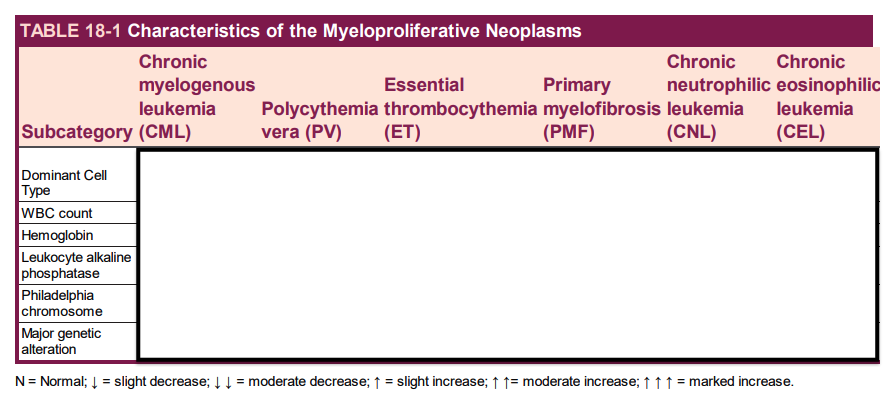
MPN Classifications

Chronic Phase (CP)
≤10% blast count
Most common diagnosed stage
High prognosis and responsive to tyrosine kinase inhibitors
Accelerated Phase (AP)
10% to 20% blast count
Worsening symtoms
Tyrosine kinase inhibitor resistant that limit the TKI effectiveness
Blastic Phase (BC)
>20% blast count
Multiple mutation to the BCR-ABL1 proteins
Poor prognosis, and may progress to AML or ALL
CML Treatment
Imatinib mesyslate (Gleevec) is the first TKI to prevent BCR-ABL1 fusion gene
Five TKIs have now been approved: imatinib, dasatinib, nilotinib, bosutinib, ponatinib
Patient in blastic have less than 30% response rate and have less than 5 year survival rate
Patient with ALL and Philadelphia chromosome has similar treatment response as blastic phase
Atypical Chronic Myeloid Leukemia (aCML)
Features both MPN and myelodysplastic syndrome
Resembles CML in neutrophilic leukocytosis, granulocytic hyperplasia
No basophilia, no dysplastic features in granulocytic line
No Philadelphia chromosome, but positive CSF3R mutation
Chronic Neutrophilic Leukemia (CNL)
Over 80% WBC are neutrophils, high matured cells (band & segmented), low immature cells (blast, metamyelo, myelo promyelo)
No basophilia, eosinophilia, and monocytosis
No Philadelphia chromosome, JAK2/CLR/MPL mutations
Positive CSF3R mutation
Chronic Eosinophilic Leukemia
Eosinophilia, less than 2% blasts
No Philadelphia chromosome
Positive trisomy 8
Does not respond to TKI therapy
Polycythemia Vera (PV)
Erythroid hyperplasia leads to high RBC and hemoglobin, thrombosis
No Philadelphia chromosome
Positive JAK2 mutation
Major PV shows increase red cell mass, not just elevate Hb & Hct
Splenomegaly, plethora (rosy/reddish complexion) from excessive amount of blood
Associate with iron-deficiency anemia (mycrocytic-hypochromic) due to therapeutic phlebotomy (blood draw), increased RBC production and gastrointestinal blood loss due to platelet dysfunction
High LAP compared to CML, blood assay for EPO-independent colonies helps confirm diagnosis
Treatments include therapeutic phlebotomy, aspirin. Cytoreduction therapy (hydroxyurea) controls blood cell count.
Essential Thrombocytopenia (ET)
High platelet count and anisocytosis (size variation), and megakaryocytes in marrow, no left-shift in granulocytes
No Philadelphia chromosome
Positive JAK2 (60%), CALR (30%), MPL(3%) mutation, or triple-negative (12%)
Higher risk in women
Platelet clumping that leads to false-low platelet count. Manual count is mandatory
Need to differentiate from reactive thrombocytosis (presence of inflammatory markers)
Treatments include plateletpheresis (removal of platelets from blood), cytoreduction (hydroxyurea), and interferon (IFN) targets mutated stem cells

Primary Myelofibrosis (PMF)
Pancytopenia due to fibrosis, early stage (pre-PMF) may show an increase in all cell types
No Philadelphia chromosome
Positive JAK2/CALR/MPL mutation
Categories as prefibrotic & overfibrotic PMF
Morphology shows dacrocytes
Relative Erythrocytosis
RBC and hematocrit appear elevated due to plasma volume decrease. In reality, it’s not an increase in erythrocytes.
Absolute Erythrocytosis
Primary absolute erythrocytosis: The BM marrow proliferates neoplastic RBC independently of EPO such as in the case of PV. EPO level decreases in attempt to suppress the excessive production
Secondary absolute erythrocytosis: Increased EPO level that directly impacts RBC production
JAK-STAT Pathway
Cytokine binds to receptor and activate JAK proteins kinase
JAK phosphorylates tyrosine residues on the receptor
STAT is recruited to the site
JAK directly phosphorylates STAT protein
Activated STAT protein forms dimer
STAT dimer enters nucleus and bind to DNA prompting cell proliferation & differentiation