MECHANICS FORMULAS
 Call Kai
 Learn
 Practice Test
 Spaced Repetition
 Match
 Flashcards
 Knowt Play
1/37

There's no tags or description
Looks like no tags are added yet.
38 Terms
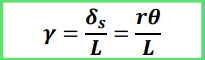
Torsional Shear Strain, γ
Torsional Shear Stress, τ

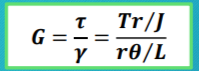
Modulus of Rigidity, G
Angle of Twist, θ

Polar Moment of Inertia, J

For Solid Shaft

For Hollow Shaft:


Shape of cross section (Tmax)


Shape of cross section (ϕ)


Shape of cross section (Tmax)

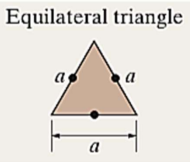
Shape of cross section (ϕ)


Shape of cross section (Tmax)


Shape of cross section (ϕ)

Power Transmission (uses angular velocity)

Power Transmission (uses frequency)

Flanged bolt couplings

Single Row of Bolts (Flanged Bolt Couplings)

Two Concentric Row of Bolts (Flanged Bolt Couplings)


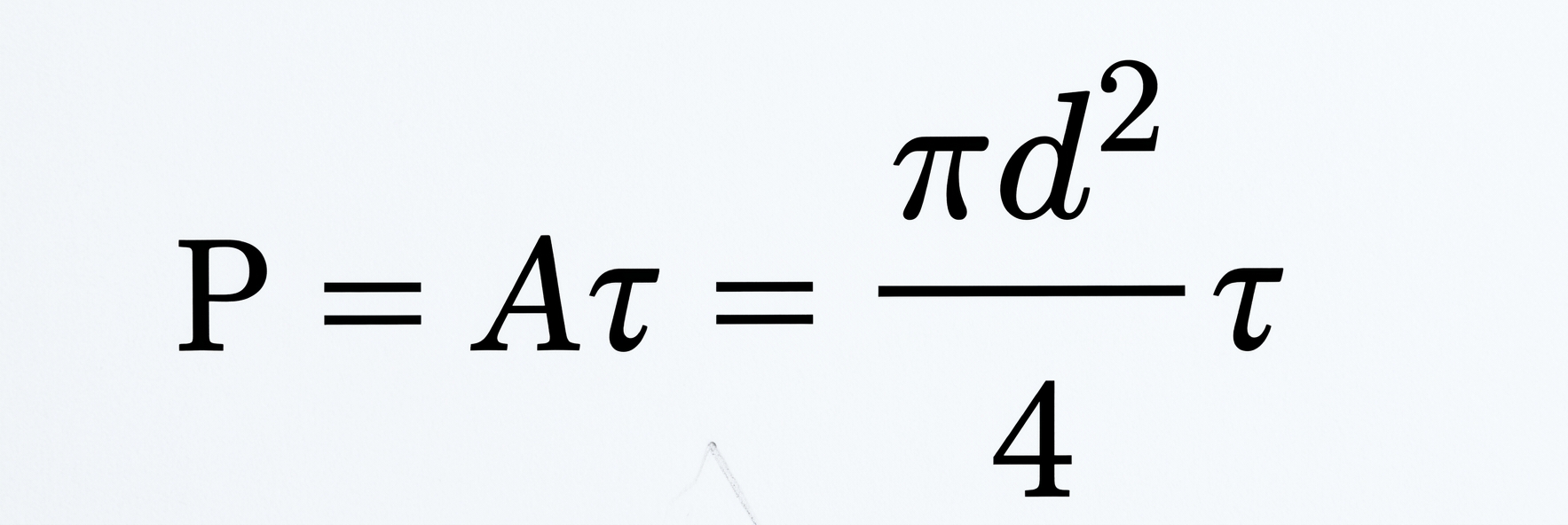
For rigid flanges, the shear deformations in the bolts are proportional to their radial distances from the shaft axis. The shearing strains are related by:

Using Hooke’s law for shear, G = τ / γ, we have:

If the bolts on the two circles have the same area, A1 = A2, and if the bolts are made of the same material, G1 = G2, the relation between P1 and P2 reduces to:

Maximum Shearing Stress, τ (Helical Springs)
This formula neglects the curvature of the spring. This is used for light spring where the ratio d/4R is small.

Maximum Shearing Stress, τ (Helical Springs)
Wahl’s Formula
For heavy springs and considering the curvature of the spring, a more precise formula is given by:
where m is called the spring index and is equal to 2R/d or D/d and (4m – 1) / (4m – 4) is the Wahl Factor.

Spring Deflection/Elongation, δ

When the deformations caused by direct shear were neglected, spring deflection may be computed by:

Spring Constant, k (Spring Deflection/Elongation)

Notice that the deformation δ is directly proportional to the appliedload P. The ratio of P to δ is called the spring constant k and is equal to:


SPRINGS IN SERIES
For two or more springs with spring laid in series, the resulting spring constant k is given by:


SPRINGS IN PARALLEL

Torsion of Thin-Walled Tubes

(Torsion of Thin-Walled Tubes) The average shearing stress across any thickness t is:

the average shear stress acting over a particular thickness of the tube (Torsion of Thin-Walled Tubes)
T avg
the resultant internal torque at the cross section (Torsion of Thin-Walled Tubes)
T
the thickness of the tube where T avg is to be determined
t
the mean area enclosed within the boundary of the centerline of the tube’s thickness
Am
Since 𝑞 = T avgt , then the shear flow throughout the cross section becomes:

is the product of the tube’s thickness and the average shear stress. This value is the same at all points along the tube’s cross section. As a result, the largest averageshear stress on the cross section occurs where the thickness is smallest.
shear flow q