Compass Study Plan A: Maternity Quiz 4
 Call Kai
 Learn
 Practice Test
 Spaced Repetition
 Match
 Flashcards
 Knowt Play
1/12

There's no tags or description
Looks like no tags are added yet.
13 Terms
The nurse observes bleeding into the subgaleal compartment on reviewing a child’s magnetic resonance imaging (MRI) results. Which other conditions would the nurse evaluate for in the child? Select all that apply. One, some, or all responses may be correct.
Decreased heart rate
Decreased platelet levels
Decreased bilirubin levels
Decreased hematocrit levels
Decreased head circumference
Decreased platelet levels
Decreased hematocrit levels
Bleeding into the subgaleal compartment indicates subgaleal hemorrhage in an infant. Subgaleal hemorrhage is also associated with disseminated intravascular coagulation, which results in thrombocytopenia or decreased blood platelets in the body. A neonate with subgaleal hemorrhage experiences destruction of red blood cells within the hematoma; therefore the neonate will have decreased hematocrit. Subgaleal hemorrhage is characterized by tachycardia, not decreased heart rate or bradycardia. Subgaleal hemorrhage is characterized by hyperbilirubinemia because of degradation of red blood cells. A neonate with subgaleal hemorrhage shows megacephaly, not decreased head circumference.
Which parent teaching would the nurse provide to minimize regurgitation in an infant with a cleft lip?
Offer a thickened formula.
Burp frequently during a feeding.
Place the child in an infant seat during feedings.
Position the child on the side with the bottle propped.
Burp frequently during a feeding.
Because of the cleft (opening) in the lip, infants with this condition tend to suck in excessive air; burping helps prevent regurgitation of formula. Thickened formula is given to infants with reflux problems, such as vomiting after each feeding. This infant should be held during feedings, not positioned in an infant seat. The bottle should never be propped, because aspiration may occur.
A 62-year-old client reports to the nurse, "My eyes don’t feel right, and I have a gritty and sandy sensation in my eyes." Which condition might this client have?
Retinal detachment
Infection of the cornea
Changes in tear composition
Hemorrhage in the vitreous humor
Changes in tear composition
Decreased tear formation or changes in the tear composition because of aging or various systemic diseases may cause dryness in the eye. This may manifest in eye discomfort and a sandy, gritty, or burning sensation. Retinal detachment may cause blurred vision. Infection of the cornea may result in photophobia. A vitreous humor hemorrhage manifests as spots or floaters seen in the field of vision.
The nurse is caring for a client with severe burns and determines that the client is at risk for hypovolemic shock. Which physiological finding supports the nurse’s conclusion?
Decreased rate of glomerular filtration
Excessive blood loss through the burned tissues
Plasma proteins moving out of the intravascular compartment
Sodium retention occurring as a result of the aldosterone mechanism
Plasma proteins moving out of the intravascular compartment
The shift of plasma proteins into the burned area increases the shift of fluid from the intravascular to the interstitial compartment; the result is decreased blood volume and hypovolemic shock. Decreased glomerular filtration may occur because of hypovolemia; it does not cause hypovolemia. Extracellular fluid, not blood, is lost through burned tissue. Sodium is not retained; it passes to interstitial spaces and surrounding tissue.
Which statements by a client with hyperemesis gravidarum would confirm that the client requires further teaching? Select all that apply. One, some, or all responses may be correct.
"I’ll start drinking protein shakes."
"I’ll start drinking plenty of fluids."
"I’ll start limiting my carbohydrates."
"I’ll lie down for at least 2 hours after I eat."
"I’ll be sure to schedule rest periods throughout the day so I won’t get tired."
"I’ll start limiting my carbohydrates."
"I’ll lie down for at least 2 hours after I eat."
The client should not decrease carbohydrate intake. During pregnancy the cardiac sphincter may relax, which allows food to come back up into esophagus when the client is supine. The client should not lie down for 2 hours after eating to provide time for digestion so that food is not regurgitated. Drinking protein shakes can help provide protein needed to decrease the chance of a negative nitrogen balance. The individual protein shakes, though, should be evaluated for other additive ingredients that may be not recommended in pregnancy. The client should be encouraged to drink plenty of fluids to help prevent dehydration. Hyperemesis gravidarum can be aggravated by stress and fatigue. Rest periods may reduce the client’s stress level and fatigue and promote relaxation.
A neonate is born with exstrophy of the bladder, and the parents are visibly upset. They are told that corrective surgery will be performed as soon as possible. Which nursing action would assist the parents at this time?
Teaching the parents about preoperative and postoperative care
Caring for the newborn in the same manner as any other newborn
Keeping the newborn as clean as possible to decrease the odor of urine
Reassuring the parents that after surgery their newborn will grow and develop without any after-effects
Caring for the newborn in the same manner as any other newborn
The nurse’s role-modeling of acceptance of the infant, even with the newborn’s altered physical appearance, can help the parents adjust. Teaching the parents about preoperative and postoperative care is appropriate later; the parents first need to deal with their feelings regarding the newborn’s appearance. The parents’ current major adjustment concern is the appearance of the infant; odor is secondary. Reassuring the parents that after surgery their newborn will grow and develop without any after-effects is false reassurance; there are no guarantees related to the outcome of the surgery.
Which behavior would the nurse determine is developmentally appropriate in a 6-month-old infant?
Says "mama"
Crawls forward
Turns pages in a book
Holds a bottle without help
Holds a bottle without help
A 6-month-old infant is capable of holding a bottle in his or her hands. Holding a bottle is a basic gross motor skill that develops early during infancy. Saying words is a skill of older infants. Language development requires expressive (ability to make thoughts, ideas, and desires known to others) and receptive (ability to understand words being spoken) skills. Crawling is a skill of older infants. As the neurological system begins to mature, the strong flexor tone of the lower extremities subsides, permitting independent limb movement. Turning pages in a book is a skill of older infants; it requires fine motor skills and hand-eye coordination.
Which is the priority of care for a child who was recently diagnosed with celiac disease?
Preventing celiac crisis and resulting problems
Minimizing complications of respiratory involvement
Teaching the parents to establish a diet that promotes optimal growth
Helping the parents and child adjust to the long-term dietary restrictions
Helping the parents and child adjust to the long-term dietary restrictions
Adherence to dietary restrictions can prevent future complications and celiac crisis. Celiac crisis usually develops as a result of nonadherence to the diet, so adherence to the diet, rather than preventing celiac crisis, is the primary objective. Respiratory involvement is not a primary problem with celiac disease. Teaching the parents to establish a growth-encouraging diet is incorrect because, regardless of adherence to the diet, the disease may interfere with the expected growth rate.
The primary health care provider instructs the nurse to apply an emollient to an infant. During assessment, the nurse finds that the neonate is a preterm infant and has a body weight of 900 g. Which is the appropriate nursing intervention in this situation?
Administer intravenous fluids before applying emollient.
Monitor for coagulase-negative staphylococcal infection.
Avoid applying emollient to dry, flaking, and fissured areas on the skin.
Hold applying emollient and recheck with the primary health care provider.
Monitor for coagulase-negative staphylococcal infection.
Emollients can cause coagulase-negative staphylococcal infection in a preterm infant who weighs 900 g or less. Intravenous fluids do not increase the effectiveness of the emollients, so there is no need to administer intravenous fluids before applying the emollient. Emollients effectively reduce dry, flaking, and fissured areas on the infant’s skin. Emollients are not contraindicated in preterm infants, so there is no need to hold application or recheck with the primary health care provider.
Which pathophysiological abnormality is present in cystic fibrosis?
Dysfunction of sweat glands
Inactivity of respiratory tract cilia
Dysfunction of mucus-secreting glands
Overproduction of endocrine gland activity
Dysfunction of mucus-secreting glands
Cystic fibrosis is a genetic disorder affecting all mucus-secreting (exocrine) glands. A sweat gland abnormality is not involved in cystic fibrosis; children with cystic fibrosis lose excessive amounts of sodium through perspiration caused by exocrine gland dysfunction. Cilia action may be influenced by the thickened secretions, but the cilia are not affected by cystic fibrosis. Exocrine, not endocrine, glands are involved in cystic fibrosis.
A 15-year-old adolescent is found to have type 1 diabetes. Which would the nurse include when teaching the adolescent about type 1 diabetes?
It does not always require insulin.
It involves early vascular changes.
It occurs more often in obese adolescents.
It has a more rapid onset than does type 2 diabetes.
It has a more rapid onset than does type 2 diabetes.
A characteristic difference between type 1 and type 2 diabetes is the rapid onset of type 1 diabetes. Type 1 diabetes often is first diagnosed during an episode of acute ketoacidosis. Children, adolescents, and adults with type 1 diabetes are insulin dependent. Vascular changes are complications associated with long-standing diabetes. Maturity-onset diabetes of the young (MODY), similar to type 2 diabetes, is more often seen in obese teenagers. Adolescents with type 1 diabetes tend to be at or below the expected weight for their height and bone structure.
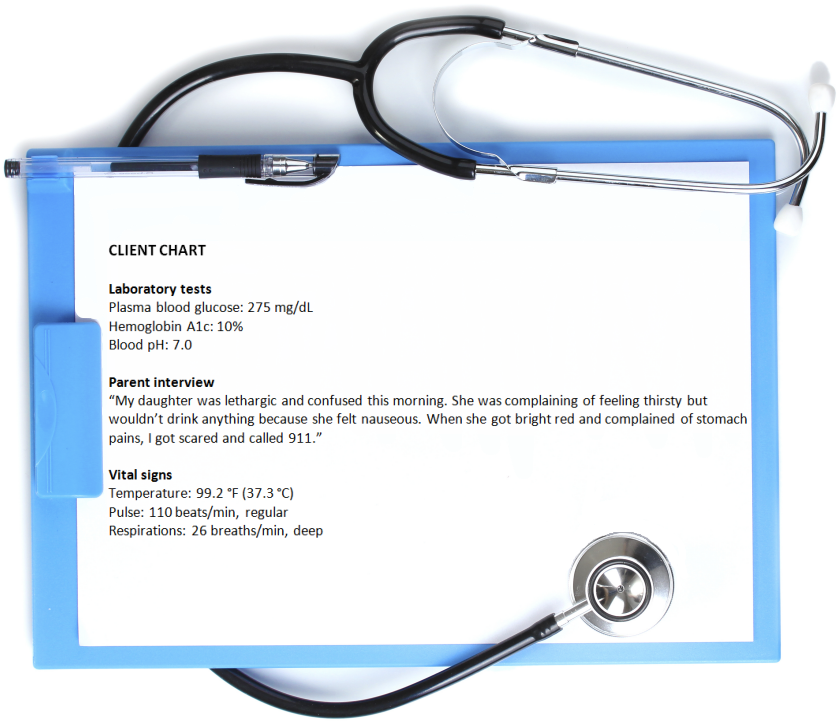
A 14-year-old adolescent with diabetes has been self-administering insulin twice a day. This morning the parents found their child lethargic and confused. After the adolescent’s admission to the emergency department, laboratory testing reveals a hemoglobin A1c level of 10% and a blood glucose level of 200 mg/dL (11.1 mmol/L). Which would the nurse suspect as the most likely cause of this client’s condition?
Hypoglycemia
Somogyi effect
Uncontrolled blood glucose level
Noncompliance with the prescribed insulin regimen
Uncontrolled blood glucose level
The blood glucose is increased above the expected range of 90 to 130 mg/dL (5–7.2 mmol/L) in adolescents older than 12 years of age, per the American Diabetes Association. Hemoglobin A1c is increased above the expected range of less than 7.5% in adolescents older than 12 years, per the American Diabetes Association. Although compliance is not optimal in the adolescent population, there are not enough data to justify this conclusion at this time. The Somogyi effect (rebound hyperglycemia) occurs when there is an increase in blood glucose at bedtime and a drop at 2 AM followed by a rebound increase in the morning. Periodic blood glucose monitoring, including at night, must be performed to document the Somogyi effect. The plasma blood glucose will be less than 60 mg/dL (3.3 mmol/L) with hypoglycemia. Lethargy, confusion, thirst, nausea, flushed face, and abdominal pain are associated with hyperglycemia, not with hypoglycemia. Suggesting that the prescribed regimen was not followed is a judgmental assumption, and there is insufficient information to justify this conclusion.
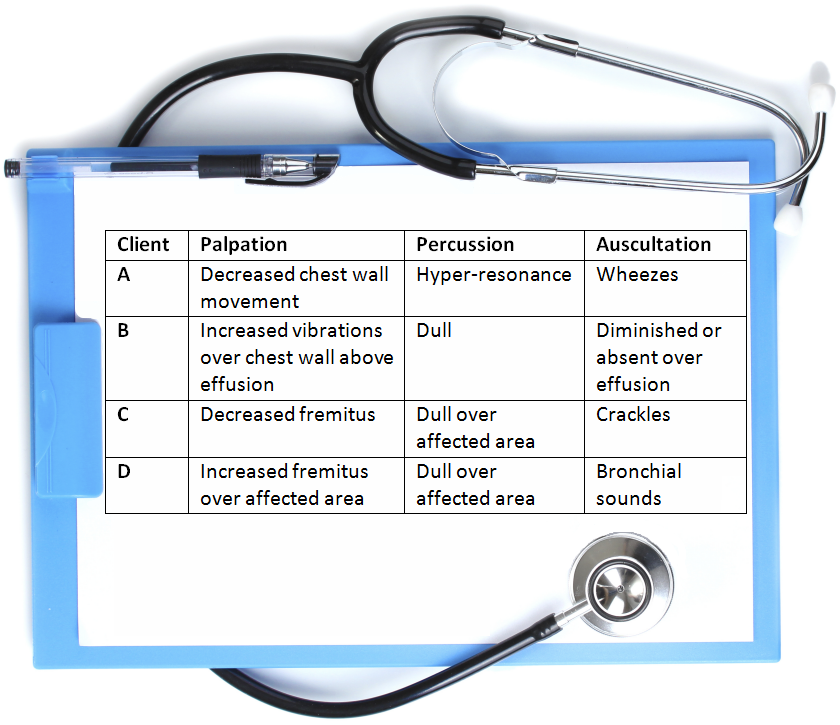
Which of the nurse’s assigned clients may have atelectasis?
Client A
Client B
Client C
Client D
Client C
A client suffering from atelectasis may have decreased fremitus, dull percussion over the affected area, and crackling sounds upon auscultation like client C. Decreased chest wall movements, hyperresonance, and wheezing indicate asthma in client A. Client B with increased vibrations over the chest wall above effusion, dull percussion, and diminished or absent breath sounds over the affected area may have a pleural effusion. Client D with increased fremitus over the affected area, dull percussion over the affected area, and bronchial sounds upon auscultation may have pneumonia.