Spectral Properties of Vegetation
 Call Kai
 Learn
 Practice Test
 Spaced Repetition
 Match
 Flashcards
 Knowt Play
1/14

There's no tags or description
Looks like no tags are added yet.
15 Terms
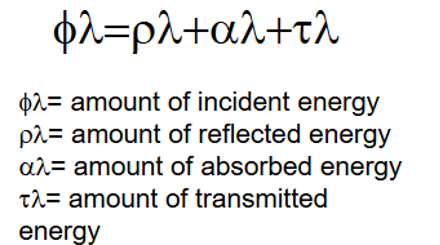
What is the equation where EMR interacts with the Earth’s surface
Reflection, absorption and transmission vary with the spectral and structural properties of the object it interacts with
What is spectral reflectance
The reflectance within a specified wavelength range (e.g. 0.3-0.4um)
What is a spectral signature
The unique pattern of electromagnetic radiation reflected, absorbed, transmitted, or emitted by a material across different wavelengths
What are the direct interests for studying the interaction between EMR and vegetation
-Often the first surface encountered by the energy used for RS
-Vegetation plays a key role in the carbon cycle
-Helps analyse disease, precision agriculture, forestry, climate change and biodiversity
What are the indirect interests for studying the interaction between EMR and vegetation
Analysing geologic and pedologic patterns
How much of Earth’s land surface is covered by vegetation
70% (with perennial or seasonal photosynthetic activity)
What is the equation for photosynthesis
Carbon Dioxide + water → glucose + oxygen
6CO2 + 6H2O + sunlight → C6H12O6 + 6O2
How do leaves process absorbed light for photosynthesis
Via chlorophylls, which appear green, and carotenoids, which range in color from yellow to orange. These pigments are embedded in the membranes of chloroplasts.
Absorption of light begins when photons strike a pigment molecule, exciting an electron and enabling energy transfer between adjacent pigments. This energy reaching reaction centres where it is transformed into energy-rich molecules

What four main pigments do vegetation contain
-Chlorophyll-a
-Chlorophyll-b
-Xanthophylls
-β-carotene
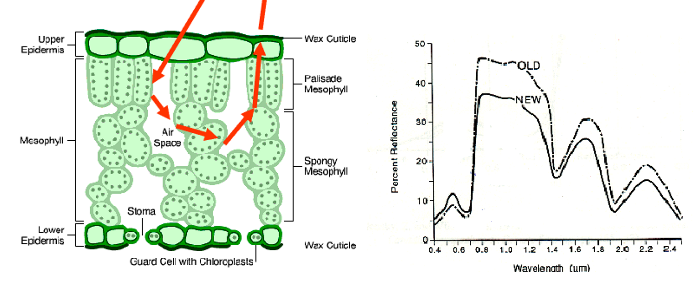
Where in the leaf interacts with the NIR wavelength
-Occurs at the upper half of the leaf and more importantly between cell and air spaces (amount of airspace increases with level of leaf maturity)
-High reflectance
Does dense vegetation have a higher red wavelength or NIR reflectance
Areas of dense vegetation have lower reflectance in the red waveband but higher in the NIR

What is the red edge
The sharp, sudden increase in plant leaf reflectance between 680 nm and 750 nm, transitioning from heavy red light absorption to high near-infrared scattering
What is the red edge position
The point of maximum slope of the curve in red/near infrared region. It’s sensitive to the chlorophyll content of vegetation
What are the interactions affecting shortwave infrared wavelengths
-Atmosphere and materials on surface contain water
-Amount of reflectance is inversely proportional to water content
-Dominated by water absorption

What other factors affect spectral reflectance of vegetation
-Soil background (i.e. beneath the canopy)
-Solar (illumination) and sensor (viewing) geometry
-Vegetation 3D structure (height, size & shape of leaves, shape of the crown etc)
-Phenology (lifecycle of plants (or animals)). Including temporal characteristics of vegetation growth and depending on available water via rainfall/irrigation, temperature and vegetation type (evergreen vs. deciduous)