The Nervous System
 Call Kai
 Learn
 Practice Test
 Spaced Repetition
 Match
 Flashcards
 Knowt Play
1/21

There's no tags or description
Looks like no tags are added yet.
22 Terms
What is the function of the nervous system?
It enables our humans to coordinate and regulate our body function in response to our environment and adapt to detected stimuli.
Define stimuli
A change in the enviroment
How is stimuli detected?
Stimuli is detected by receptor cells in our body that make up our 5 sense organs.
1) Ears = detect changes in sound and physical balance
2) Eyes = detect changes in light intensity
3) Tounge = detect changes in chemical within our food
4) Nose = detect chemical changes in the air
5) Skin = detect changes in temperature, pressure and pain
What are the two parts of the Nervous System?
1) The CNS (Central Nervous system) containing the brain and spinal cord that process incoming electrical impulses from receptor cells and input command impulses to be send to effectors.
2) The PNS (peripheral nervous system) that consists of nerves and sensory receptors to detect stimuli and relay information to the brain. It also process the motor commands of the brain and sends it to the effectors.
Draw out the 3 different neurones and explain purpose + differences
1) Sensory neurone = transmits impulses from receptor cells to the CNS (its cells body is located at the center of its structure and branches out from the exon. )
2) Relay Neurone = transmits information from CNS → CNS (doesn’t have a myelin sheath)
3) Motor Neurone = transmits command impulses from CNS → effector (cell body is on one end)
What are effectors?
Effectors are muscles that contract/relax or glands that produce chemical (hormones) when recieving motor commands from the brain through electrical impulses.

Label the neurone
1) Dendrites
2) Nucleus
3) Cell membrane
4) Myelin sheath
5) Axon
9) Nerve endings
note the inside of the cell body is made of cytoplasm
What is the purpose of the myelin sheath?
→ The myelin sheath is a fatty sheath layer that acts as an electrical insulator to increase the rate of transmission for electrical impulses by reducing the loss of electrical energy (the impulses travel along the axon by active transport of ions)
Define a synapse
The gap between two neurones that acts as a junction of transmission for electrical impulses from one neurone to another
→ They ensure impulses travel in a one way direction by converting electrical energy to chemical to electrical
How do neurones transmit electrical impulses through a synapse?
1) The electrical impulses arrive at the terminal of the pre-synaptic neurone
2) The impulses trigger calcium ions to enter the pre-synaptic neuron, the influx of ions causes the vesicles containing tiny neurotransmitters to move towards and fuse to the membrane of the presynaptic neurone.
3) Once fused to the membrane, the vesicle release their neurotransmitters to diffuse across the synapse cleft between the membrane of the two neurones
4) The receptors at the membrane of the post-synaptic neurone have an active site complementary to the shape of their neurotransmitter so that it can bind to the receptor
5) The binding stimulates a new electrical impulse to be released from the receptor through the post-synaptic neurone until it finds the next synapse
→ note that once used, neurotransmitters can be broken down to be recycled
How is ATP required in the process of synapses?
→ ATP energy is required to transmit electrical impulses across the axon by active transport of ions
→ ATP is required in protein synthesis to produce neurotransmitters
What is the difference between voluntary and involuntary actions?
Voluntary Actions: actions controlled by the brain processing electrical impulses and outputting motor commands (controled by somatic nervous system = branch of the PNS)
Involuntary Actions: doesn’t include consious processing of impulses from the brain. Instead electrical impulses bypass the brian running straight through the spinal cord to the effector (the product of this is a reflex action that is often fast and sudden to place you out of danger) + (controlled by the autonomic nervous system = another branch of the PNS)
What’s a reflex arc?
The shortened nerve pathways that electrical impulses take when they bypass the brain to get to the receptor through the spinal cord. This produces involuntary actions called reflexes. Some neurones still travel through the brain so that we can still process the action once its happened?
What is the eye?
The eye is a specific sense organ connected to the central nervous system through the optic nerve and is designed to detect changes in light intensity
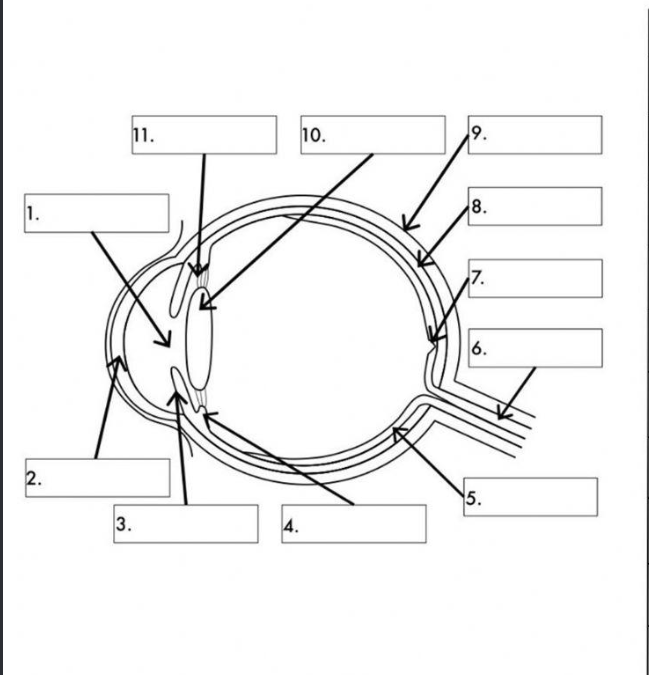
Label the eye diagram and state functions
1) Pupil = gap between at the centre of the iris where light passes through
2) Cornea = transparent layer at the front of the eye that refracts some light to direct it through the pupil and lens
3) Iris = Muscle that controls the amount of light entering the eye
4)Ciliary Muscle
5) Retina
6) optic Nerve (carries electrical impulses from eye to brain through CNS)
7) Fovea =. concentrated area of cone cells to take in coloured lighting at high light intensities
10) Lens = bends light in order for the rays to converge at the retina
11) Suspensory Ligaments
How is light detected in the eye?
→ Light is detected by light receptors located at the fovea
There are two light receptors at the retina:
1) Rods (designed to detect low light intensities and mostly black and white light) = located around the edge of the retina in order to increase their surface area to catch scattered, low intensity light when the pupils dialate
2) Conses (designed to detect high intensity and coloured light) = concentrated at the fovea where high ligh intensities are concentrated when the pupils contract
What is the eye responsible for?
Controlling how much light enters the eye to prevent damage to nerve endings and ensure enought light is entering to stimulate receptor cells
How do pupils respond when light intensities are too high?
→ When light intensities are too high the nerve endings are at risk of being damaged so the pupil contracts to reduce the amount of light entering The Ciliarly muscles contract
The radial muscles tighten
and the pupil therefore contracts to become smaller
How do pupils respond when light intensities are too low?
→ When light intensities are too low there may not be enough light to stimulate the cells so the pupils dialate to take in more light
The Ciliary muscle relax
The radial muscles contracts
The pupil dialate to become wider
What is accomodation?
A reflex action in which the eye changes its optical power, by changing the shape of the lens to focus on objects that are moving through different distances
How does accommodation work in closer objects?
→ The light rays of closer objects need to be more refracted to ensure they converge at the retina and not beyond this
The Ciliary muscles contract
The suspensory ligaments relax and are not being pulled
The lens itself is not being pulled and remains short and convex so allow for a greater refraction of light
How does accommodation work in further objects?
→ Light rays from objects further away need to be refracted less so they can converge at the retina and not before it
The Ciliary muscles slacken
The Suspensory ligaments contract to tighten
The lens is pulled thinner to allow for less refraction of light