Bio 180-271 - Unit 4: Nervous System - Week 1: Slides 16-27
 Call Kai
 Learn
 Practice Test
 Spaced Repetition
 Match
 Flashcards
 Knowt Play
1/55

There's no tags or description
Looks like no tags are added yet.
56 Terms
In adults, what percentage of the body's neural tissue does the brain contain?
97%
What is the spinal cord?
A continuation of neural tissue off of the medulla oblongata.

Function of the Spinal Cord
Transmits information to and from the brain;
Independently responsible for numerous reflexes

What does Somatic Motor movement relate to?
Skeletal muscle

Which area of the brain directs movement? Which area refined the movement?
Cerebellum - Refines
Cerebrum - Directs
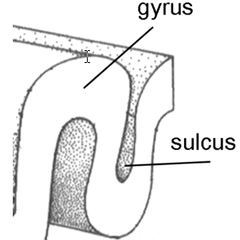
Define "Gyrus"
Raised area
Which area of the brain is skeletal muscle controlled in?
The Precentral gyrus
True or False: Most voluntary skeletal muscle movement is contralateral
True
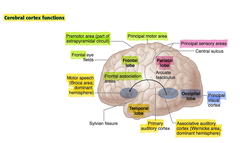
Name the four lobes of the Brain
• Frontal
• Parietal
• Occipital
• Temporal

True or False: Everything in the brain is contralaterally controlled
False
Functions of the Frontal Lobe
• the ability to recognize future consequences resulting from current actions (allows us to pause before we act and consider the options)
• helps with the determination of similarities and differences between things or events

Functions of the Temporal Lobe
• The retention of visual memories
• the processing of sensory input
• the comprehension of language and emotion
• the storage of new memories
Function of the Parietal Lobe
• integrate sensory information from various parts of the body
• involved with the knowledge of numbers and their relations

Function of the Occipital Lobe
processing visual information
Name the gyrus's of the Brain
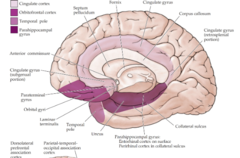
• Precentral Gyrus
• Postcentral Gyrus
Function of the Precentral Gyrus
The primary somatic motor (skeletal muscle) area - Voluntary movement
Function of the Postcentral Gyrus
receives somatic sensory information

Define Meninges
membranes that surround the central nervous system

What does "Meninge" translate to?
"Mother"
Name the three Meninges of the Cranium
Dura Mater
Arachnoid Mater
Pia Mater

Define Dura Mater
The thick membrane and outermost of the meninges

Define Arachnoid Mater
The middle, web-like meningeal layer

Define Pia Mater
the innermost and delicate meningeal layer that clings on to the brain and spinal cord

Name the three main dural folds
Falx Cerebri
Falx Cerebelli
Tentorium Cerebelli

Function of the Falx Cerebri
separates the two brain hemispheres

Function of the Tentorium Cerebelli
surrounds and separates cerebellum from hemispheres

Where is the Falx Cerebelli in relation to the other main dural folds?
separated by cerebellum

Role of the Brain Ventricles
TP create and help transport cerebrospinal fluid (CSF)
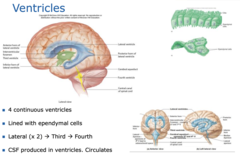
Define Cerebrospinal Fluid
The clear, colorless, bodily fluid that helps protect the brain and spinal cord mechanically and chemically

Where can you find Cerebrospinal Fluid?
In the subarachnoid space (between pia mater and arachnoid mater)

Function of Corpus Collosum
allows the two sides of the brain to "talk" or "communicate", which typically stops one side from over- communicating, in a sense

Define Arachnoid Granulations
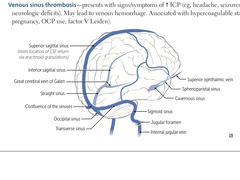
projections of arachnoid mater that allow cerebrospinal fluid to enter the dural venous sinuses

Define the Dural venous sinus
The channel found between layers of the dura mater that receive blood from the veins of the brain and cerebrospinal fluid from the subarachnoid space
Where does the Dural Venous Sinus empty Cerebrospinal fluid into?
Into the internal jugular veins (drains the brain of blood and cerebrospinal fluid)
Where is Cerebrospinal Fluid produced?
Choroid plexus

Name the six structures of the brain stem
•Thalamus
•Hypothalamus and pituitary gland
•Midbrain
•Pons
•Medulla
• Pituitary Gland
Role of the Pituitary Gland
The endocrine gland that is responsible for interfacing the nervous system and the endocrine system;
bridge between hormones and nervous system
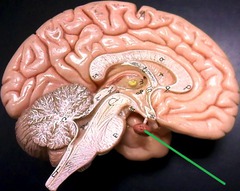
Function of the Thalamus
relays sensory info up to the postcentral gyrus

Role of the hypothalamus
bridge between hormones and nervous system

Function of the Midbrain
maintaining consciousness

Function of the Pons
subconscious control and thoughts, part of the brain stem

Functions of the Medulla
regulates autonomic centers (heart, lungs, digestion)

Where is the Spinal Cord Located
begins past the medulla oblongata and tapers at the conus medullaris (L1 or L2; end of the spinal cord)

Define the Cauda Equina
The bundle of spinal nerves that continue off of the conus medullaris

Define Filum terminale
A modification of pia mater that attaches the conus medullaris to the coccyx (anchors conus medullaris to coccyx)

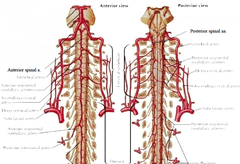
Name the branches of the spinal cord and how many structures are in each
• 8 cervical spinal nerve pairs
• 12 thoracic spinal nerve pairs
• 5 lumbar nerve pairs
• 5 sacral nerve pairs
• 1 coccygeal nerve pair
Define Cranial Nerves
Nerves that are connected to the brain
Define Spinal Nerves
Nerves that are connected to the spinal cord

True or false: Spinal Nerves all have the same layout and work in the same way, regardless of location.
True
True or False: Cranial Nerves all have the same layout and work in the same way, regardless of location.
False
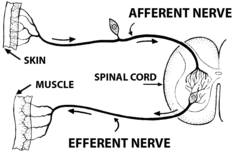
Define Afferent Nerves
those that carry sensory information to the CNS

Define Efferent Nerves
those that carry motor information from the CNS
Name the two parts of the Autonomic Nervous System
Sympathetic division
Parasympathetic division
What is the Sympathetic Division of the Autonomic Nervous System responsible for? Name an example
stimulatory effects on the body;
Fight or Flight response
What is the Parasympathetic Division of the Autonomic Nervous System responsible for?
relaxing effects on the body;
Resting and digesting
What is Second Impact Syndrome?
A term to describe a second traumatic brain injury prior to recovering from a first
