ansc314 - vitamin A & D
 Call Kai
 Learn
 Practice Test
 Spaced Repetition
 Match
 Flashcards
 Knowt Play
1/36

There's no tags or description
Looks like no tags are added yet.
37 Terms
vitamins
vital to life
casimir funk (1905)
Cornelius Adrianus Pekelharing found animals fed purified proteins, carbohydrates, fats, inorganic salts, and water would thrive only if small amounts of milk were added to the diet
1911, Casimir Funk isolated a concentrate from rice polishing that cured polyneuritis in pigeons
named the concentrate “vitamine” b/c it appeared to be vital to life and b/c it was probably an amine
vitamin functions
vitamins & minerals close interactions w/ macronutrients to accomplish metabolic functions
co-enzymes → energy & protein metabolism
cell regulators & hormones → growth & development
anti-oxidants → health & disease
enzyme
protein that functions as catalyst to mediate speed of chemical reaction
cofactor
non-protein chemical compound
bound to protein & needed for biological activity of protein
helps enzymes
coenzyme
substance that enhances action of enzyme
cofactors that are bound to an enzyme loosely
prosthetic group
tightly bound cofactor
specific non-polypeptide unit needed for biological function some proteins
vitamin classifications
fat soluble - stored in fatty tissues
water soluble - no real storage site in body
fat soluble vitamins
stored in fatty tissues
A → retinol
D → cholecalciferol, ergocalciferol
E → tocopherols
K → phylloquinones, menaquinones, menadione
water soluble vitamins
no real storage site, go away when secreting water (urine, sweat, etc)
dietary requirement MUCH higher
thiamin (B1)
riboflavin (B2)
niacin (B3)
pantothenic acid (B5)
pyridoxine (B6)
biotin (B7)
folate / Folacin (B9)
cobalamin (B12)
inositol, choline, ascorbic acid (C)
plant vitamins
vitamins, trace elements, & proteins are in the germ & bran of the plant
germ is reproductive part
germinates → grow into plant
in leaves: associated w/ chlorophyll

vit A sources
vegetable sources (beta-carotene - precursor for Vit. A)
green, leafy vegetables
intensely colored fruits & vegies
animal sources
eggs, meat, & dairy products

carotenoids
derived from plants & give them their color
precursor for Vit. A
body enzymes turn it → Vit. A
50/600 carotenoids are converted → Vit. A

vitamin A forms
retinol
retinal
retinoic acid
Retinol & retinal converted → other forms
retinoic acid can’t
In general, animal foods provide most of the preformed Vit. A
plants provide most of the provitamin A carotenoids in diet.

vitamin A functions
group of related vitamins w/ multiple functions
visual pigment - retinal
growth (bone) retinoic acid (hormone)
reproduction - retinoic acid
cell differentiation/gene expression - retinoic acid
immune cells - retinol/retinal
most prevalent vitamin deficiency
Vit A & carotenoids digestion & absorption
stored in liver
travels w/ lipids → other tissues
consuming:
animal product → Vit. A
plant product → carotenoids → enzymes → active Vit. A form (retinal)

15-15’-dioxygenase
cleaves carotenoids → 2 Vit. A units
enzyme absent in cats & minks

plasma protein
70% plasma protein → albumin
albumin
transport protein
vitamin A storage
in liver

carotenoids
500 plant pigments
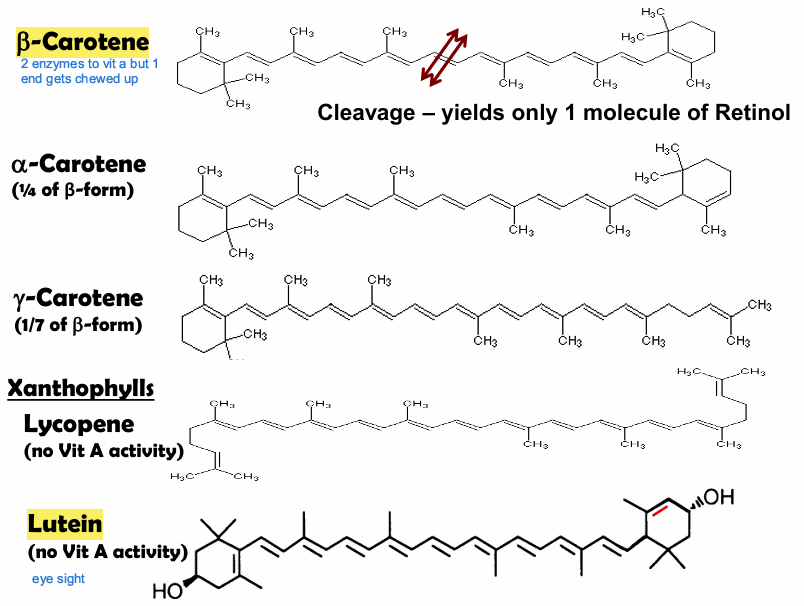
ꞵ-carotene
enzymes → 2 Vit. A but 1 end gets chewed up
lutein
not Vit A activity (eye sight)
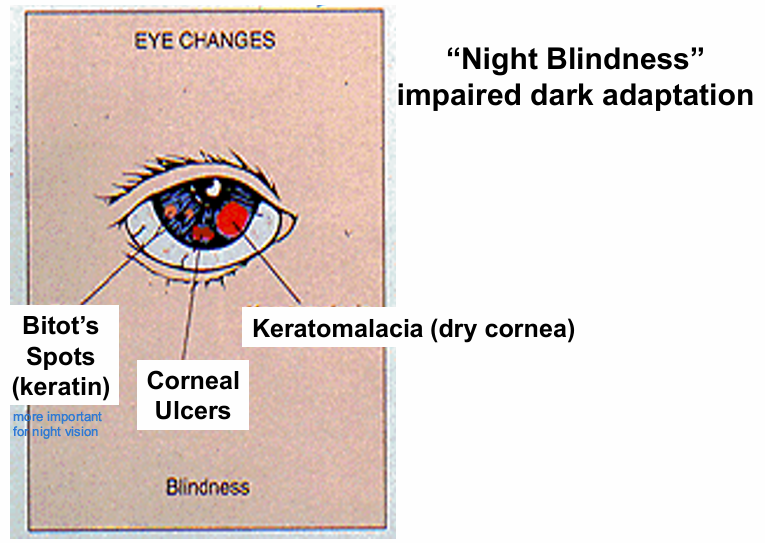
vitamin A eye deficiency
visual cycle
light hits retina → Vit A prominent in rhodopsin (made of opsin & cis retinal) → light breaks it up → splits into opsin & trans-retinal

retinoic acid
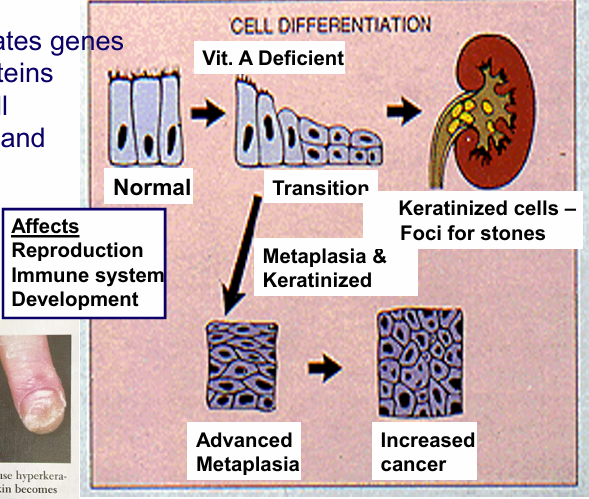
cell differentiation & division
vit A regulates gene coding for proteins needed for cell differentiation & maturation
vitamin A deficiency bulls
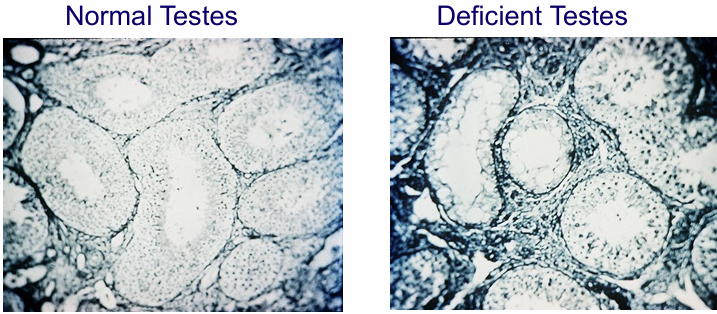
retinoic acid controls meiotic initiation & formation of seminiferous epithelium & regulate spermatogenesis
normal testes
spermatogonia & sertoli cells visible
inwards → maturing spermatocytes & spermatids (precursors of spermatozoa)
deficient testes
sperm production dmg
tubules shrunken
vitamin A deficiency cow
born blind & weak
improper skull growth (retinoic acid)
optic nerves pinched where pass through optic chiasma
vitamin A toxicity
chronic
> 10X RDA over weeks or months
headache, alopecia, dry skin, joint pain
birth defects (teratogen, esp. 13 cis-retinoate)
Acute
> 100X RDA
nausea, vomiting, headache, vertigo, blurred vision, coma, death
vitamin D
body makes vitamin D w/ sun exposure
cholesterol precursor
cheese, butter, margarine, fortified milk, fish, fortified cereals
D3
synthesized in body
cholesterol → cholecalciferol (D3)
7-dehydrocholesterol intermediate
not dietary requirement w/ enough sunlight

D2
synthesized in plants
ergosterol → ergocalciferol (D2)
exposure of harvested green grasses & hays to sunlight

D3 biosynthesis
spin epidermis
cholesterol
liver synthesis, diet sources
7-dehydrocholesterol intermediate
w/ sun → pre-vitamin D
cholecalciferol (D3)
from spontaneous isomerization
→ blood stream
DBP-D3
vit D3 binding protein transports D3 → hepatic cells

vitamin D activation
activation → calcitriol (regulates Ca+ lvls) in KIDNEY
kidney convert calcidiol → calcitriol in response to PTH
parathyroid gland produces PTH in response to ↓ Ca+
master regulator of producing calcitriol
stimulate liver to convert vit D3 → calcitriol in kidney

calcium homeostasis
vitamin D helps maintain Ca+ homeostasis
calcitriol maintains Ca+ balance
↑ Ca+ absorption in s. intestine
↓ excretion by kidneys
↑ resorption in bones
pregnancy & lactation
new bones & tissue growth
milk production

vit D requirement factors
Ca+ & P amt in diet
Ca+ & P ratio in diet (1-2:1)
Ca+ & P availability in diet
physiological status - young animals (growth), lactation, pregnancy
vitamin D deficiency symptoms
all animals
failure of Ca-salt deposited in cartilage matrix
↓ bone calcification
cartilage cells fail to mature
compression of cartilage cells
invasion of cartilage by capillaries (swelling)
Ca & P deficiency
rickets (young) & osteomalacia (old)
tetany (intermittent muscular spasms)
assessment:
Serum 25-OH-D3 , & 1, 25-(OH)2-D3, Ca2+, P, PTH
calcidiol (25-OH-D3) is best indicator of D3 status
tetany
intermittent muscular spasms caused by malfunction of parathyroid glands & Ca+ deficiency
vitamin D toxicity chronic
> 20X required for more than 3 months
over-supplementation (not from too much sun)
calcification of organs (liver damage) and arteries
hypertension
irritable
vitamin D toxicity acute
> 600X required for 1 day
Hypercalcemia
Poor appetite, thirsty, bone pain, tired