business strat chapter 4
 Call Kai
 Learn
 Practice Test
 Spaced Repetition
 Match
 Flashcards
 Knowt Play
1/17

Earn XP
Description and Tags
sustaining competitive advantage
18 Terms
sustaining CA
superior performance persists only if rivals cannot easily identify, diagnose, acquire, or neutralise the source of advantage
it is uneven across firms & over time
competition tends to erode excess returns unless something blocks imitation or entry
why profits regress toward the mean over time
entry
imitation
price competition
innovation
luck fades
Mueller’s sample of convergence
shows convergence, not full equalisation
competitive forces push firms toward the competitive RoR → other forces impede that dynamic
net result: persistent ROA gap between initially high & low profit firms
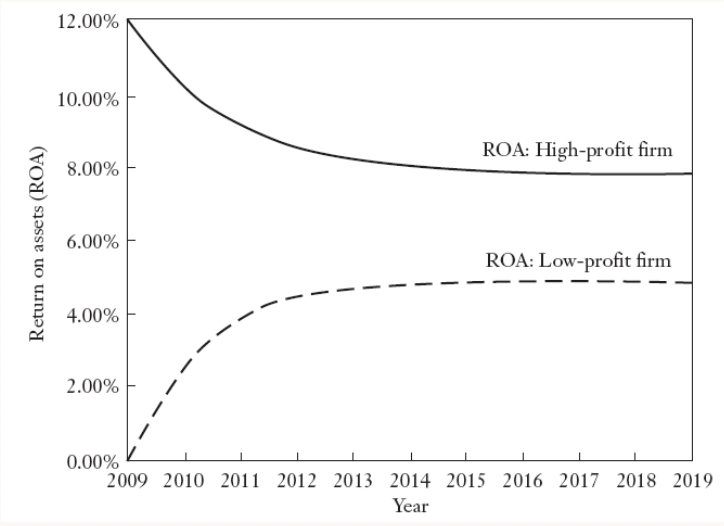
resource-based theory of why some advantages persist
sustained advantage depends on persistent differences in resources & capabilities
firms differ in resources & capabilities → can persist over time
heterogeneity supports superior performance
2 paths to sustainability
resources & capabilities remain different
isolating mechanisms protect the advantage
they function like entry barriers at the firm level
sources of sustainable CA (8)
loyalty
location
locked-up supply: few or new alternatives in the supply of a key product or service
innovation
intellectual property: proprietary formulas, processes, patents, & protected know-how
property info: knowledge, process data, customer history, & other private info
scale
network effects
3 conditions resources must satisfy for sustained advantage
scarce: not widely available to competitors
imperfectly mobile: difficult to transfer, buy, or redeploy across
unavailable in the open market
types of resources & indicators
financial: borrowing capacity, internal funds generation, debt/equity, credit rating
physical: plant & equipment, location, tech, scale of plants
tech: patents, copyright, know-how, R&D, R&D staff & expenditure
reputation / human: brand equity, customer retention, employee qualification
resource categories: tangible, intangible, & HR
what makes a resource valuable?
when demand, scarcity, & appropriability reinforce each other
3 market forces define value creation zone
demand: does it meet customer needs? is it competitively superior?
scarcity: is it imitable or suitable? is it durable?
appropriability: who captures the profits created by the resource?
resource imitability
easy: cash, commodities
can be imitated: capacity pre-emption, EOS
difficult: loyalty, favourable cost position, employee satisfaction, rep for fairness
can’t: patents, unique location & assets
isolating mechanism
limits rivals’ ability to erode a firm’s advantage
firm with the advantage tries to disrupt process imitation process through isolating mechanism
process imitation
identification: recognise that a rival has a CA
incentives: have a reason to imitate that advantage
diagnosis: understand the sources of the rival’s advantage
resource acquisition: obtain resources & capabilities needed to imitate
impediments to imitation
prevent rivals & potensh entrants from duplicating resources & capabilities behnd the advantage
eg. legal restrictions, superior access, scale barriers
early-mover advantages
increase economic power of an advantage once the firm has it
eg. learning curve, rep, switching costs, network effects
impediments to imitation
legal restrictions
superior access: exclusivity
scale economies: may weaken if the market grows
learning & reputation
learning curve: early sales move the firm further down the learning curve
lower unit costs allow price pressure, volume growth, more learning
rep & buyer uncertainty: for experience goods, a rep for quality reduces perceived risk
pioneering brands can shape category preferences
brand becomes an isolating mechanism
switching costs & networks
switching costs: buyer incurs costs if they change supplier
network effects: customer value depends on how many others use the product
direct: social networks
indirect: operating systems, gaming, smartphones