Endo Exam 1: Lewis Testosterone (Simplified)
 Call Kai
 Learn
 Practice Test
 Spaced Repetition
 Match
 Flashcards
 Knowt Play
1/36

There's no tags or description
Looks like no tags are added yet.
37 Terms
Clinical presentation of hypogonadism in adulthood
Early signs and symptoms
Decreased _____, decreased _____
_____
Over time, men with hypogonadism can develop:
ED
_____
Decrease in hair growth on the face and body
Decrease in muscle mass
Development of breast tissue (gynecomastia) → Spironolactone
Loss of bone mass (osteoporosis)
Severe hypogonadism
Difficulty concentrating
_____
sex drive, energy, depression, infertility, hot flashes
Indications for testosterone replacement
Hypogonadism (men)- “failure of testes to produce physiological levels of testosterone… due to disruption of ≥1 levels of the hypothalamic-pituitary-testicular axis”
Primary- _____ T; _____ gonadotropin → not enough testosterone produced
Secondary- _____ T; _____ gonadotropin
Mixed- _____ T; _____ gonadotropin levels
Males > _____ y/o
“andropause” or “male menopause”
Low, high, Low, Low-normal, Low, variable, 40
AUA Guideline
“recommend testosterone therapy for men with _____ testosterone deficiency to induce and maintain secondary sex characteristics and correct symptoms of hypogonadism after discussing the potential benefits and risks of therapy and of monitoring therapy…”
“aim to achieve testosterone concentrations in the mid-normal range during treatment with any of the approved formulations, taking into consideration patient preference, pharmacokinetics, formulation- specific adverse effects, treatment burden, and cost.”
“use a total testosterone level _____ ng/dL as a reasonable cut-off in support of the diagnosis of low testosterone”
“low testosterone should be made only after _____ total testosterone measurements are taken on separate occasions with both conducted in an _____ fashion”
“diagnosis of testosterone deficiency is only made when patients have _____ combined with _____”
symptomatic, <300, 2, early morning, low levels, S/Sxs
TRAVERSE study
In men with hypogonadism and preexisting or a high risk of CVD testosterone-replacement therapy was noninferior to placebo with respect to the incidence of major adverse cardiac events
KNOW
Current State
2025 → class-wide labeling change (implemented)
Added a warning about increased BP
Removed the prior language on elevated risk of adverse CV outcomes
Retained the "limitation of use" language stating that safety and efficacy have not been established for men with low T due to aging
2026 → proposal (pending, not yet finalized)
HHS is seeking further labeling revisions through FDA
Removing the long-standing limitation that safety/effectiveness have not been established for age-related hypogonadism
Narrowing the prostate cancer contraindication to men with metastatic prostate cancer only, while still recommending screening and monitoring
Updating the BPH warning to reflect that T does not worsen symptoms in most men
Proposal remains controversial; experts divided if current evidence justifies broader prescribing
KNOW
Oral testosterone products
Capsule: Testosterone Undecanoate
_____®
_____®
_____®
_____®
NOT SUBSTITUTABLE
Kyzatrex, Undecatrex, Jatenzo, TIando
Intramuscular testosterone products
Parenteral (IM)
_____ (Azmiro®): 100 mg/mL; 200 mg/mL
_____: 200 mg/mL
Undecanoate (Aveed®): 750mg/3mL
linked to _____.
_____ carries BBW for pulmonary oil microembolism (POME) reactions (cough, SOB, chest pain, anaphylaxis)
Cypionate, Enanthate, mood swings, Undecanoate
Subcutaneous testosterone products → SQ and SQ Implant
SQ testosterone _____ (_____) → Once weekly
SQ testosterone _____ (_____)
Testosterone _____ 75 mg (Testopel®)
Two to six 75 mg testosterone pellets every 3-6 months
ADR: pellet extrusion, infection, and fibrosis
Not routinely recommended
Enanthate, injection, enanthate, implantation, pellets
Nasal testosterone products
Nasal
_____® (1 pump per nostril _____)
5.5 mg per actuation
ADR:
_____ (_____, _____, nasopharyngitis)
Natesto, TID, Nasal irritation, nosebleed, rhinorrhea
Oral (_____) —> Capsule (Jatenzo, Kyzatrex, Undecatrex, TIando)
IM (_____)
Ethanthate, Cypionate (_____, _____) —> _____ or q_____
Testosterone Undecanoate (_____) —> Bolus, Repeat after 4 weeks, every 10 weeks thereafter
SQ Injection (_____) —> Solution (_____)
SQ Pellet (_____) —> Pellet (_____)
Intranasal (_____) —> Gel (_____)
BID, Solution, Azmiro, Depo-T, weekly, 2 weeks, Aveed, once weekly, Xyosted, 3-6 months, Testopel, TID, Natesto
Topical testosterone products
Topical: Gel
_____® Pump
_____®
_____® Pump
_____®
Generics
AndroGel, Testim, Vogelxo, Volgelxo
Counseling points for topical products
Transdermal products
Applied in the _____
_____ for secondary exposure – cover application site w/ clothing
Avoid swimming, showering, or washing administration site for _____ application
AM, BBW, 2-5 hours after
Transdermal Solution Applied to _____ (apply deodorant _____)
axilla, 1st
Testosterone products
Controlled substances (Schedule-_____)
C/I
Men with _____
_____
BBW
_____: Risk of 2° exposure to children → virilization
_____: pulmonary oil microembolism reactions (POME)
_____: Oral undecanoate (Kyzatrex®, Tlando®, Undecatrex®)
3, breast or prostate cancer, pregnancy, Topical Gel/Solutions, Undecanoate Injection, Increased BP
Testosterone products
C/I (product specific)
Age-related hypogonadism: Tlando®, Undecatrex®, Kyzatrex® (oral TUK)
Serious cardiac, hepatic, or renal disease: _____
Breastfeeding: _____®, _____
Warnings/Precautions
_____ esp in cancer pts
Depression
Hepatic/renal impairment
Sleep apnea
Patients >65 y/o (older adults)
Depo-T, Natesto, Transdermal Solution, HyperCa
Adverse effects: Testosterone products
Potential adverse effects
↑ _____
↑ _____ and worsen _____
Fluid retention
_____
_____ (↑ TG; ↓ HDL)
Polycythemia (Increased hematocrit)
_____
prostate specific antigen (PSA), BPH, LUTS, Increased BP, Hyperlipidemia, Gynecomastia
Metabolic effects of testosterone → KNOW THIS!!
↑ _____
↑ _____
↑ _____; ↑ _____
↓ _____
↑ _____
↑ _____; ↓ _____ → with very high doses
Insulin sensitivity, glycemic control, lean body mass, muscle mass, SQ fat, bone density, TGs, HDL-C
Diagnosis of hypogonadism
Requires _____ + confirmed hypogonadism (_____)
_____ total testosterone levels required for confirmation (_____)
Total testosterone (_____ ng/dL)
Levels drawn in _____
Measure free testosterone, when total testosterone concentrations are near the lower limit of the normal range (_____ ng/dL)
Sxs, low testosterone, 2, different times, <300, AM, 200-400
Do not initiate testosterone
_____ (CI)
PSA
_____ ng/mL → DO NOT INITIATE
_____ ng/mL IF high-risk for _____ → DO NOT INITIATE
Severe _____
Suggests _____
Severe LUTS symptoms (score >_____) next slide
Erythrocytosis (hematocrit >_____% or >50% at high-altitude)
Untreated severe obstructive sleep apnea (OSA)
_____
Recent (<_____) → _____
Hypercoagulable state (Factor X → Blood Clot (_____))
Prostate/Breast Cancer, >4, >3, prostate cancer, LUTS, BPH, 19, 48, uncontrolled HF, 6 months, MI/Stroke, DVT
Testosterone replacement: Monitoring for Generally All Products
Baseline
_____ levels
_____
_____ (Hematocrit)
_____ function → Monitor
_____ (ASCVD risk) → Monitor
_____
testosterone, PSA, CBC, Liver, Lipids, BP
Testosterone replacement: Monitoring for Generally All Products
6-12 months once stable
_____ levels* → Varies by PRODUCT
_____ (Hematocrit)
_____* → Varies by AGE
Liver function
Lipids
_____
testosterone, CBC, PSA, BP
Testosterone replacement: Monitoring for Generally All Products
3-months
_____ levels* → Varies by PRODUCT
_____
_____ (Hematocrit)
Liver function
Lipids
_____
testosterone, PSA, CBC, BP
D/C testosterone if
PSA
Increase >_____ ng/mL from baseline
PSA >_____ ng/mL
Substantial worsening of _____
Hematocrit >_____%
_____®, _____®
d/c if total serum testosterone consistently outside normal range
Adjust testosterone dose ↑ or ↓ based on dose/product
1.4, 4, LUTS, 54, Natesto, TIando
Oral → _____ dose for peak level only
IM → _____ Level before 4th dose (_____) or Just BEFORE each injection/measure halfway bwtn _____ dosing interval of 1st + 2nd dose (_____)
Transdermal Gel → Depends on formulation, Just before AM dose 2–4 weeks after start of therapy or after dose adjustment, Concentration _____, At Least _____ must be checked, Lab draw _____ of application
2-3 hours after, midpoint/trough, Cypionate, 10-week, Undecanoate, varies, 2 levels, not on same arm
Length of testosterone replacement therapy
Discuss cessation _____ starting treatment
If T level _____ but s/sx _____
3-6 months after, normalizes, do not improve
Case 1
LM is a 69-year-old man who presents to his primary care physician with a chief complaint of low sex drive and flat/low mood. Based on these symptoms, his PCP checks a serum testosterone level (result = 156 ng/dL; reference range=250-850 ng/dL).
PMH- hypertension, gout
Objective: Vitals (today): BP=132/74 mmHg; HR=84 bpm; Wt=191 lbs. BMI= 26.3 kg/m2
Does this patient meet the diagnosis of hypogonadism? (why or why not)
They only have _____ (need _____)
Need to know _____
Need to know if lab draw was in the _____
1 serum testosterone level, 2, Sxs, AM
Case 1 follow-up
Additional lab testing confirms the diagnosis of hypogonadism. Both the patient and clinician agree that testosterone therapy is appropriate to improve this patient’s symptoms of hypogonadism.
Before initiating any testosterone product, what baseline parameters do we need to assess?
Get _____ → measure _____ (ensure it’s not above _____%)
D/C if above _____
Testosterone worsens Severe _____
PSA
Increase >_____ ng/mL from baseline
PSA >_____ ng/mL
Substantial worsening of _____
CBC, hematocrit, 48, 54, LUTS, 1.4, 4, LUTS

Case 2
Based on vitals/lab values above, any contraindications to initiating testosterone replacement therapy in this patient?
LUTS = _____
_____% → >_____% so DO NOT INITIATE (Erythrocytosis)
3, 49, 48
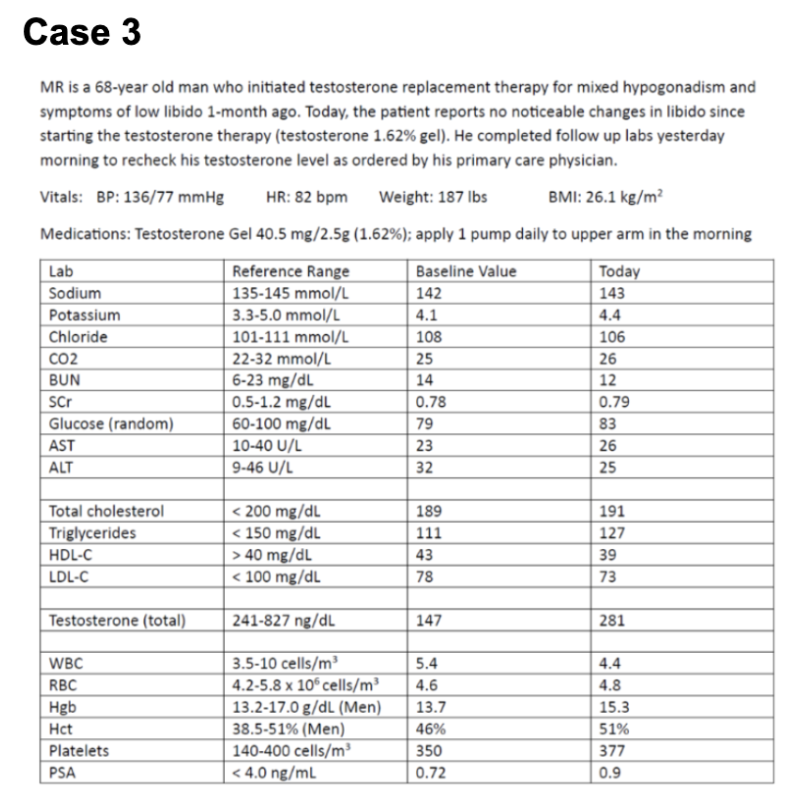
What would you want to know about the lab draw for MG?
On Gel → _____ before blood draw? Check level _____ they apply OR check levels after _____ from application
What specific adverse effects would you assess related to MR’s testosterone replacement therapy?
Increase in _____
_____
_____ (_____)
Based on the lab results and vitals, make a recommendation for MR’s testosterone therapy?
_____ bc need _____ for gels
_____ looks okay, but hematocrit went from _____ → _____ = OKAY TO CONTINUE (STOP IF >_____)
when did he apply the gel, before, 2 hours, BP, mood changes, fluid retention, ankle swelling, No changes, 2 levels, PSA, 46, 51, 54
Case 4
FG is a 71-year-old male who switched from testosterone axilla solution 60 mg daily to testosterone cypionate 100 mg every 2 weeks. The patient’s PCP has ordered labs to check FG’s testosterone level since starting testosterone injections. FG used to get his testosterone levels checked 2-hours after applying the solution. He is asking you when he should get the new testosterone labs completed and if the time of the day matters?
How would you respond to FG’s request about the best timing to recheck his testosterone labs since switching products?
Check in the _____
Check his levels drawn → _____ of dosing interval to measure _____ level right before the _____ dose (Testosterone Cypionate)
AM, Midpoint, trough, 4th
Summary
Reasonable to treat men for age-related hypogonadism in the setting of documented low T and Sxs
Absolute C/Is and lab values for which testosterone should not be initiated
Follow-up monitoring required to adjust dose and identify those who should not continue treatment
Adverse effects may limit treatment
Uncertain risk of DVT
No increased risk of MI, stroke, but must monitor BP with all products
KNOW
Terminology
Gender / Gender identity: A person’s _____ sense of self and how they fit into the world, from the perspective of gender.
Sex: Historically has referred to the _____, based on assessment of _____ genitalia, as well as chromosomes and gonads.
Gender expression: The outward manner in which an individual expresses or displays their gender.
Transgender: A person whose gender identity differs from the sex that was assigned at birth.
A transgender _____ is someone with a male gender identity and a female birth assigned sex;
A transgender _____ is someone with a female gender identity and a male birth assigned sex.
internal, sex assigned at birth, external, man, woman
Gender affirming care
Feminizing hormone therapy (male → female; transgender _____)
_____ + _____
Masculinizing hormone therapy (female → male; transgender _____)
_____
woman, estrogen, androgen blocker, man, testosterone
Testosterone for transgender males: Monitoring
Hemoglobin/Hematocrit changes (male reference range)
KNOW
Example: A transgender man, receiving testosterone masculinizing therapy has a 3-month follow-up Hct value of 49%.
Should this patient discontinue testosterone therapy?
_____ → flagged bc it’s _____ range, BUT use transgender _____ reference
No, above female, men
Normal testosterone values men vs women
Normal physiologic testosterone range (male/transgender man): _____ ng/dL (need more testosterone → use reference range)
300-1100

What changes would you recommend to the patient’s current testosterone treatment?
_____ bc they identify as _____ → go off of _____ levels for _____ (reference range: 250–827)
Male: HGB = 13.2 –17.1 and HCT = 38.5–50.0
No, male, testosterone, males