Free Market Systems exam 2
 Call Kai
 Learn
 Practice Test
 Spaced Repetition
 Match
 Flashcards
 Knowt Play
1/45

There's no tags or description
Looks like no tags are added yet.
46 Terms
What is a Firm’s goal?
To maximize Profit
How to calculate profit
Total Revenue-Total Cost
How to calculate total revenue?
Price 1 x Quantity 1 + Price 2 x Quantity 2
What are explicit costs
These are costs that require a firm to spend money.
implicit costs
Costs that represent opportunities that could have generated revenue if the firm resources in another way
What are accounting Profits+ how to calculate it
when companies report their profits, Accounting profit = Total revenue - Explicit costs
What are economic profits
Profits that account for implicit costs+ Economic profits=Accounting profit-Implicit cost
What is a production function
the relationship between quantity of inputs and resulting quantity of outputs
What’s marginal product
an increase in output generated by addition unit of input
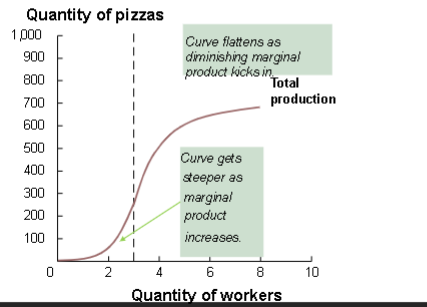
What is this graph for?
Production function
how to calculate total costs?
Fixed costs + Variable costs
What are Fixed and Variable costs
Fixed costs are costs that stay the same, while variable changes depending on quantity of output produced
How to calculate Marginal Costs
Change in total cost/ change in quantity
How to calculate AFC
Fixed cost/Quantity
how to calculate AVC
Variable cost/quantity
how to find average total cost ATC
AFC+AVC
In the long run, what will happen to fixed costs?
They may be adjusted
What is the Critical Path method (CPM)
A method that allows you to build a crucial path to determine the minimum time required to complete the projects
What is Value chain
Broader set of activities and relationships involved to deliver value to customers
What is vertical intergration?
an activity internally performed that could be performed by another organization
What is Outsourcing?
an arrangement for another organization to perform an activity
What is offshoring?
Moving production or activities to another country
What are charateristics of a competitive market
Participants are price-takers, Standardized goods, Full information, no transaction costs
If marginal revenue exceeds marginal cost,
the firm should increase its output
If marginal cost exceeds marginal revenue
the firm should decrease its output.
At the profit-maximizing level of output
marginal revenue equals marginal cost.
If a firm is making decision in the short run
They only think whether should produce anything or just shut it down. Depends on variable costs, not fixed costs. They should produce if TR – VC > 0, They should shut down if TR – VC < 0. Hence, they should produce if P – AVC > 0.
If a firm is making decision in the long run
They think whether they should stay in the industry or exit.

What is this graph for?
Shutdown rule for short run
Long run
they should produce if P – ATC > 0, They should continue to stay in the market and produce if TR – TC > 0. They should exit if TR – TC < 0.

What graph is this for?
Long run supply curve
If positive economic profits exist P>ATC (Long Run)
New firms enter the market to earn profits, Market supply curve shift outwards until P=ATC
the demand for a perfectly competitive good increases; what happens in the short
and long run?
Increase in demand shifts the demand curve right= Equilibrium price and quantity increase. This causes new firms to enter so supply shifts to the right decreasing price and increasing quantity
If economic profits are positive
firms enter the market and the supply shifts outward until profits are zero.
If economic profits are negative
firms exit the market and the supply shifts inward until profits are zero.
What is an Monopoly?
a firm that is the only producer of a good or service with no close substitutes.
If a firm is a perfect monopoly
if it controls the whole market
if a firm has monopoly power then
it can manipulate price
What are barriers to entry that prevents other firms from entering the market
Scarce resources, Government intervention, Economies of Scale, Aggressive Business Tactics
When a monopolist produces more of a good
the market price is driven down.
Total Revenue is maxed out for monopolies when
MR=0

What is this graph for?
Monopoly Revenue

What is this graph for?
Monopoly profit maximization= Profit Maximation is point B at MR=MC, you find price by finding where it meets demand

Where to find profit from monopoly profit maximization graph
Shade from the right of price between vertical distance of A and B
What is price descrimination?
the practice of charging customers different prices for the same good. The more Monopoly Power it has the more it’s able to discriminate
Monopolistic competition
many firms that sell similar, but differentiated, goods and services.