Day 5 - Roller Chain & Sprocket, Belts, Bearings
 Call Kai
 Learn
 Practice Test
 Spaced Repetition
 Match
 Flashcards
 Knowt Play
1/63

There's no tags or description
Looks like no tags are added yet.
64 Terms
Roller Chain & Sprocket: Designation (RCXY)
RC = Roller Chain
X → Pitch = 1/8 X ; inches
Y = 0 usual proportion = 1 lightweight = 5 roller-less
Roller Chain & Sprocket: Designation Silent Chain
SCXY ; wherein Silent Chain = Inverted Tooth
Roller Chain & Sprocket: Subscript Numbering Designation
1 = smaller sprocket
2 = larger sprocket
Roller Chain & Sprocket: Estimation formula for the Chain Pitch
p = pitch in inches
N = speed in rpm
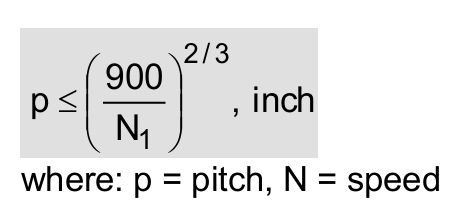
Roller Chain & Sprocket: Sprocket Teeth (pitches up to 1 inch)
d = bore in inches
p = pitch in inches
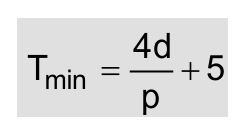
Roller Chain & Sprocket: Sprocket Teeth (pitches up to 1.25 to 2.5 inch)
d = bore in inches
p = pitch in inches

Roller Chain & Sprocket: Sprocket Teeth (Silent Chain)
d = bore in inches
p = pitch in inches

Roller Chain & Sprocket: Angle between two adjacent teeth of sprocket
θ = 360 / T
Roller Chain & Sprocket: Pitch Diameter
p = pitch
N = speed
D1 = pitch diameter of smaller sprocket
D2 = pitch diameter of larger sprocket
T1 = teeth of smaller sprocket
T2 = teeth of larger sprocket
θ = angle between two adjacent teeth

Roller Chain & Sprocket: Pitch Line Velocity
p = pitch
N = speed
D1 = pitch diameter of smaller sprocket
D2 = pitch diameter of larger sprocket
T1 = teeth of smaller sprocket
T2 = teeth of larger sprocket
θ = angle between two adjacent teeth

Roller Chain & Sprocket: Power Transmitted
F = force
V = velocity
T = torque
N = speed

Roller Chain & Sprocket: Length of Chain in pitches
Lp = length in pitches
Cp = center distance in pitches
T2 = teeth in larger sprocket
T1 = teeth in smaller sprocket

Roller Chain & Sprocket: Length of Chain in pitches to Length in Inches
Lp = length in pitches
L = length in inches
p = pitch in inches

Roller Chain & Sprocket: Center Distance in pitches to Center Distance in Inches

Roller Chain & Sprocket: Average Good Center Distance (Standard)
C = D2 + D1/2

Roller Chain & Sprocket: Horsepower Capacity based on Link Plate Fatigue Strength

Roller Chain & Sprocket: Horsepower Capacity based on Silent Chain

Roller Chain & Sprocket: Width of Chain

Roller Chain & Sprocket: Design HP
Design HP = Given HP x Service Factor
Service Factor = 1 if not given
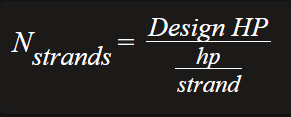
Roller Chain & Sprocket: Number of Strands
Belts: Subscript Numbering Designation
1 = smaller pulley
2 = larger pulley
Belts: Open - Diameter and Speed Relation

Belts: Open - Belt Length

Belts: Open - Angle of Contact or Wrap Angle
(-) = smaller pulley
(+) = larger pulley
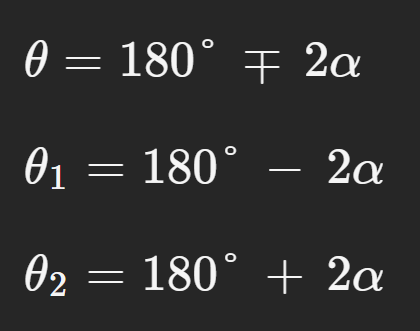
Belts: Open - Alpha
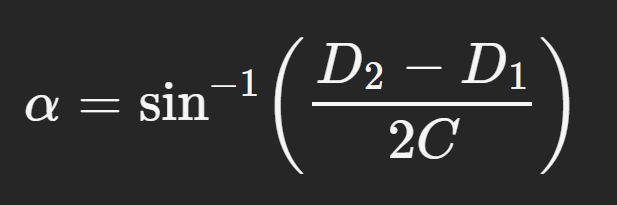
Belts: Crossed - Belt Speed and Diameter Relation

Belts: Crossed - Belt Length

Belts: Crossed - Angle of Contact or Wrap Angle

Belts: Crossed - Alpha

Belts: Open or Crossed - When there is %slip

Belt Tension: Centrifugal Tension is Neglected
F1 = tension in tight side
F2 = tension in slack side
f = coefficient of friction
θ = arc of contact in radians
F1 > F2

Belt Tension: Maximum Tension on Belt
Sd = belt design stress
b = width
t = thickness

Belt Tension: Belt Design Stress
Sd = 400 e
Sd = belt design stress in PSI
e = joint efficiency
Belt Tension: Joint Efficiency
e = 1 for cemented joint = 0.88 wirelace ends = 0.35 ends joined by metal hooked
Belt Tension: Centrifugal Tension is Considered

Belt Tension: Centrifugal Tension
Fc = centrifugal tension
p = belt density
v = belt velocity
b = belt width
t = belt thickness

Belt Tension: Net Belt Pull

Belt Tension: Stress in Belt
Sw = working stress
F1 = tension in tight side
b = belt width
t = belt thickness

Belt Tension: Working Stress for Leather Belts
Sw = 300 PSI for leather belts
Belt Tension: Power Transmitted

Belt Tension: Torque

Belt Tension: When to determine if to consider or not Centrifugal Tension
If specific weight of belt is given, consider Centrifugal Tension
Belt Tension: Density of leather, rubber, and balata belts

V-Belt: Designation (B75)
B = Type
75 = Nominal Length in inches (Ln)
V-Belt: Designation (SPB 1950)
B = Type
1950 = Pitch Length in mm
V-Belt: Pitch Length from Designation
Lp = pitch length
Ln = nominal length
x = type factor

V-Belt: Type Factor (x)
Type A: x = 1.3
Type B: x = 1.8
Type C: x = 2.9
Type D: x = 3.3
x in inches
V-Belt: Belt Length

V-Belt: Center Distance
L = pitch length of belt
C = center distance
D2 = pitch diameter of large pulley
D1 = pitch diameter of small pulley

V-Belt: b

V-Belt: Arc of Contact on Small and Large Sheave

Bearings: Units of Dynamic Viscosity

Bearings: Diametral Clearance
D = diameter (bore) of bearing
d = diameter of the journal

Bearings: Radial Clearance
D = diameter (bore) of bearing
d = diameter of the journal

Bearings: Diametral Clearance Ratio

Bearings: Bearing Pressure
Fr = radial load
L = length of journal inside bearing
D = diameter of bearing

Bearings: Bearing Modulus = Bearing Characteristic Number
BCN = unitless
μ = viscosity in reyns = psi-sec
N = speed in radians / second
P = pressure or unit loading in psi
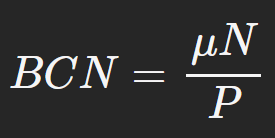
Bearings: BCN if speed changes

Bearings: Frictional Torque (Vallance)
F = force in lbs
fb = bearing friction
D = diameter (bore) of bearing

Bearings: Frictional Torque (Faires)
Tf = frictional torque in lb-in
u = viscosity in reyns
r = journal radius in inch
L = axial length of bearing in inch
ns = journal speed in radians per second
Cr = radial clearance in inch

Bearings: Heat Dissipated (Vallance)
H = heat dissipated in BTU/min
Ch = heat dissipation coefficient of projected area in lb-ft/min-in²
L = length of bearing in inches
D = diameter of bearing in inches

Bearings: Heat Radiating Capacity
Hd = heat radiating capacity in BTU / in² or lb-ft/min-in²
N = speed in rpm
T = torque in lb-ft
L = length in inch
D = diameter in inch

Bearings: Heat Radiating Capacity (Axel K. Pedersen)
Hd = heat radiating capacity in BTU / in² or lb-ft/min-in²
To = operating temperature of bearing in F
Ta = ambient temperaeture of surrounding air in F
k = construction constant

Bearings: Construction Constant (Axel K. Pedersen)
k = 31 (heavy duty)
k = 55 (light duty)