GNED 1301 Exam 2
 Call Kai
 Learn
 Practice Test
 Spaced Repetition
 Match
 Flashcards
 Knowt Play
1/72

There's no tags or description
Looks like no tags are added yet.
73 Terms
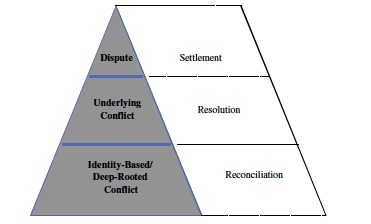
What are the three levels of conflict in the Conflict Transformation Model?
Dispute, Underlying Conflict, and Identity-Based/Deep-Rooted Conflict.

What is a dispute-level conflict?
The obvious, tangible, and immediate components of a disagreement, often involving material issues.

What is an underlying conflict?
A history of unresolved disputes rooted in social and psychological concerns, making losses harder to articulate.

What is an identity-based or deep-rooted conflict?
Conflict involving values, beliefs, cultural heritage, and social-psychological needs central to a person or community's identity.
What are the three forms of conflict transformation?
Settlement addresses disputes, resolution addresses underlying conflicts, and reconciliation addresses deep-rooted conflicts.

How would a dispute-level conflict appear during wolf reintroduction?
Farmers experience livestock losses or broken fences. Settlement could involve compensation.
How would an underlying conflict appear during wolf reintroduction?
Historical distrust between local communities and government agencies. Resolution addresses past grievances.
How would a deep-rooted conflict appear during wolf reintroduction?
Disagreements involving cultural identity, land use, autonomy, and relationships with nature. Reconciliation recognizes these values.

What is a keystone species?
An organism that has a disproportionately large effect on its environment relative to its population abundance.
Why are buffalo considered a keystone species?
They maintain grassland diversity and support other organisms through grazing, wallowing, fertilizing, and other behaviours.

How does buffalo grazing benefit grasslands?
It maintains grassland diversity and prevents certain plants from becoming dominant.

How does buffalo dung benefit ecosystems?
It provides nutrients for insects, fertilizes the soil, and supports seed dispersal.

What are buffalo wallows?
Depressions created by buffalo rolling in the ground that collect rainwater and create small ecosystems.
How do buffalo wallows support other species?
They provide water habitats for amphibians, including spadefoot toads.
How many buffalo historically roamed North America?
Approximately 30 million.

What was the historical range of buffalo?
They roamed across vast portions of North America, from Alaska through the U.S. plains and into Mexico.

Where are buffalo primarily found today?
In localized captive or managed herds, national parks, and specific Indigenous lands.
What happened to prairie ecosystems when buffalo disappeared?
Their absence caused major ecological changes and disrupted important grassland processes.

How does buffalo rubbing behaviour benefit grasslands?
It helps prevent invasive tree growth and woodland encroachment.

How can buffalo help restore sagebrush communities?
Winter dung pelleting helps spread seeds and support sagebrush growth.

What is a cultural keystone species?
A species deeply connected to a community's cultural identity, traditions, spirituality, and way of life.
Why are buffalo considered a cultural keystone species to Indigenous plains peoples?
They are deeply connected to Indigenous beliefs, ceremonies, governance, and social relationships.

What is the Sun Dance?
A ceremony that reflects the spiritual and cultural significance of buffalo within Indigenous traditions.
What is the seasonal round?
The seasonal movement and activities of Indigenous communities that followed patterns of buffalo and the natural environment.
How were Indigenous plains communities connected to buffalo?
Their lifestyles, movements, food systems, cultural practices, and traditions were closely connected to buffalo.

What does it mean that every part of the buffalo was used?
Buffalo provided food, shelter, clothing, tools, and medicines, reflecting an interconnected way of life.

When did large buffalo herds gather during the seasonal round?
During summer, particularly for the rut.

Where did buffalo seek shelter during winter?
Near forested areas.

How were buffalo commonly hunted communally in the fall?
Through communal buffalo jumps.
Why was the seasonal round important?
It allowed Indigenous communities to organize their lives around buffalo movements and seasonal environmental patterns.
Why were buffalo nearly exterminated during the 19th century?
Colonial forces deliberately targeted buffalo to weaken Indigenous populations and force plains communities onto reservations.
Who identified buffalo extermination as a strategy against Indigenous peoples?
General Philip Sheridan.
What was the purpose of destroying the buffalo population?
To destroy the Indigenous food supply and economic independence, weakening resistance to colonial expansion.
What were the material losses caused by buffalo extermination?
Starvation, malnutrition, loss of food, economic power, and land.
What were the immaterial losses caused by buffalo extermination?
Spiritual and cultural trauma, loss of political self-determination, and disruption of intergenerational knowledge.
What is buffalo consciousness?
The awareness, stories, and intergenerational knowledge that develop through regular contact with buffalo.
Why is the physical presence of buffalo important to buffalo consciousness?
Seeing live buffalo helps maintain cultural relationships, traditions, stories, and Indigenous treaties across generations.

What were the original goals of early national parks?
Tourism, nation-building, economic benefits for railways, and securing natural resources.

What role did railway companies play in early national parks?
Companies like the CPR and Northern Pacific benefited economically from tourism and park development.
Was conservation the primary goal of early national parks?
No. Conservation was often accidental rather than the main purpose.

What are the main goals of modern national parks?
Ecosystem protection, biodiversity conservation, and scientific preservation.
How were Indigenous peoples affected by the creation and expansion of early national parks?
They experienced displacement, exclusion, restrictions on traditional activities, and assimilation.

How did early park hunting laws affect Indigenous peoples?
Traditional subsistence hunting was criminalized, while wealthy settlers were often allowed to participate in trophy hunting.
How did early park officials view Indigenous subsistence hunting?
They viewed it as an obstacle to the supposed goal of civilizing Indigenous communities.
How did park expansion contribute to Indigenous assimilation?
It restricted traditional land use, hunting practices, and cultural ways of life.
How did early views of wilderness differ from modern conservation ideas?
Early views emphasized tourism, settlement, and resource usefulness, while modern ideas emphasize preservation and biodiversity.
Why is the history of Banff National Park significant?
Its establishment involved the exclusion of Indigenous peoples, including the Stoney people, from traditional lands and activities.
What does it mean that wilderness is socially constructed?
Ideas about what nature should look like are shaped by human beliefs, values, and priorities.
How did early park managers view predators like wolves and cougars?
They viewed them as threats to valuable game animals and economic resources.
Why did early park managers eliminate predators?
To increase populations of docile game animals that attracted tourists.
How does predator removal demonstrate socially constructed wilderness?
Managers manipulated ecosystems to create a version of nature that matched human preferences.
How were bears treated in early national parks?
They were habituated to humans through garbage-feeding displays and roadside begging.
Why did early bear-feeding displays become a problem?
They encouraged bears to associate humans with food, resulting in injuries, property damage, and safety concerns.
What happened in the 1960s when parks tried to stop bear feeding?
Parks abruptly removed food sources and culled hundreds of stressed bears, failing to address the underlying causes.
What was Night of the Grizzlies?
A 1969 book by Jack Olsen exposing the deadly consequences of poor human-bear management.
How did Night of the Grizzlies influence bear management?
It helped trigger a major shift toward modern, science-based wildlife management.
What did early bear management misunderstand?
Bears were treated like big dogs rather than wild animals with natural behaviours and needs.
What does the evolution of bear management reveal about changing societal values?
A shift from prioritizing tourist entertainment toward wildlife safety, ecological understanding, and science-based conservation.
What relationship has research found between social media exposure and park visitation?
High-social-media-exposure parks experience significantly larger increases in annual visitation than low-exposure parks.
How much higher can visitation increases be in high-exposure parks?
Up to 20% higher compared to low-exposure parks.
How do Instagram and TikTok distort perceptions of national parks?
They promote idealized images while hiding crowds, travel logistics, risks, and everyday realities.
How can social media contribute to visitor safety problems?
Visitors may underestimate risks, arrive unprepared, or attempt dangerous activities to recreate online images.
What does SAR stand for?
Search and Rescue.
How does increased visitation affect national parks?
It contributes to SAR incidents, car accidents, traffic congestion, wildlife harassment, infrastructure strain, and maintenance backlogs.
How can social media contribute to wildlife harassment?
Visitors may approach, disturb, or attempt close-up encounters with wildlife to recreate online content.
How does overcrowding affect park infrastructure?
It places pressure on older facilities, roads, parking areas, and maintenance systems.
Why are social media images sometimes misleading?
They often show isolated, aesthetic locations without showing crowds, accessibility challenges, or safety concerns.
How can visitors use social media more responsibly?
Share realistic experiences, respect wildlife, avoid promoting dangerous behaviour, and encourage responsible park use.
What is fortress conservation?
A conservation approach that excludes or restricts local and Indigenous communities from their ancestral lands to create protected areas.
How does fortress conservation affect Indigenous communities?
It can result in forced displacement, marginalization, and restrictions on traditional land use.
What is the Western idea of untouched wilderness?
The belief that healthy, natural ecosystems should exist without human presence.
How does the film Inhabited challenge the idea of untouched wilderness?
It shows that Indigenous peoples have lived in, managed, and sustained many protected landscapes for thousands of years.
What does Inhabited reveal about the relationship between humans and nature?
Human presence and ecological conservation are not necessarily opposites; Indigenous stewardship has helped shape and maintain healthy ecosystems.