ECON 474 - Midterm 1 Vocab
 Call Kai
 Learn
Learn Practice Test
 Spaced Repetition
 Match
Match Flashcards
 Knowt Play
1/39

There's no tags or description
Looks like no tags are added yet.
Name | Mastery | Learn | Test | Matching | Spaced | Call with Kai | Chat |
|---|
No analytics yet
Send a link to your students to track their progress
40 Terms
Stable unit treatment value assumptions (SUTVA) assumptions
1) No interference - my treatment does not affect your outcome
2) No hidden treatment versions - treatment is well-defined (one “aspirin” is the same as another)
Assignment Mechanism - Randomized Experiment
Assignment is completely random, independent of potential outcomes
Assignment Mechanism - Unconfounded (Ignorable) Assignment
assignment depends on observed covariates but not on potential outcomes
Assignment Mechanism - irregular (confounded) assignment
assignment is correlated with potential outcomes
stratified randomized experiment
Research design that divides participants into distinct, homogeneous subgroups based on key background characteristics before randomly assigning them to treatment or control groups
Paired Randomized experiment
Match units on observed characteristics, randomly assign one in each pair to treatment. Improves power when the matching variable predicts outcomes
Internal validity
study correctly identifies casual effects for the study population
External validity
findings generalize to the broader population of interest


OLS Assumption: Exogeneity
X should not be related the factors in the error term, on average
OLS Assumption: Idependent and identically distributed (I.D.D.)
Independent - one observation should not influence another observation
Identically Distributed - all observations come from the same underlying pop. dist.
OLS Assumption: Variation on the regressor
X must vary across observations
OLS Assumption: Finite fourth moments
X and the error term cannot have extremely heavy-tailed distributions that make their 4th moments infinite
Type 1 error
When you reject a true null hypothesis
Type 2 error
When you fail to reject a false null hypothesis
Power
1 - B; probability that the test correctly rejects H0 when H1 is true
Observational study: Unconfoundedness assumption
There are no unobservable factors that simultaneously determine treatment and potential outcomes
Observational study: Overlap Assumption
within every subclass defined by xi, we must have both treated and control units to make a comparison. If a subclass contains only one group, the treatment effect is not identified there.
norm.diff formula

caliper matching
Match only if propensity scores differ by less than a threshold
Balancing score
A balancing score b(X) is any function of X such that D ⊥ X | b(X). Balance is about whether the groups have enough similar characteristics that regression or matching can credibly adjust for the gap
Balancing Score: Finest
X itself. Conditioning on X trivially balances X.
Balancing Score: Coarsest
It throws away as much information as possible while still balancing.
Balancing Score: In between
any function of X that is at least as fine as p(X) also works, meaning p(X) can be recovered from it. For example, (p(X), one extra covariate) is a balancing score.
norm diff defintion
Measures how many standard deviations apart the group means are, indicating how much the covariate distributions overlap.
t-stat - two sample, unequal variances
t = (X̄₁ − X̄₀) / √(s₁²/n₁ + s₀²/n₀)
t-stat - beta hat
t = β̂ / se(β̂)
(Y(0), Y(1)) L treatment | X
potential outcomes statistically independent of treatment holding covariates fixed
Block-level standard error

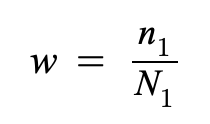
Weight of each block
n1 - number of treated individuals in a block, N1 - total number of treated peopel across all blocks
Overall standard error

Overall avg treatment effect on the treated

Average treatment effect across the entire population

Sum of squared residuals

p-value
Assuming null is true, what is the probability of getting a test statistic at least as extreme as the one observed?
propensity score
P(Di = 1 | X1 = x) - the probability that a person gets a treatment, given their characteristics
When are ATE and ATT equal
when treatment status is determined using random assignment
The logic behind using a propensity score
Suppose you want to know if textbooks improve test scores. You can’t always compare a student who doesn't use textbooks with one who does because they might be different kinds of students with different aptitudes and circumstances that impact their scores. If you take 2 students who both had the same probability of being assigned, you take out how the other factors impact them, and you are able to just look at the effects.
Robust to specification