AGRY 320 Lecture Notes and Exam Prep Unit 2
 Call Kai
 Learn
Learn Practice Test
 Spaced Repetition
 Match
Match Flashcards
 Knowt Play
1/145

There's no tags or description
Looks like no tags are added yet.
Name | Mastery | Learn | Test | Matching | Spaced | Call with Kai | Chat |
|---|
No analytics yet
Send a link to your students to track their progress
146 Terms
In the late 19th century, cytologists observed _______ in cells using a microscope.
Chromosomes.
Genome:
An organism’s unique and complete set of genetic information (DNA) / chromosomes.
Ploidy:
The number of homologous sets of chromosomes in a biological cell.
Diploid (2n):
An organism that contains two complete genomes.
Haploid (n):
An organism that contains one complete genome.
Haploid number (designated n):
The number of chromosomes in a genome.
Homologous chromosomes:
In a diploid nucleus, two members of a chromosome pair.
Mitosis:
Somatic (body) cells divide to increase their number.
Meiosis:
In most eukaryotes, specialized diploid cells (germ line cells/meiocytes) divide to produce sex cells.
When did precise techniques for controlled crossings in domesticated plants and animals to produce desired traits come about.
The 19th century.
Blending inheritance:
Parental traits become mixed and forever changed in offspring.
Why was the “pea” a good choice for genetic experiments?
Easy to grow, and easy to pollinate in a controlled way.
What is a pure-breeding line of pea plants?
A group of plants which are all homozygous for a particular trait of interest.
In Mendel’s experiments, one _____ disappeared in the F1 progeny.
Phenotype.
In Mendel’s experiments, one phenotype disappeared in the F1 progeny, and reappeared in the ____ progeny.
F2.
In Mendel’s experiments, one phenotype disappeared in the F1 progeny, and reappeared in the F2 progeny with a _:_ ratio.
3:1.
Mendel’s Scientific Method:
1) Question, 2) Careful experimental design, 3) Data, 4) Model, 5) Prediction.
Gene:
One of the factors of inheritance that controls a trait.
Alleles:
Alternative forms of a gene (R and r).
Genotype:
A pair of alleles carried by individuals (R/R, R/r, r/r).
Phenotype:
Appearances of genotypes (round, wrinkled).
Homozygote:
An individual who has a genotype that has two identical alleles (R/R, r/r).
Homozygous ______ genotypes are used in testcrosses.
Recessive.
Heterozygote:
An individual who has two alternatives (R/r).
Dominant:
A phenotype appears in F1 of two pure-breeding lines.
Recessive:
A phenotype disappears in F1 of two pure-breeding lines.
Dominant/recessive refers to ____.
Phenotype (traits).
Singel genes control ___ identity in flowers.
Organ.
What is a monohybrid cross?
R/r x R/r
Mendel’s Law of Equal Segregation:
There is equal separation of alleles during gamete formation, and a gamete contains only ONE form of the alleles. At fertilization, gamete fusion is random.
There is equal/unequal separation of alleles during gamete formation, and a gamete contains only ONE form of the alleles.
Equal.
There is equal separation of alleles during gamete formation, and a gamete contains _______ form(s) of the alleles.
Only one.
At fertilization, gamete fusion is _____.
Random.
When the Parents of the F1 generation are R/R and r/r, and the F1 generation is crossed with itself, what is the phenotypic ratio of the F2 generation?
3:1.
When the Parents of the F1 generation are R/R and r/r, and the F1 generation is crossed with the homozygous recessive parent, what is the phenotypic ratio of the F2 generation?
1:1.
The law of equal segregation states:
That members of each pair of alleles of the gene separate equally when gametes are produced in meiosis.
Which of these would be a testcross?
R/r x r/r.
What is the mechanism that ensures Mendel’s Law of equal segregation?
Segregation of sister chromatids (homologous chromosomes) during meiosis I.
Most mutations alter the amino acid sequence of the gene’s product, resulting in _____ or _____ function.
Reduced, absent.
Null alleles:
Protein encoded by them completely lack the PAH function, or the alleles do not encode the protein.
Leaky alleles:
Reduce the level of enzyme function.
Silent alleles:
No effect on protein function.
When the activity of the enzyme phenylalanine hydroxylase is severely reduced or absent, what occurs?
Phenylketonuria (PKU).
Phenylketonuria is ______, meaning both copies of the gene must be mutated for the condition to develop.
Recessive.
Human pedigree analysis:
Deducing single-gene inheritance patterns by the study of the progeny of matings within a family.
Why can’t experimental crosses be made within humans?
1) Small populations, 2) Few individuals.
Human chromosomes =
Diploid 46.
Autosomal recessive disorders:
Phenotypes appear in progeny from unaffected parents (recessive gene).
In autosomal recessive disorders, the affected progeny includes males/females, and they are _______ effected.
Males and females, equally.
Which one is a genetic argument against inbreeding?
Autosomal recessive disorders.
True/false: In autosomal dominant disorders, all of the generation are usually affected.
True.
In autosomal dominant disorders, males/females are affected.
Males and females.

In autosomal dominant disorders, normal siblings of the affected parents ____ transmit the trait.
Do not.
In X-linked recessive disorders, the sons of the affected males are:
Neither affected nor are they carriers.
In X-linked recessive disorders, the daughters of the affected males are:
Carriers (XaXA) and are rarely affected (XaXa).
Red-green color blindness is an example of:
An x-linked recessive disorder.
In x-linked dominant disorders, affect males pass the trait to:
All their daughters.
In x-linked dominant disorders, affect females pass the trait to:
Half their sons and daughters.
Product Rule:
The probability of two independent events both occurring is the product of the individual probabilities.

Two unaffected individuals have a 1/3 carrier risk each. What is the probability they have a child with an autosomal recessive disease?
1/36.

What disorder is described by the image?
Autosomal recessive disorder.
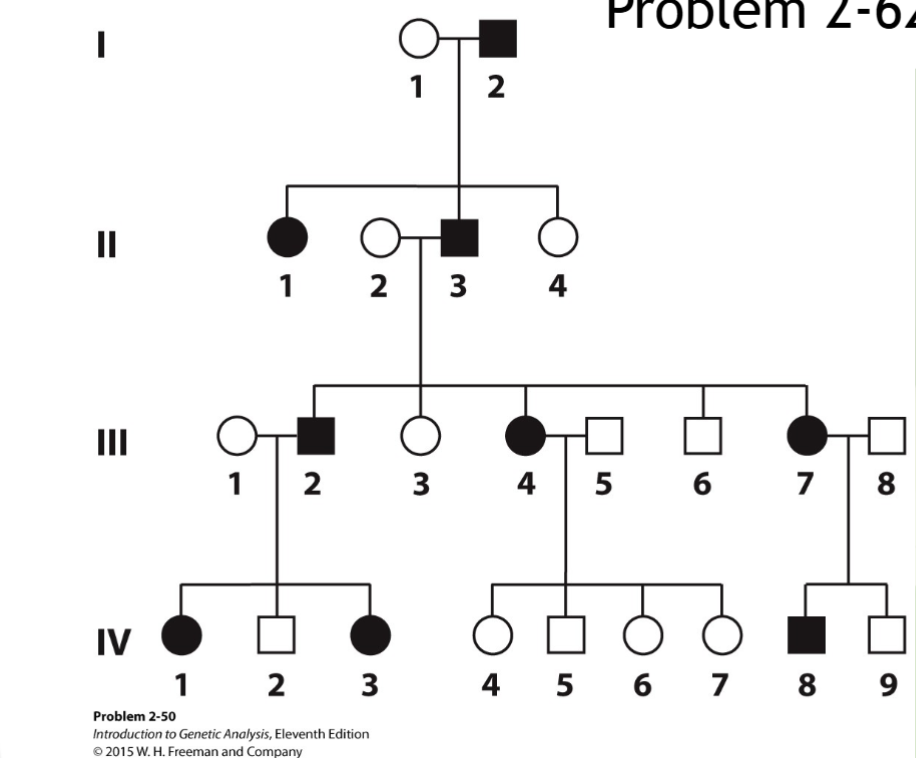
What disorder is described by the image?
Autosomal dominant disorder.
Many human traits have ________ alleles.
Polymorphic.
What determines sex?
The number of X chromosomes, or the presence of Y.
X/X/X/X/X/Y =
Male.
X/null =
Female.
X/X/X/X =
Female.
Y chromosome encodes the _________ factor (SRY, Sex Determining Region Y) and is a dominant activator of the “maleness” pathway.
Testis-determining.
X-linked inheritance:
A trait that is governed by a gene located in the “differential” region of X-chromosome (often has nothing to do with sex).
Hemizygous:
Having only one allele.
Sex linked inheritance was first discovered in:
Drosophila (1910).
Sex linked inheritance was first discovered in Drosophila by ______ in 1910.
Thomas H Morgan (and students).
Drosophila sex is controlled by:
Sex chromosomes.
In drosophila, the eye color is an ___-linked traits that is controlled by an ___-linked gene.
X.
In X-linked genes, the gene:
Does not have a counterpart in the Y chromosome.
True/False: X chromosomes contain many more genes than Y chromosomes.
True.
Sex-linked genes show a single-gene inheritance pattern:
X linkage or Y linkage.
Most observed sex-linked genes are _-linked genes.
X.
Mendel’s 2nd Law:
Law of Independent Assortment.
The ratio Mendel observed from a dihybrid cross:
9:3:3:1.
Mendel’s Second Law:
Different allele pairs sort independently during gamete formation.
Interphase:
Chromosomes are unpaired.
Prophase:
Chromosomes and centromeres have replicated, but the centromeres have not split.
Anaphase:
Centromeres attach to spindle and are pulled to poles of the cell.
What proportion of a progeny will be a/a; b/b; c/c; d/d? To determine this, what rule do we use?
The product rule.
Chi-squared test:
A statistical test to determine the probability of obtaining observed proportions by chance under a specific hypothesis.
If the null hypothesis is false, then the __ statistic will be large
χ2
If the null hypothesis is false, then the χ2 statistic will be _____.
Large.
Mitochondria:
Exist in most eukaryotic cells.
Chloroplasts are unique to:
Plant cells.
Uniparental inheritance:
Progeny inherit organelle genes exclusively from one parent but not the other.
In maternal inheritance, when the mutant female is crossed with a wild-type male, then the progeny are all _____.
Mutant.
In maternal inheritance, when the wild-type female is crossed with a mutant male, then the progeny are all _____.
Wild-type.
Organelle genes:
Eggs contribute the bulk of the cytoplasm, while sperms contribute none.
Organelle chromosomes are located in:
The cytoplasm.
Nuclear genes are transmitted from:
Both parents.
Organelle genes are only transmitted from:
The mother.
Organelle genes are generally inherited maternally and independent of the Mendelian inheritance of nuclear genes.
True.

What inheritance does this image showcase?
Mitochondrial inheritance.

Cytoplasmic segregation:
A population of distinct organelle chromosomes often show segregation of two types into daughter cells at cell division.