Perio 14 - Intro to Peri-implant Health and Disease (Dr. Chinipardaz)
 Call Kai
 Learn
 Practice Test
 Spaced Repetition
 Match
 Flashcards
 Knowt Play
1/56

There's no tags or description
Looks like no tags are added yet.
57 Terms
titanium
What are dental implants typically made of?
Dental implant
Define the following:
An artificial tooth root, typically made of titanium, surgically placed into the jawbone to support a replacement tooth or bridge. It serves as an anchor for dental prosthetics and integrates with the bone through a process called osseointegration.
osseointegration
Define the following:
The direct structural and functional connection between living bone and the surface of a load-bearing artificial implant. In dentistry, it refers to the process by which bone tissue integrates with the titanium surface of a dental implant, providing stable anchorage for a prosthetic dental crown.
- Essential for long-term implant success
- Affects patient's oral health and quality of life
- Prevents complications and implant failure
What is the importance of peri-implant health?
- Peri-implant mucosa
- Junctional epithelium
- Connective tissue
What are the three soft tissue components of peri-implant tissues?
- Alveolar bone
- Osseointegration zone
What are the two hard tissue components of peri-implant tissues?
- Cementum
- PDL
What two periodontal components do peri-implant tissues lack?
longer
Is peri-implant epithelium often shorter or longer?
true
T/F: There are no inserting fibers into the implant surface
less
Is there more or less vascularization between bone crest and junctional epithelium in peri-implant tissues?
natural
Natural tooth anatomy or implant anatomy?
- Bone support includes a periodontal ligament (PDL) with connective tissue fibers (Sharpey's fibers) inserting into the dentin
implant
Natural tooth anatomy or implant anatomy?
- Supporting bone is directly in contact with the surface, with no PDL
natural
Natural tooth anatomy or implant anatomy?
- A connective tissue zone sits above the bone crest
implant
Natural tooth anatomy or implant anatomy?
- Connective tissue fibers run parallel, not inserting into the surface
natural
Natural tooth anatomy or implant anatomy?
- The junctional epithelium attaches to the tooth, with a gingival sulcus lined by sulcular and oral gingival epithelium
implant
Natural tooth anatomy or implant anatomy?
- There is a junctional epithelial attachment and a mucosal sulcus but lined with mucosal epithelium rather than gingival epithelium
True
T/F: In peri-implant health, the tissues are very similar to periodontal tissues
Deeper
Implants generally have a _________ probing depth than natural teeth
Shorter
Interproximal papillae of implants may be __________
- Absence of clinical signs of inflammation.
- Absence of bleeding and/or suppuration on gentle probing.
- No increase in probing depth compared to previous examinations.
- Absence of bone loss beyond crestal bone level changes resulting from initial bone remodeling
What does the diagnosis of peri-implant health require?
peri-implant health
What is the clinical periodontal diagnosis?

peri-implant health
What is the clinical periodontal diagnosis?

peri-implant health
What is the clinical periodontal diagnosis?

peri-implant health
What is the clinical periodontal diagnosis?

peri-implant health
What is the clinical periodontal diagnosis?

Observe for signs of redness, swelling, or other visible changes
What are visual inspections when detecting inflammation at implant site?
plastic
What type of probe is usually used for perio probing at implant sites to assess tissue response and pocket depths?
Digital palpation
Define the following:
Gently feel the tissue for changes in texture or tenderness
peri-implant mucositis
Define the following:
Reversible inflammation of soft tissues around a dental implant
BOP (Gentle probing - May also include erythema, swelling, suppuration)
What is the primary clinical sign of peri-implant mucositis?
peri-implant mucositis
What is the clinical periodontal diagnosis?

plaque accumulation
What is the main cause of peri-implant mucositis?
- Smoking
- Diabetes
- Radiation
What are three modifying factors of peri-implant mucositis?
False (Host response may vary between patients)
T/F: The host response to bacterial challenges is similar among patients
- Presence of bleeding and/or suppuration on gentle probing with or without increased probing depth compared to previous examinations.
- Absence of bone loss beyond crestal bone level changes resulting from initial bone remodeling
What is required for the diagnosis of peri-implant mucositis?
peri-implant mucositis
What is the clinical periodontal diagnosis?

peri-implant mucositis
What is the clinical periodontal diagnosis?
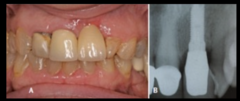
peri-implantitis
Define the following
A plaque-associated pathological condition occurring in tissues around dental implants, characterized by inflammation in the peri-implant mucosa and subsequent progressive loss of supporting bone
peri-implantitis
These are clinical characteristics of?
- Clinical signs of inflammation
- Bleeding on probing and/or suppuration
- Increased probing depths
- Possible recession of the mucosal margin
- Radiographic bone loss compared to previous examinations
probing depth
What correlates with bone loss, indicating disease severity of peri-implantitis?
False - Rate of bone loss progression may vary between patients
T/F: Patients all have similar rates of bone loss progress
peri-implantitis
What is the clinical periodontal diagnosis?

peri-implantitis
What is the clinical periodontal diagnosis?

peri-implantitis
What is the clinical periodontal diagnosis?

true
T/F: For peri-implantitis there is no specific or unique bacteria or proinflammatory cytokines
true
T/F: For peri-implantitis, onset may occur early in folow-up period and progression appears faster than periodontitis
Early detection and intervention
What is KEY when diagnosing peri-implantitis?
strong
Do the following major risk indicators for peri-implantitis have strong evidence, inconclusive evidence or limited evidence?
- History of severe periodontitis
- Poor plaque control
- Lack of regular maintenance care after implant therapy
inconclusive
Do the following major risk indicators for peri-implantitis have strong evidence, inconclusive evidence or limited evidence?
- Smoking
- Diabetes
limited
Do the following major risk indicators for peri-implantitis have strong evidence, inconclusive evidence or limited evidence?
- Submucosal cement post-restoration
- Implant positioning hindering oral hygiene
- Peri-implant keratinized mucosa
- Occlusal overload
- Titanium particles
- Bone compression necrosis
- Overheating
- Micromotion
- Biocorrosion
What are some factors requiring further research of indicators for peri-implantitis?
- Presence of bleeding and/or suppuration on gentle probing.
- Increased probing depth compared to previous examinations.
- Presence of bone loss beyond crestal bone level changes resulting from initial bone remodeling.
What is required for the diagnosis of peri-implantitis?
- BOP and/or suppuration on gentle probing
- Probing depth ≥ 6mm
- Bone levels ≥ 3mm apical of the most coronal portion of intraosseous part of implant
In the absence of previous exam data, diagnosis of peri-implantitis can be based on the combination of what three things?
≥ 6mm
What is the typical probing depth of the diagnosis of peri-implantitis?
Patient education
All of the following fall under what category of prevention and maintenance?
- Importance of oral hygiene for implant longevity
- Proper brushing and flossing techniques
- Use of interdental brushes and water flossers
Professional cleaning techniques
All of the following fall under what category of prevention and maintenance?
- Use of non-metal instruments to avoid implant surface damage
- Air-polishing devices with appropriate powders
- Ultrasonic devices with implant-safe tips
Importance of Regular Check-ups
All of the following fall under what category of prevention and maintenance?
- Recommended frequency of dental visits
- Early detection of potential issues
- Adjustment of maintenance protocol as needed