Finance Exam 1
 Call Kai
 Learn
 Practice Test
 Spaced Repetition
 Match
 Flashcards
 Knowt Play
1/106

There's no tags or description
Looks like no tags are added yet.
107 Terms
Which of the following is an example of an agency problem?
A failure to make an investment that would make shareholders wealthier
B payment of interest to creditors
C payment of income tax to state and federal authorities
D costs incurred for setting up an agency
A
An objection to managing a firm on behalf of stakeholders rather than shareholders is that ________.
A stakeholders have no economic interest in the firm
B there is no clear way to satisfy all stakeholders whose economic interests may be at odds with each other
C the goal of managing on behalf of stakeholders is too narrow
D stakeholders have an interest only in short-term outcomes
B
In a recent quarter, Amazon and Clorox reported nearly identical earnings per share, but the stock price of Amazon was more than six times higher than the Clorox stock price. The most likely explanation for that difference is that ________.
A investors see better long-term prospects for Amazon
B Clorox is bad for the environment
C Amazon has more shares of stock outstanding
D Amazon is a riskier company
A
A financial manager must choose between four alternative equally risky Assets: A, B, C, and D. Each asset costs $35,000 and is expected to provide cash inflows over a three-year period as described below.
Asset | Year 1 | Year 2 | Year 3 |
Asset A | $6,000 | $15,000 | $21,000 |
Asset B | $14,000 | $14,000 | $14,000 |
Asset C | $20,000 | $14,000 | $8,000 |
Asset D | $21,000 | $15,000 | $6,000 |
Based on the wealth maximization goal, the financial manager would choose ________.
Asset A
Asset B
Asset C
Asset D
D
________ pool investment capital, make risky investment decisions, and manage risky investments on behalf of investors who would otherwise not be able to do so own their own.
A Stakeholders
B Stockholders
C Firms
D Regulators
C
Firm A generates more cash flow while taking less risk than Firm B. The stock price of Firm A should be higher than the stock price of Firm B. True or false? Why?
A False. Holding cash flow fixed, investors will pay more for access to riskier investments.
B True. Regardless of risk, investors will pay more for firms that generate more cash flows.
C False. Holding risk fixed, investors will pay more for firms that generates higher cash flows.
D True. Holding cash flow fixed, investors will pay more for shares that are less risky.
D
Common, Inc. has just ended the calendar year making a sale in the amount of $12,000 of merchandise purchased during the year at a total cost of $8,000. Although the firm paid in full for the merchandise during the year, it is yet to collect at year end from the customer. The net profit and cash flow from this sale for the year are ________.
A $4,000.0 and -$8,000.0, respectively
B $4,000.0 and $12,000.0, respectively
C $4,000.0 and $8,000.0, respectively
D $8,000.0 and -$4,000.0, respectively
A
A corporation has received $120,000 in dividends that qualify for the 50% corporate dividend exclusion. Based on the corporate tax rate of 21%, what is the incremental tax liability the corporation must pay on the dividend income?
A $10,000
B $12,600
C $25,200
D $34,800
B
Jacko Corporation expects pretax earnings of $345,000 for the current tax year. Using the U.S. corporate flat tax rate of 21%, compute Jacko’s after-tax earnings if the firm is 100% equity financed versus partially debt financed. In the debt financed scenario, Jacko will have a $50,000 interest expense.
A. $72,450.0; $61,950
B. $233,050.0; $312,050
C. $272,550.0; $233,050
D. $312,050.0; $272,550
C
After college you start a 50/50 partnership business with a classmate that during its first year of operation generates business income of $280,000, all of which is distributed to the partners. If your distribution from the partnership is your only taxable income, what are your tax liability, after-tax income, marginal tax rate, and average tax rate?
A. 26,590; 113,410; 22%; 19.0%
B. 27,680; 113,410; 24%; 19.0%
C. 26,590; 112,321; 22%; 19.8%
D. 27,680; 112,321; 24%; 19.8%
D
You are contemplating starting a new business as either a sole proprietorship or a
corporation. To help you decide, find your final after-tax income you will have from
$69,000 of business income if you organize your business as a proprietorship versus
a corporation. Assume this is your only income.
A) $10,970; $54,510
B) $58,030; $46,334
C) $58,030; $54,510
D) $10,970; $46,334
B
For the year just ended, Overward Corp. had pretax earnings from operations of $1,300,000. In addition, it received $120,000 in interest income from bonds it held in X-Space and it received $70,000 in dividend income from its 8% common stock holding in Up Mars Corp. What is the total tax liability and after-tax income for Overward Corp. for the year?
A. $292,950; $1,219,450
B. $298,200; $1,177,100
C. $305,550; $1,184,450
D. $312,900; $1,149,450
C
(dont forget to add the non-taxed 35k back on at the end!)
Wise Corp. expects earnings before interest and taxes to be $700,000 for the year. Using the corporate tax rate, compute the firm's earnings after taxes and earnings available for common stockholders (i.e., earnings after taxes and preferred stock dividends, if any) if the firm pays $30,000 in interest expense versus $30,000 in preferred stock dividends.
A. $529,300; $523,000
B. $553,000; $523,000
C. $523,000; $529,300
D. $529,300; $553,000
A
As the sole owner of Vessel Corporation, you are considering expanding its operations to boost income, but before making a final decision, you want to calculate the corporate tax consequences of such a decision. Currently, Vessel generates before-tax yearly income of $4,700,000 and has no debt outstanding. Expanding operations would allow Vessel to increase before-tax yearly income to $5,150,000. To finance Vessel expansion you can either cash reserves or new debt financing. If you choose to use debt financing, Vessel will have a yearly interest expense of $290,000. What will Vessel’s after-tax profit be if it financing the expansion with cash versus debt?
A. $3,568,500; $3,555,000
B. $3,555,000; $1,264,000
C. $1,264,000; $3,555,000
D. $4,068,500; $3,839,400
D
Who are investors?
a. Owners
b. Creditors
c. ESOP participants
d. All of the above
D

Subject to the goal of value maximization, all else equal, as a financial manager you would choose ________.
a. investment A
b. investment B
c. investment C
d. investment D
D
There is a tradeoff between risk and return because ________.
a. investors like risk and return and want more of both
b. investors are risk averse and will only accept riskier investments that offer higher returns
c. higher returns are associated with bigger investments, which are always riskier than smaller investments
d. regardless of risk, investors want investments with the biggest returns
B
Marginal cost–benefit analysis refers to ________.
a. the matching principle that financial decisions should be made, and actions taken, only when any business expense incurred is recorded with its related revenues
b. the economic principle that financial decisions should be made, and actions taken, only when the marginal benefits exceed the marginal costs
c. the agency principle that financial decisions should be made, and actions taken, only when managers are acting on behalf of shareholders’ interests
d. the finance principle that financial decisions should be made, and actions taken, only when expected profits are maximized
B
There is a tendency for CEOs of larger companies to earn more money than CEOs of smaller companies. Suppose a CEO decides to acquire another company to justify increasing his compensation. This would appear to be an example of ________.
a. a CEO pursuing shareholder wealth maximization
b. a CEO maximizing stakeholder welfare
c. a principal-agent problem resulting in agency costs
d. the general fact that acquisitions are not good investments
C
Peter Strong is the sole proprietor of Argaiv Software, and from that business he earned taxable income of $300,000.
If Peter is single and this is his only source of income, then based on the 2020 Federal tax rates for individual taxpayers: what is his marginal tax rate, his total tax liability, his after-tax income, and his average tax rate?
marginal tax rate = 35%
total tax liability = $79,795
after-tax income = $220,205
average tax rate = 26.6%
Instead of a sole proprietorship, assume Peter organized Argaiv Software as a corporation that in 2020 generated taxable income of $300,000 and paid all after-tax income to Peter as a dividend.
If Peter is single and this is his only source of income, then based on the 2020 corporate tax rate of 21% and Federal tax rates for individual taxpayers what is Peter’s total tax liability and after-tax income?
total tax liability = $99,956
after-tax income = $200,044
The term “double taxation” means that ________.
a. corporations pay tax on the business income and then shareholders pay tax on the distributions they receive
b. partnerships and sole proprietorships pay business tax on income and then the owners pay personal taxes on the business distributions
c. the highest federal income tax rate faced by corporations is twice the highest tax rate faced by individuals
d. corporations pay tax on the interest paid to bondholders and then bondholders pay tax on the interest income they receive
A
The tax deductibility of various expenses, such as general and administrative expenses, ________.
a. increases a firm’s pretax cost
b. has no effect on a firm’s after-tax profit
c. has no effect on a firm’s pretax profit
d. reduces a firm’s after-tax cost
D
A corporation has pretax earnings from operations of $800,000 and interest income of $140,000 from bond investments. Using the 21% corporate tax rate, what is the company’s corporate tax liability and after-tax income?
Corp tax liab = $197,400
Corp. ATI = $742,600
A corporation has pretax earnings from operations of $800,000 and interest income of $140,000 from bond investments. Instead of interest income from bonds, the company has $140,000 in dividend income from stock investments that is eligible for the 50% dividend exclusion, what is the corporate tax liability and after-tax income?
Corp tax liab = $182,700
Corp. ATI = $757,300
Equity Corporation currently has no debt and generates pre-tax annual income of $400,000. It is considering expanding operations to increase pre-tax annual income to $580,000. EC can either use cash reserves or debt to finance its expansion. If EC uses debt, it will have a yearly interest expense of $90,000.
How do the after-tax earnings compare under these two scenarios?
Debt = subtract interest expense up-front, no debt = no interest expense

After college you start a 50/50 partnership business with a classmate that during its first year of operation generates business income of $160,000, all of which is distributed to the partners. If your distribution from the partnership is your only taxable income, what are your after-tax income and average tax rate?
a. $66,610; 16.7%
b. $127,521; 20.3%
c. $127,521; 24%
d. $66,610; 22%
A

You are contemplating starting a new business as either a sole proprietorship or a corporation. To help you decide, find the difference in personal after-tax income you will have from $75,000 of business income if you organize your business as a proprietorship versus a corporation. Assume this is your only income.
a. $14,599
b. $3,460
c. $12,348
d. $15,310
C

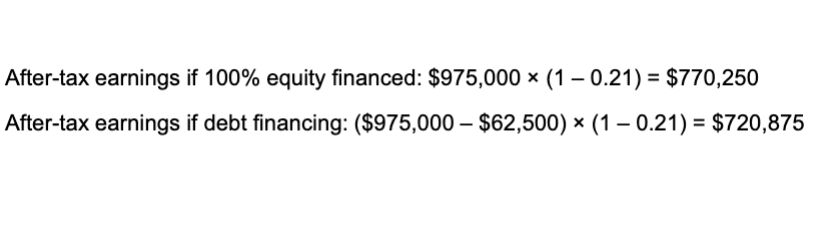
For the current tax year, Runa Corporation expects pretax earnings of $975,000 for the current tax year. Using the U.S. corporate flat tax rate of 21%, compute Runa’s after-tax earnings if the firm has no interest expense versus a $62,500 interest expense.
a. $720,875; $720,875
b. $720,875; $770,250
c. $770,250; $770,250
d. $770,250; $720,875
D
A U.S. corporation has generated $1.02 million in operating income. The company also received $94,000 in interest income and $360,000 in dividend income. What is the company’s after-tax profit?
a. $1,202,260
b. $1,164,460
c. $1,382,260
d. $1,022,260
A

In the USA, the first $______ of deposits in an account at an FDIC-insured depository institution is covered dollar-for-dollar, principal plus any interest accrued or due the depositor.
A $300,000
B $200,000
C $350,000
D $250,000
D
Which of the following is not the function of Investment banks?
A. Provide savers with a secure place to deposit or save funds for future use.
B. Advise firms on major transactions such as mergers or financial restructurings
C. Engage in trading and market-making activities
D. Assist companies in raising capital
A
Firms that wish to raise funds for investment purposes issue securities in the
A. primary and secondary markets.
B. primary markets.
C. secondary markets.
D. intermediary markets.
B
Which of the following is true of a dealer market?
A. Brokers execute the buy or sell orders in a dealer market.
B. Buyers and sellers are never brought together directly.
C. It has centralized trading floors.
D. It is a part of the broker market.
B
Famous for their aggressive product placement/advertising in movies like Disney’s Avengers: Endgame, Rocket Mortgage by Quicken Loans is a non-depository institution that engages in mortgage lending, much like a traditional bank. This is an example of:
A. Commercial banking system.
B. Investment banking system.
C. Shadow banking system.
D. Central banking system.
C
Japanese conglomerate, Softbank, runs Vision Fund; the world’s largest _______ fund, pooling capital from individual investors to make private equity investments in small, private firms operating in the technology, energy, and finance industries.
A. angel investment
B. venture capital
C. mutual
D. exchange traded
B
A market that establishes correct prices for the securities that firms sell and allocates funds to their most productive uses is called a(n) ________.
A. future market
B. forex market
C. efficient market
D. weak-form market
C
Urla Inc. sold 11,000,000 shares of stock in its IPO at an offer price of $19.00 per share. After the first day of trading on the secondary market, Urla’s closing price was $24.41 and it had 18,500,000 shares outstanding. What Urla’s IPO underpricing and market capitalization?
A. 22.16%; $451,585,000
B. 22.16%; $351,500,000
C. 28.47%; $451,585,000
D. 28.47%; $351,500,00
C
A firm conducting an IPO of common stock sold 1,100,000 new shares in the offering and upon completion of the offering had 5 million shares outstanding. The offer price was $11.00 per share and the price of those shares in the secondary market was $13.00. If the underwriter discount was 7.00%, what were the total proceeds and net proceeds?
A. $14,300,000; $11,253,000
B. $12,100,000; $11,253,000
C. $14,300,000; $13,299,000
D. $12,100,000; $13,299,000
B
You own 700 shares of Coke that you have decided to sell through your TD Ameritrade brokerage account that charges a commission of $8.50 for broker-assisted trades. Suppose that your total transaction costs for selling your shares with broker assistance is $57.00, what was the bid/ask spread for Coke at the time your trade was executed? Who provided liquidity for your order to be executed?
A. $0.187; dealer
B. $0.139; order flow
C. $0.139; dealer
D. $0.187; order flow
C
On April 18, 2019, the video conferencing company, Polo, completed its IPO on the Nasdaq. Polo sold 9,922,313 shares of Class A stock with one vote per share at an offer price of $34.00 and underwriter discount of $1.90 per share. Polo’s closing stock price on the first day of trading on the secondary market was $61.00, and 23,010,203 Class A shares were outstanding. There were also 253,423,123 shares of Class B common stock with 10 votes each outstanding and held privately by Polo insiders. Calculate the percentage underwriter discount and the dollar amount of the underwriting fee for Polo’s IPO.
A. 3.1%; $62,571,780
B. 5.6%; $18,852,395
C. 3.1%; $18,852,395
D. 5.6%; $62,571,780
B
(only concerned w class a stock for this one!)
On April 18, 2019, the video conferencing company, Polo, completed its IPO on the Nasdaq. Polo sold 9,922,313 shares of Class A stock with one vote per share at an offer price of $34.00 and underwriter discount of $1.90 per share. Polo’s closing stock price on the first day of trading on the secondary market was $61.00, and 23,010,203 Class A shares were outstanding. There were also 253,423,123 shares of Class B common stock with 10 votes each outstanding and held privately by Polo insiders. What percentage of Polo’s total common stock (Class A plus Class B) do Class A stockholders own after the IPO? What percentage of votes do they control?
A. 9.1%; 0.4%
B. 9.1%; 0.9%
C. 8.3%; 0.4%
D. 8.3%; 0.9%
D
Which of the following serves as an intermediary channeling the savings of individuals, businesses, and governments into loans and investments?
a. financial institutions
b. financial markets
c. Securities and Exchange Commission
d. OTC market
A
As a key participant in financial transactions, individuals are ________.
a. net demanders of funds because they save more money than they borrow
b. net users of funds because they save less money than they borrow
c. net suppliers of funds because they save more money than they borrow
d. net purchasers of funds because they save more money than they borrow
C
In a ________ market, the buyer and seller are brought together to trade securities in an organization called a(n) ________.
a. dealer; securities market
b. broker; over-the-counter market
c. dealer; over-the-counter market
d. broker; securities exchange
D
For Netflix’s stock, the ask price is $582.87 and the bid price is $582.67. What is the bid/ask spread for Netflix?
$0.20
For Netflix’s stock, the ask price is $582.87 and the bid price is $582.67. What is the midpoint of Netflix’s bid/ask spread?
$582.77
For Netflix’s stock, the ask price is $582.87 and the bid price is $582.67. Find the total transaction costs to purchase 100 shares of Netflix by submitting a Fidelity FAST (Fidelity Automated Service Telephone) order at a cost $12.95 per trade?
Brokered TTC: $12.95
Dealer Transaction: $22.95
In an efficient market ________.
a. investors are more likely to find undervalued or overvalued securities
b. there is no incentive to buy or sell securities because prices reflect all available information
c. prices do not reflect private information and only react to new public information
d. the price of a security is an unbiased estimate of its true value
D
Which ordering below best describe the level of responsibility for helping a firm conduct an IPO offering (ordering goes from most responsible to least responsible)?
a. originating investment bank > underwriting syndicate > selling group
b. originating investment bank > selling group > underwriting syndicate
c. underwriting syndicate > originating investment bank > selling group
d. selling group > underwriting syndicate > originating investment bank
A
On July 2, 2020 Lemonade Insurance Company went public, selling shares of common stock at an offer price of $29 per share. With a quick check on Yahoo! Finance, you can find that the final trading price on the first day of secondary market trading was $69.41. What was Lemonade’s IPO underpricing?
139.34%
On July 2, 2020 Lemonade Insurance Company went public, selling shares of common stock at an offer price of $29 per share. According to its prospectus, Lemonade sold 11 million shares and underwriters received a $2.03 discount and commission per share.
Find the percentage underwriting discount and total underwriter fees for the IPO.
%age UWD = 7%
total UW fees = $22,330,000
On July 2, 2020 Lemonade Insurance Company went public, selling shares of common stock at an offer price of $29 per share. With a quick check on Yahoo! Finance, you can find that the final trading price on the first day of secondary market trading was $69.41. According to its prospectus, Lemonade sold 11 million shares and underwriters received a $2.03 discount and commission per share.
Find the total proceeds and net proceeds for Lemonade’s IPO.
TP = $319,000,000
NP = $296,670,000
On July 2, 2020 Lemonade Insurance Company went public, selling shares of common stock at an offer price of $29 per share. With a quick check on Yahoo! Finance, you can find that the final trading price on the first day of secondary market trading was $69.41. According to its prospectus, Lemonade sold 11 million shares and underwriters received a $2.03 discount and commission per share. According to Lemonade’s prospectus, there would be 54,896,246 shares of common stock outstanding following its IPO.
Find Lemonade’s first-day market capitalization and determine how much money it left on the table.
Mkt Cap = $3,810,348,435
left on table = $444,510,000
You recently purchased 200 shares of Hovnanian Enterprises through your online brokerage account that charges a commission of $7.50 for broker-assisted trades. If your total transaction costs for buying the 200 shares with broker assistance was $39.50, what was the bid/ask spread for Hovnanian Enterprises at the time your trade was executed?
a. $0.190
b. $0.160
c. $0.320
d. $0.200
c
On October 1, 2021, First Watch Restaurant Group, completed its IPO on the NYSE. First Watch sold 9,459,000 shares of common stock at an offer price of $18 and underwriter discount of $1.26 per share. First Watch’s closing stock price on the first day of trading on the secondary market was $22.13, and 57,629,596 shares were outstanding. Calculate First Watch’s IPO underpricing and market capitalization.
a. 22.9%; $1,275,342,959
b. 18.7%; $11,918,340
c. 18.7%; $158,343,660
d. 22.9%; $170,262,000
A
What is your total transaction cost if you sell 1,000 shares of Skillz Inc. through your brokerage account that charges a $4.95 commission for online trades and your order is routed to a dealer for execution? The market quotation for Skillz at the time you place your trade is a bid price of $7.79 and an ask price of $8.05.
a. $264.95
b. $4.95
c. $134.95
d. $4,950
C
On September 15, 2022, Third Harmonic Bio, Inc., completed its IPO on Nasdaq. Third Harmonic Bio sold 10,900,000 shares of common stock at an offer price of $17 and underwriter discount of $1.19 per share. Third Harmonic Bio’s closing stock price on the first day of trading on the secondary market was $19.68, and 38,693,935 shares were outstanding.
Calculate the net proceeds for Third Harmonic Bio’s IPO.
a. $185,300,000
b. $761,496,641
c. $12,971,000
d. $172,329,000
D
On September 15, 2022, Third Harmonic Bio, Inc., completed its IPO on Nasdaq. Third Harmonic Bio sold 10,900,000 shares of common stock at an offer price of $17 and underwriter discount of $1.19 per share. Third Harmonic Bio’s closing stock price on the first day of trading on the secondary market was $19.68, and 38,693,935 shares were outstanding.
Calculate Third Harmonic Bio’s IPO underpricing.
a. 15.76%
b. 13.29%
c. 7.00%
d. -13.62%
A
On September 15, 2022, Third Harmonic Bio, Inc., completed its IPO on Nasdaq. Third Harmonic Bio sold 10,900,000 shares of common stock at an offer price of $17 and underwriter discount of $1.19 per share. Third Harmonic Bio’s closing stock price on the first day of trading on the secondary market was $19.68, and 38,693,935 shares were outstanding.
Calculate the dollar amount of money left on the table for Third Harmonic Bio’s IPO.
a. $185,300,000
b. $29,212,000
c. $761,496,641
d. $12,971,000
B
In the USA, the first $______ of deposits in an account at an FDIC-insured depository institution is covered dollar-for-dollar, principal plus any interest accrued or due the depositor.
A) $300,000
B) $200,000
C) $350,000
D) $250,000
D
You purchase 100 shares of Walmart through your TD Ameritrade brokerage account that charges a $6.85 commission for online trades. The market quotation for Walmart at the time you place your trade is a bid price of $2,001.15 and an ask price of $2,025.70. What are your total transaction costs if the market maker acts as a broker vs. a dealer when executing your order?
A) $685; $1,234.35
B) $6.85; $2,455.00
C) $6.85; $1,234.35
D) $685; $2,455.00
C
Several years ago, you purchased 1,000 shares of Amazon stock that today has a bid/ask spread of $0.40 and market makers are willing to sell for $3,515.50. What term represents the implied market value of a stock and what is this value for Amazon’s stock?
A) midpoint; $3,515.30
B) price; $3,515.10
C) half spread; $3,515.70
D) bid; $3,515.90
A
A biotechnology company, Lego, completed its IPO on April 8, 2020, and listed on the Nasdaq. Lego sold 7,000,000 shares of stock to primary market investors at an IPO offer price of $17.00, with an underwriting discount of 7%. Secondary market investors, however, were paying $21.09 per share for Lego’ 19,198,729 shares of stock outstanding. What is the dollar amount of underwriter fees?
A) $10,334,100
B) $22,846,488
C) $28,343,084
D) $8,330,000
D
A biotechnology company, Lego, completed its IPO on April 8, 2020, and listed on the Nasdaq. Lego sold 7,000,000 shares of stock to primary market investors at an IPO offer price of $17.00, with an underwriting discount of 7%. Secondary market investors, however, were paying $21.09 per share for Lego’ 19,198,729 shares of stock outstanding. What is the dollar amount of money left on the table?
A) $28,630,000
B) $78,522,802
C) $119,000,000
D) $404,901,195
A
On April 18, 2019, the video conferencing company, Polo, completed its IPO on the Nasdaq. Polo sold 9,922,313 shares of Class A stock with one vote per share at an offer price of $34.00 and underwriter discount of $1.90 per share. Polo’s closing stock price on the first day of trading on the secondary market was $61.00, and 23,010,203 Class A shares were outstanding. There were also 253,423,123 shares of Class B common stock with 10 votes each outstanding and held privately by Polo insiders.
Calculate the percentage underwriter discount and the dollar amount of the underwriting fee for Polo’s IPO.
A) 3.1%; $62,571,780
B) 5.6%; $18,852,395
C) 3.1%; $18,852,395
D) 5.6%; $62,571,780
B
Nextracker (ticker: NXT) raised funds in the capital markets via an initial public offering (IPO) conducted in February 2023. Nextracker’s final IPO prospectus filed with the SEC showed that Nextracker sold 26,600,000 shares of Class A common stock at an offer price of $24 per share and with underwriting discounts and commissions of $1.32 per share.
Calculate the total proceeds for Nextracker’s IPO.
$638,400,000
Nextracker (ticker: NXT) raised funds in the capital markets via an initial public offering (IPO) conducted in February 2023. Nextracker’s final IPO prospectus filed with the SEC showed that Nextracker sold 26,600,000 shares of Class A common stock at an offer price of $24 per share and with underwriting discounts and commissions of $1.32 per share.
Calculate the total dollar amount of the underwriting discounts and commissions.
$35,112,000
Nextracker (ticker: NXT) raised funds in the capital markets via an initial public offering (IPO) conducted in February 2023. Nextracker’s final IPO prospectus filed with the SEC showed that Nextracker sold 26,600,000 shares of Class A common stock at an offer price of $24 per share and with underwriting discounts and commissions of $1.32 per share.
Calculate the percentage value of the underwriting discounts and commissions.
5.5%
Nextracker (ticker: NXT) raised funds in the capital markets via an initial public offering (IPO) conducted in February 2023. Nextracker’s final IPO prospectus filed with the SEC showed that Nextracker sold 26,600,000 shares of Class A common stock at an offer price of $24 per share and with underwriting discounts and commissions of $1.32 per share. Total proceeds are $638,400,000, and the underwriter discount/share is $35,112,000.
Calculate the net proceeds for Nextracker’s IPO.
$603,288,000
Nextracker’s final IPO prospectus filed with the SEC showed that Nextracker sold 26,600,000 shares of Class A common stock at an offer price of $24 per share. $30.46 is the closing price on Feb 9, 2023.
Calculate the underpricing for Nextracker’s IPO.
26.92%
$30.46 is Nextracker’s closing price on Feb 9, 2023.
Class A stock outstanding = 41,879,190 shares
Class B stock outstanding = 102,194,522 shares
Calculate Nextracker’s market capitalization at the close of the first day of secondary market trading.
$4,388,485,267.52
Nextracker (ticker: NXT) raised funds in the capital markets via an initial public offering (IPO) conducted in February 2023. Nextracker’s final IPO prospectus filed with the SEC showed that Nextracker sold 26,600,000 shares of Class A common stock at an offer price of $24 per share and with underwriting discounts and commissions of $1.32 per share. Total proceeds are $638,400,000, and the underwriter discount/share is $35,112,000. Nextracker’s final IPO prospectus filed with the SEC showed that Nextracker sold 26,600,000 shares of Class A common stock at an offer price of $24 per share. 26,600,000 shares are outstanding.
Calculate the money left on the table in Nextracker’s IPO.
$171,836,000
The rule-setting body that authorizes the practice and
procedure guidelines used to prepare and maintain
financial statements is ________.
a. IFRS
b. FASB
c. PCAOB
d. GAAP
B
Which of the following is not true regarding the use of financial ratios?
a. Cross-sectional analysis compares a firm’s financial ratios to those of other firms.
b. Combined analysis is a combination of cross-sectional and benchmarking analysis.
c. Time-series analysis compares a firm’s financial ratios over time.
d. Benchmarking analysis compares a firm’s ratios to those of key competitors.
B
A firm's total asset turnover increased from 0.75 to 0.90. Which of the following is true about the given data?
a. The firm is generating more dollars of sales per dollar of assets now than it was before.
b. The firm is generating fewer dollars of sales per dollar of assets now than it was before.
c. By cutting back on assets, the firm runs the risk of creating problems like inventory stockouts and production delays.
d. The firm's stock price will go up because it is using assets more efficiently
A
________ is a term used to describe the magnification of risk and return introduced with fixed-cost financing, such as debt.
a. Financial leverage
b. Operating leverage
c. Fixed-payment coverage
d. Benchmarking
A
The DuPont system merges the income statement and balance sheet into two summary measures of profitability, ________.
a. net profit margin and return on total assets
b. financial leverage multiplier and return on equity
c. return on total assets and return on common equity
d. net profit margin and total asset turnover
C
In its 2021 fiscal year, the data storage company, NetApp Inc., reported that it had 357.8 million shares of common stock outstanding, trading at a price of about $96 per share. On the firm's balance sheet, the value of common stock equity was reported as $3.034 billion. NetApp's market/book ratio was ________.
a. 31.64
b. 11.32
c. 87.52
d. greater than 100
B
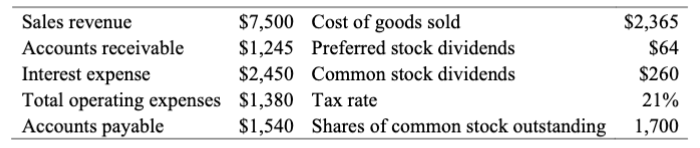
Use the following 2022 financial data to find the earnings per share for First-Run Corporation.
a. $0.61
b. $0.42
c. $1.71
d. $0.57
D

Windsock Inc. has one issue of preferred stock and one issue of common stock outstanding. Given its stockholders' equity account that follows, determine the offer price per share at which the firm sold its single issue of common stock.
a. $25.61
b. $24.22
c. $23.69
d. $22.69
C
All Common Inc. has no debt or preferred stock financing. Find the company's net profits after taxes using the following information.
Return on total assets = 11%
Total asset turnover = 0.93
Cost of goods sold = $356,000
Gross profit margin = 0.27
a. $96,120
b. $36,706
c. $57,682
d. $131,671
C
Use the following to calculate the DuPont system of analysis three component ratios: profit-on-sales component, efficiency-of-asset-use component, and use-of-financial-leverage component.
Sales = $83,400
Total assets = $53,700
Total liabilities = $36,500
Common stock equity = $17,200
Earnings available for common stockholders = $5,685
a. 6.8%; 1.55; 3.12
b. 10.6%; 2.15; 3.12
c. 6.8%; 2.15; 156
d. 10.6%; 1.55; 156
A
In its 2021 fiscal year, the data storage company, Data Cloud Inc., reported that it had 286.4 million shares of common stock outstanding and was trading at a price of about $58 per share. On the firm's income statement, the earnings available for common stockholders was $657.4 million. Data Cloud’s P/E ratio was ________.
a. 31.64
b. 25.27
c. 5.48
d. 2.30
B
LinJet Inc. has total liabilities of $141,900, a debt ratio of 0.30, and a debt-to-equity ratio of 0.43. Based on this information, what is LinJet’s financial leverage multiplier (FLM)?
a. 0.70
b. 2.33
c. 1.43
d. 0.43
C
The three categories of a firm's statement of cash flows are ________.
A) cash flow from operating activities, cash flow from investment activities, and cash flow from financing activities
B) cash flow from operating activities, cash flow from noncash activities, and cash flow from financing activities
C) cash flow from equity activities, cash flow from investment activities, and cash flow from financing activities
D) cash flow from operating activities, cash flow from investment activities, and cash flow from noncash activities
A
Total assets less net fixed assets equals ________.
A) gross assets
B) current assets
C) depreciation
D) liabilities and equity
B
Paid-in capital in excess of par represents the amount of proceeds ________.
A) in deficit of the par value from the original sale of common stock
B) in excess of the par value from the current value of common stock
C) in excess of the par value from the original sale of common stock
D) in excess of the par value from the intrinsic value of common stock
C
As an analyst, you have prepared a comprehensive suite of financial ratios for a major online retailer for the past 10 years. For comparison purposes, you have also prepared financial ratios for three direct competitors over the same period. How would you classify this ratio analysis?
A) Cross-sectional analysis
B) Time-series analysis
C) Benchmarking analysis
D) Combined analysis
D
A firm has a current ratio of 1. To increase that ratio the firm might ________.
A) develop a better inventory management system so the firm doesn't have to hold as many items in inventory at one time
B) hold lower cash balances at the bank and increase holdings of interest-earning marketable securities
C) take out a long-term bank loan and simultaneously offer customers better credit terms, allowing them to pay their bills more slowly
D) issue bonds and use the proceeds to purchase new equipment
C
You compare the liquidity ratios for many firms that operate in the same industry. If you compare these ratios for the largest firms in the industry to the same ratios for the smallest firms in the industry you should expect to find that ________.
A) larger firms tend to operate with higher liquidity ratios compared with smaller firms because larger firms need to accumulate much larger cash balances to survive when business conditions deteriorate
B) smaller firms tend to operate with lower liquidity ratios compared with larger firms because small firms rely more heavily on short-term sources of financing
C) there is usually not much difference between the liquidity ratios of large and small firms because the whole point of using ratios is to focus on a relative comparison when looking at firms that vary greatly in size
D) larger firms tend to operate with lower liquidity ratios compared with smaller firms because larger firms have better access to outside financing, such as bank loans and credit lines, that they can rely on during business downturns
D
The ________ ratio may indicate poor collections procedures or a relaxed credit policy.
A) average payment period
B) inventory turnover
C) average collection period
D) total asset turnover
C
An unusually high ________ may indicate a firm is experiencing stockouts and lost sales.
A) average payment period
B) inventory turnover ratio
C) average collection period
D) average age of inventory
B
A firm's total asset turnover increased from 0.75 to 0.90. Which of the following is true about the given data?
A) The firm is generating fewer dollars of sales per dollar of assets now than it was before.
B) By cutting back on assets, the firm runs the risk of creating problems like inventory stockouts and production delays.
C) The firm is generating more dollars of sales per dollar of assets now than it was before.
D) The firm's stock price will go up because it is using assets more efficiently.
C
The more money a firm borrows ________.
A) the larger is the gap between its ROA and its ROE
B) the lower is its operating profit margin
C) the higher is its gross profit margin
D) the lower is its ROE because more interest expense reduces earnings
A

Vox Inc. has one issue of preferred stock and one issue of common stock outstanding. Given their stockholders' equity account that follows, determine the original price per share at which the firm sold its single issue of common stock.
A) $12.33
B) $12.43
C) $0.10
D) $14.37
B

Based on the following 2023 financial data for Convo Corp., find the earnings available for common stockholders.
A) $59.95
B) $249.55
C) $435.20
D) $624.80
D
Echo Enterprises began the year with a retained earnings balance of $839,000. During the year, the firm earned $357,000 after taxes. From this amount, preferred stockholders were paid $38,000 in dividends. At year-end, the firm’s retained earnings totaled $1,035,000. The firm had 130,000 shares of common stock outstanding during the year. Calculate the firm's earnings per share (EPS) and the cash dividend per share paid to common stockholders.
A) $2.75; $1.53
B) $2.75; $0.95
C) $2.45; $1.53
D) $2.45; $0.95
D
Signal Corporation has annual purchases of $250,000 and accounts payable of $25,000, then average purchases per day are ________ and the average payment period is ________.
A) $684.93; 36.50 days
B) $616.44; 36.50 days
C) $684.93; 40.56 days
D) $616.44; 40.56 days
A
Harvest Express has sales of $200,000, a total asset turnover of 1.50, and a debt ratio of 65%. What are Harvest Express’ total assets and total liabilities?
A) $300,000; $130,000
B) $133,333; $130,000
C) $300,000; $86,667
D) $133,333; $86,667
D