Finance Midterm (1-5)
 Call Kai
 Learn
 Practice Test
 Spaced Repetition
 Match
 Flashcards
 Knowt Play
1/69

There's no tags or description
Looks like no tags are added yet.
70 Terms
Opportunities in Importing & Exporting
Market expansion and revenue growth
Cost efficiency and resource access
FX favourable shifts (unhedged gains) - If exchange rates move favourably—such as a domestic currency depreciating while holding foreign currency export receivables—converted revenue increases without raising foreign unit prices
Challenges in Importing & Exporting
- Unhedged Transaction Exposure (FX Risk): Unfavorable exchange rate movements between contract signing and payment execution directly erode profit margins:
Exporters: Risk foreign currency depreciation relative to the home currency, resulting in lower home-currency revenue when receivables are converted.
Importers: Risk foreign currency appreciation relative to the home currency, increasing the home-currency cash outlay required to settle payables.
- Competitive Pricing & Volume Dilemma
- Operational & Macro Frictions
International Monetary System + from an FX perspective
The global network of rules, institutions, and agreements that allows countries to exchange their currencies, settle international payments, and move capital across borders.
From an FX and hedging perspective, the IMS defines the "rules of the game" for currency volatility:
In a fixed regime, currency risk is managed primarily by central bank interventions, limiting short-term transaction exposure. (Currency volatility is low)
In a floating regime, exchange rates are set by market supply and demand, creating continuous FX volatility that forces trading firms (importers and exporters) to actively manage and hedge transaction exposure.
Evolution of the IMS

The Gold Standard (1876–1913)
How it worked: Every country tied its currency directly to a specific amount of physical gold. (They legally put an exchange rate, fixed to how much it compared to one ounce of gold)
The result: Because all currencies were locked to gold, exchange rates between countries were automatically fixed.
FX & Trade Impact: Currency risk was non-existent for traders. However, countries couldn't print more money unless they physically dug up more gold. The system broke down when World War I started.

The Interwar Years (1914–1944)
How it worked: War forced countries off the Gold Standard. Currencies were allowed to float randomly.
The result: Total economic chaos. Speculators bet against weak currencies, and countries engaged in "competitive devaluations” (intentionally weakening their currency to make exports cheaper).
FX & Trade Impact: High FX volatility severely damaged international trade.

The Bretton Woods System (1944–1973) (1) - The Goal & Setup
Near the end of WWII, delegates from 44 Allied nations met in Bretton Woods, New Hampshire, to build a stable system that would prevent the trade chaos of the 1930s.
Instead of returning to gold directly, they created a Gold-Exchange Standard (U.S. Dollar-Based Fixed System):
The USD Anchor: The U.S. Dollar was pegged directly to gold at a fixed rate of $35 per ounce. The USD was the only currency directly convertible into gold.
Other Currencies Pegged to USD: All other countries fixed (pegged) their currencies to the U.S. Dollar.
Central Bank Interventions: Foreign central banks had to actively buy and sell their own currencies in the foreign exchange market to keep their exchange rate fixed to the dollar.
No Competitive Devaluations: Nations agreed not to intentionally devalue their currencies for trade advantages.
The Bretton Woods System (1944–1973) (2) - The Institutions Created
B. The Institutions Created
International Monetary Fund (IMF): Created to maintain exchange rate stability and lend funds to countries facing Balance of Payments (BoP) crises.
World Bank (IBRD): Created to finance post-war reconstruction in Europe and economic development globally
The Bretton Woods System (1944–1973) (3) - Why it collapsed
The Problem (Triffin Dilemma): As global trade grew, the world needed more U.S. dollars to conduct trade. The U.S. printed and spent dollars globally (through deficits and war financing).
The Gold Deficit: Eventually, foreign central banks held vastly more U.S. dollars than the U.S. had actual gold in Fort Knox to back them up.
The Panic: Countries began to lose trust and asked to trade their dollars back for gold at $35/oz.
The Nixon Shock (August 1971): President Richard Nixon unilaterally suspended the dollar’s convertibility into gold to prevent a run on U.S. gold reserves.
Final Collapse (1973): Attempts to fix the system failed, and countries officially abandoned fixed pegs, allowing currencies to float.
The Floating Era (1973–Present)
How it works: Major currencies (USD, EUR, JPY, GBP) float freely against each other.
What drives exchange rates: Market forces of supply and demand, driven by economic fundamentals like inflation differentials (PPP) and interest rate differentials (IFE).
FX & Hedging Implication: Continuous currency movement exposes importers and exporters to transaction risk. This is why financial instruments (forwards, options, futures) are needed to hedge exchange rate volatility.
What is the fx market? + Actors
The Foreign Exchange Market (FX Market) provides the physical and institutional structure through which the money of one country is exchanged for that of another country.
Through this decentralized global market, exchange rates between currencies are determined and foreign exchange transactions are physically completed.

Direct Quotation (Use ZMK and EUR) - EUR is home
0.05 EUR = 1 ZMK
THIS IS DIRECT FOR EUR
INDIRECT FOR ZAMBIA
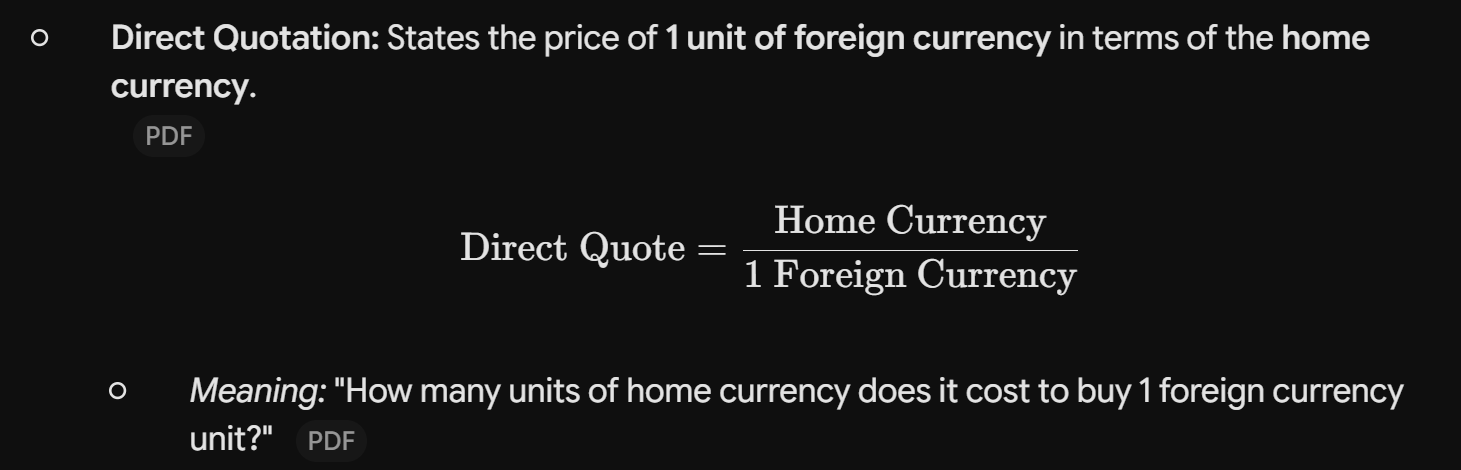
Indirect Quotation (Use ZMK and EUR) - EUR is home
1 EUR = 20 ZMK
THIS IS INDIRECT FOR EUR
DIRECT FOR ZAMBIA
WE WILL MOSTLY USE THIS ONE

Direct to indirect conversion

What does EUR/USD = 1.1274 mean?
This means 1EUR = 1.1274 USD

Exchange Rate Determinants
Exchange rates are primarily determined by the supply and demand for currencies in the global foreign exchange market.
The demand and supply of currencies are influenced by several key factors, including, for example:

Inflation Rate
In financial economics, inflation is defined as a sustained, general increase in the overall price level of goods and services in an economy over time.
inflation directly reduces the purchasing power of a domestic currency. When a nation experiences higher inflation than its trading partners, its goods become relatively more expensive, eroding export competitiveness unless offset by currency depreciation.
CPI

Inflation Rate !!

Interest Rate
The price paid for borrowing capital or the return earned on saved capital, expressed as a percentage of the total principal over a specified period.
From an FX and corporate hedging perspective, interest rates reflect inflationary forces within an economy and act as a primary fundamental driver of exchange rates
Nominal vs Real Interest Rate
1. Nominal Interest Rate (i)
What it is: The stated or stated-contract interest rate on a loan, deposit, or bond—unadjusted for inflation.
Plain English: The actual percentage number of dollars (or euros/yen) you physically earn or pay.
Example: If a bank deposit pays 8% per year, your nominal rate is 8%.
2. Real Interest Rate (r)
What it is: The actual growth in your purchasing power—adjusted for inflation.
Plain English: How many more actual goods and services you can buy with your return after inflation erodes the value of money.

International Parity Conditions
The economic theories that link exchange rates, inflation rates and interest rates are called international parity conditions
Inflation and Exchange Rate (3)

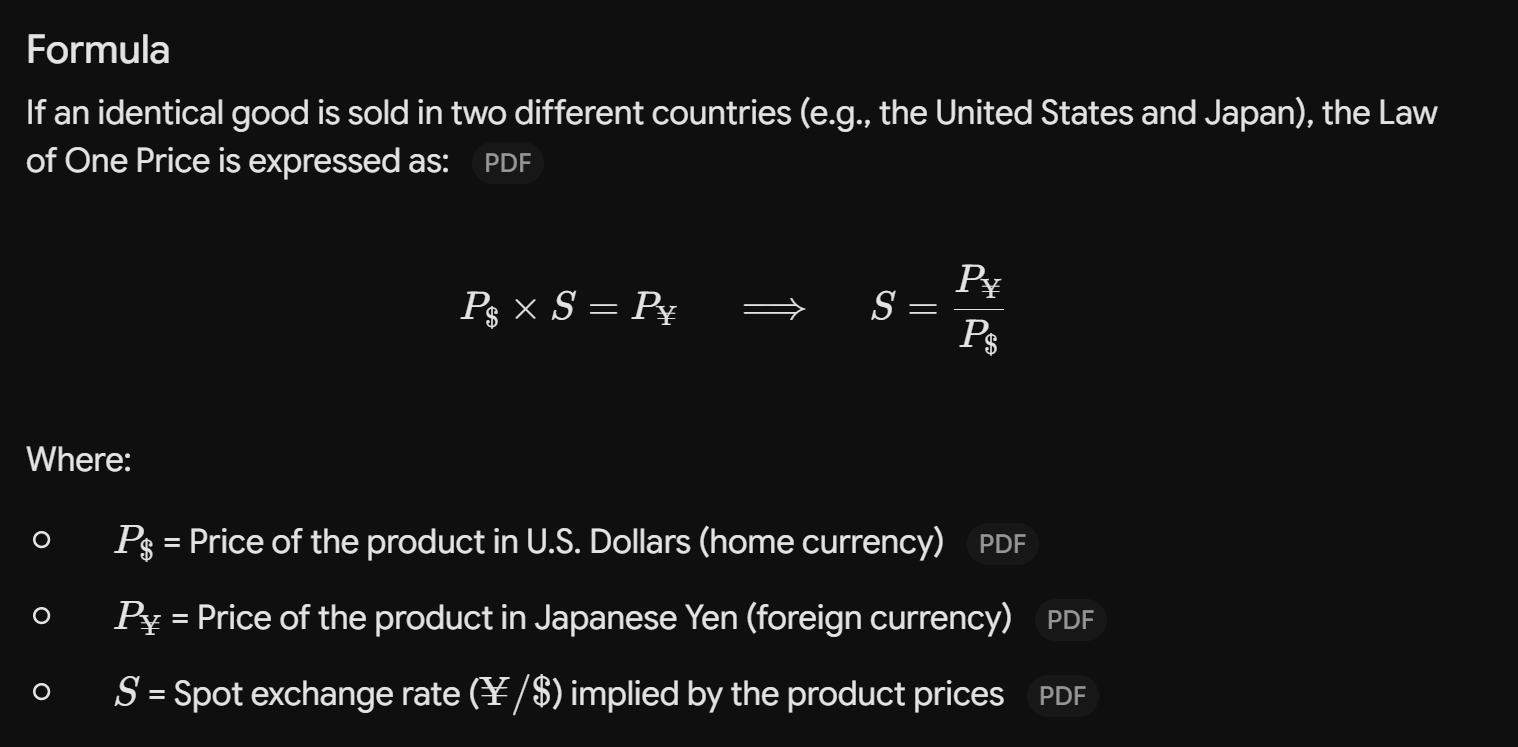
The Law of One Price
in competitive and efficient markets free from trade frictions (such as transportation costs, tariffs, or trade barriers), identical goods must sell for the exact same price when expressed in a common currency.
EG Big Mac Index - Assuming a McDonald's Big Mac is identical worldwide, comparing its local price across countries allows you to calculate the implied exchange rate.
Absolute PPP
An international finance theory stating that the spot exchange rate between two currencies is determined by the ratio of the prices of an identical representative basket of goods and services in those two countries. (Basicaly LOOP but expanded)
Absolute PPP (Is currency undervalued or overvalued)
We can also do this example with the value of a standard basket of goods instead of just ome big mac.
Eg A standard basket of goods in UK = 250 GBP and in US = 225 USD.
S = 225USD/150GBP = 1.5USD/1GBP
So the spot exchange rate should be: GBP/USD = 1.5.

Relative PPP (Reduced / Approximate Form)
When the PPP relationship is presented in the “rate of change” form, instead of price level as in the absolute PPP, we obtain the relative PPP.
Relative PPP states that if two countries start in equilibrium, any difference in their inflation rates will be offset over time by an equal and opposite change in the spot exchange rate

Relative Purchasing Power Parity (Relative PPP) - Exact Formula (Future Spot Rate Forecast)

A bit of math to prove
We also know that S1 = S0 x (1 + delta S)

Relative Purchasing Power Parity (Relative PPP) - Exact Percentage Change Formula (ΔS)

Interest rate and exchange rate

The Fischer Effect
The Fisher Effect is an economic theory named after economist Irving Fisher that defines the relationship between nominal interest rates, real interest rates, and expected inflation
1. The Core Concept
The theory states that the nominal interest rate (i) in any country equals the required real rate of return (r) plus compensation for expected inflation (π).
Nominal Interest Rate (i): The contractual or quoted interest rate paid on a loan or investment, unadjusted for inflation.
Real Interest Rate (r): The actual percentage growth in real purchasing power that an investor earns after adjusting for inflation.
Expected Inflation (π): The anticipated rate at which price levels will rise over the period.
Real IR (r) = Nominal IR (i) - Inflation Rate (pi)

International Fischer Effect
The International Fisher Effect (IFE) is an international finance theory that links nominal interest rate differentials between two countries directly to expected changes in spot exchange rates.
International Fisher Effect (IFE) — Core Logic
Real Returns Equalize Globally: Capital flows freely to where returns are best, making real interest rates equal across countries (rh=rf)
Interest Rates Reflect Inflation: Higher nominal interest rates in a country mean higher expected inflation (i≈r+π). (lenders demand extra interest to compensate for the loss of purchasing power caused by inflation.)
High Rates = Currency Depreciates: Because higher inflation erodes local purchasing power, the country with the higher nominal interest rate will see its currency depreciate.
Rule of Thumb: Higher nominal interest rate → Higher expected inflation →Currency depreciates.
International Fischer Effect Exact Form

International Fischer Effect Exact Percentage Change Formula (∆S)

International Fischer Effect Reduced / Approximate Form

How do Relative PPP and IFE connect? !!
1. Higher inflation → currency depreciates (Relative Purchasing Power Parity).
2. Higher expected inflation → higher nominal interest rate (Fisher Effect).
3. So higher nominal interest rate → currency expected to depreciate (International Fisher Effect).

Balance of Payments
The measurement of all international economic transactions that take place between the residents of a country and foreign residents within a given period of time, is called the balance of payments (BOP)
Resident
a person or firm living in the country for more than 12 months and earning income there

BOP is comprised of 3 (4) things !
1. Current Account
Definition & Scope: Records trade in goods and services, primary/factor income (interest, dividends, wages), and recurring current transfers (gifts, remittances).
Handwritten Notes Explained:
"Mostly associated with trade activities (Export - Import)":
"But also things like sending money home when studying abroad (remittance), but this is less important":
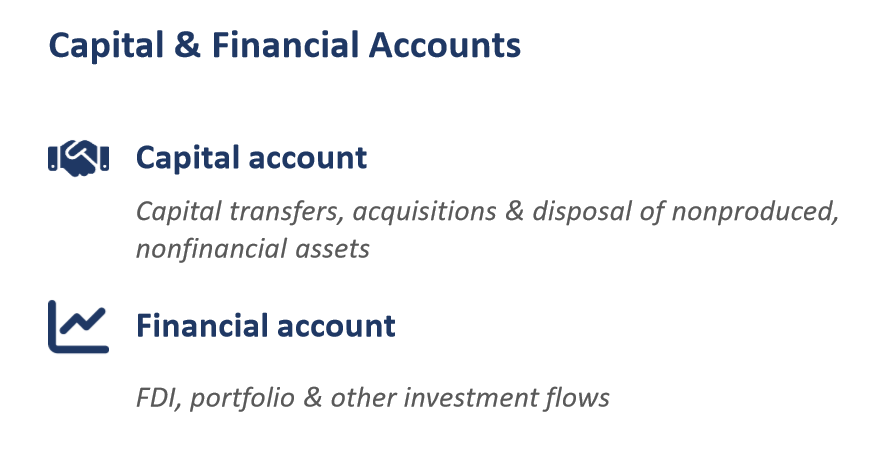
2. Capital & Financial Account
Definition & Scope: Measures international transactions of financial assets and capital assets. While the capital account covers minor capital transfers and non-financial assets (e.g., debt forgiveness), the financial account covers major investment flows like Foreign Direct Investment (FDI) and portfolio investments.
Handwritten Notes Explained:
"This is about investment activities"
3. Official Reserve Account
Definition & Scope: Measures changes in official foreign exchange reserves held by a nation's monetary authority or central bank (e.g., hard currencies like USD/EUR, gold, and SDRs).
Handwritten Notes Explained:
"Central banks buying and selling currencies, or limiting/increasing supply":
For instance, a central bank may buy or sell foreign currency reserves to defend or stabilize its domestic currency exchange rate.
4. Net Errors and Omissions Account
Handwritten Notes Explained:
"Anything that is not defined": Captures statistical discrepancies, unrecorded transactions, measurement errors, or timing differences in data collection.
Why is BOP important?

The current account (and trade balance)
Current account vs trade balance — Trade balance takes into account solely trade, whereas current account also looks at income and current transfers
Trade Balance = Total Exports - Total Imports
If TB>0 —> Trade Surplus
If TB<0 —> Trade Deficit
If TB=0 —> Balanced Trade

Capital and Financial Account
Foreign Direct Investment (FDI)
The net balance of capital flows into or out of a country intended to acquire a lasting management interest and operational control over an enterprise or asset.
Key Characteristics
Control Threshold: Defined internationally as holding a minimum 10% ownership or voting interest in a foreign company.
Primary Motivation: Long-term strategic control and operational influence rather than purely short-term financial returns.
Classification: Recorded under the Financial Account of the Balance of Payments.

Portfolio Investment
Portfolio Investment (Financial Account of BOP)
Definition: Net balance of cross-border capital flows that do not reach the 10% ownership threshold.
Core Motivation: Purely profit-motivated (driven by expected financial returns, yields, or capital gains) with no intent to manage or exert operational control over the entity
• Bonds or debt securities are also classified under Portfolio investment (as you have no vote or control over the party issuing the asset)
Official Reserve Account
Official Reserve Account
Definition: Measures total reserves held by official monetary authorities (e.g., central banks).
Asset Types: Held primarily in hard currencies used in international trade (e.g., USD, EUR, JPY), as well as gold and IMF Special Drawing Rights (SDRs).
Primary Function: Enables central banks to intervene in the Foreign Exchange (FX) market by buying or selling currencies:
To defend a domestic currency: The central bank sells foreign reserves to buy back and support its domestic currency (e.g., Venezuela selling USD reserves to defend the bolívar).
To manage currency supply: Central banks alter official reserves to stabilize exchange rates, offset trade/capital imbalances, or influence the money supply
BOP impacts on Exchange rates
If exports increase, foreign countries need to buy our domestic currency (and sell theirs) to pay us, so demand for our currency increases, supply of theirs increases, so our currency appreciates against theirs.
If Imports increase, we pay the country in our domestic currency, they need to sell our currency and buy their own (for operations), so the supply of ours increases, demand for theirs increases, and our currency depreciates against theirs.
It also works whichever currency the contract is determined in, just affects who sells/buys currency

BOP and interest rates
Low Interest Rates —> Capital Leaves the Country
When a country's real interest rates are low, global investors earn smaller returns there.
Investors move their money out of the country to invest in foreign currencies/assets with higher interest rates. This outflow of money weakens the domestic currency.
Defense Mechanism: Raising Interest Rates (and the Trade-off)
If a country with a managed exchange rate wants to prevent its currency from falling, it can raise domestic interest rates. Higher returns attract foreign investors back.
The downside: High interest rates make loans more expensive for local businesses, which can slow down domestic economic growth.
The U.S. Exception
Normally, lower interest rates cause money to leave and weaken the currency.
However, because the U.S. dollar is the world's primary reserve currency and safe-haven asset, capital often continues to flow into the U.S. regardless of low rates.
BOP and inflation rates
Capping Domestic Prices: Importing lower-priced foreign goods and services creates market competition. This places an upper limit on what domestic firms can charge for comparable items, preventing local producers from raising prices excessively.
Lowering Cost of Goods: When imported consumer goods or raw materials are cheaper, they lower the overall cost of the Consumer Price Index (CPI) basket, directly putting downward pressure on domestic inflation rates.
Why is the US okay even though imports are so mucn bigger than exports?

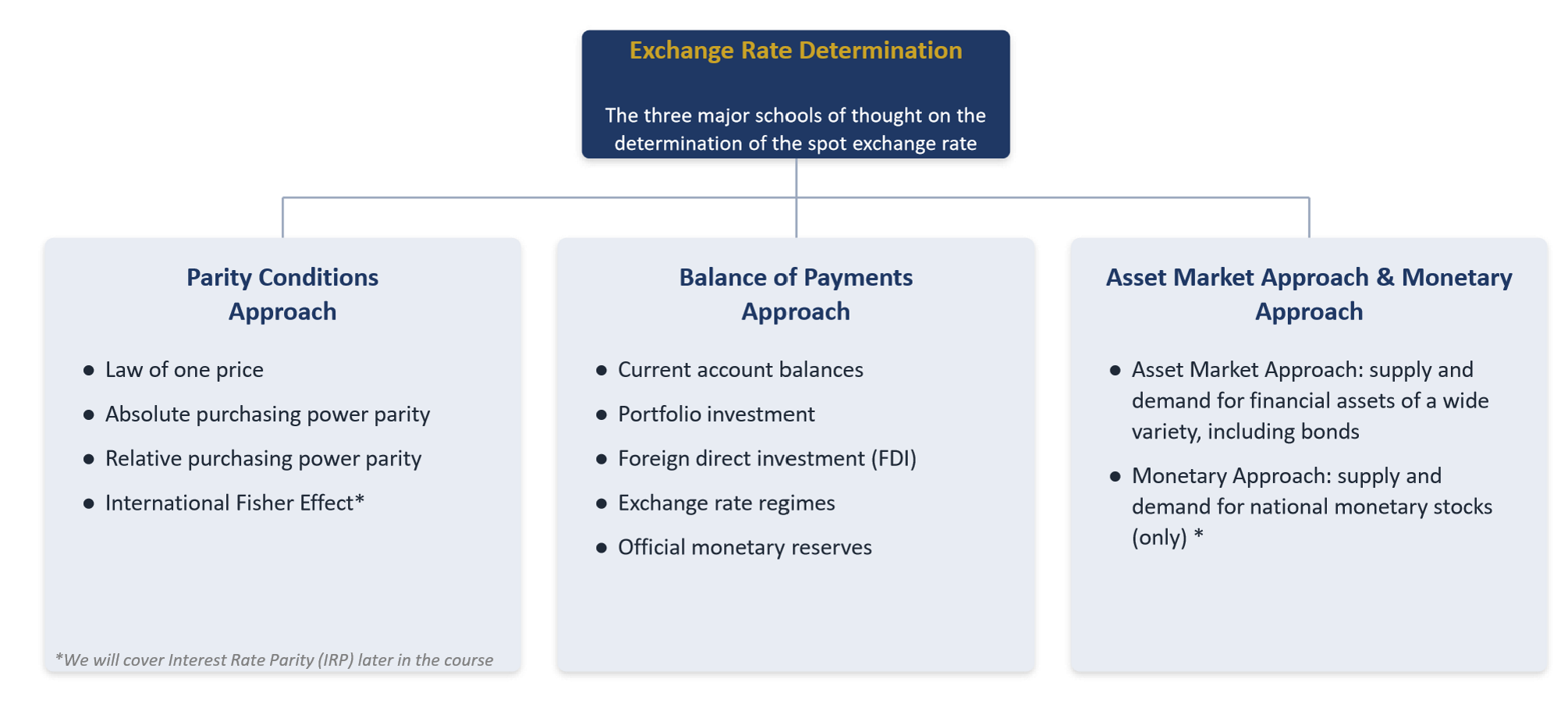
Three Major Schools of thought for spot exchange rate determination
THE ASSET MARKET APPROACH (Mathematical Setup)
Step-by-Step Breakdown
Starting Point: You start with Home Currency (e.g., USD).
Step 1 — Conversion: You convert your USD into Foreign Currency (e.g., EUR) at today's exchange rate.
Step 2 — Foreign Yield: You earn the foreign interest rate (iforeign) on those EUR. In EUR terms, your return is purely iforeign.
Step 3 — Conversion Back: At the end of the year, you must convert those EUR back into USD so you can actually spend or evaluate your profits at home.
Where Currency Movement Alters Your Total Return
If the foreign currency weakens / depreciates while you hold it, each EUR you earned buys fewer USD when you convert back. That currency loss eats away at the interest you earned.
If the foreign currency strengthens / appreciates, each EUR buys more USD, boosting your total return above iforeign

Asset Market Approach Diagram
Step-by-Step: What Happens in the Graph
Left Graph (Before the change):
The market starts in balance where the two lines cross at point S*. At this exchange rate, foreign and home investments offer equal returns.
Right Graph (Home Central Bank raises interest rates):
The home central bank increases its interest rate from r* to r'*.
The vertical line {ERR}(i_H) shifts to the right because home assets now pay a higher return.
The new crossing point moves UP to S'*

Asset Market Approach Implication
If US relative real interest rates rise, international investors tend to shift capital into USD-denominated assets to earn higher returns. The resulting increase in demand for USD causes the dollar to appreciate against other currencies — meaning the exchange rate moves in the USD's favor.

Monetary Approach
In simple terms, the Monetary Approach states that a country's exchange rate is determined strictly by the supply and demand for money in its economy.
Instead of looking at trade flows (like exports or imports), it focuses on how central banks and individuals manage money holdings

BoP approach

Foreign Exchange Rate Exposure
A measure of the potential for a firm’s profitability, net cash flow, and market value to change because of a change in exchange rates

Transaction Exposure
measures gains or losses that arise from the settlement of existing financial obligations whose terms are stated in a foreign currency
The general rule

Transaction Exposure Management 2 families of hedging tools

Invoice currency choice (3 strategies)

Lead/Lag Strategy
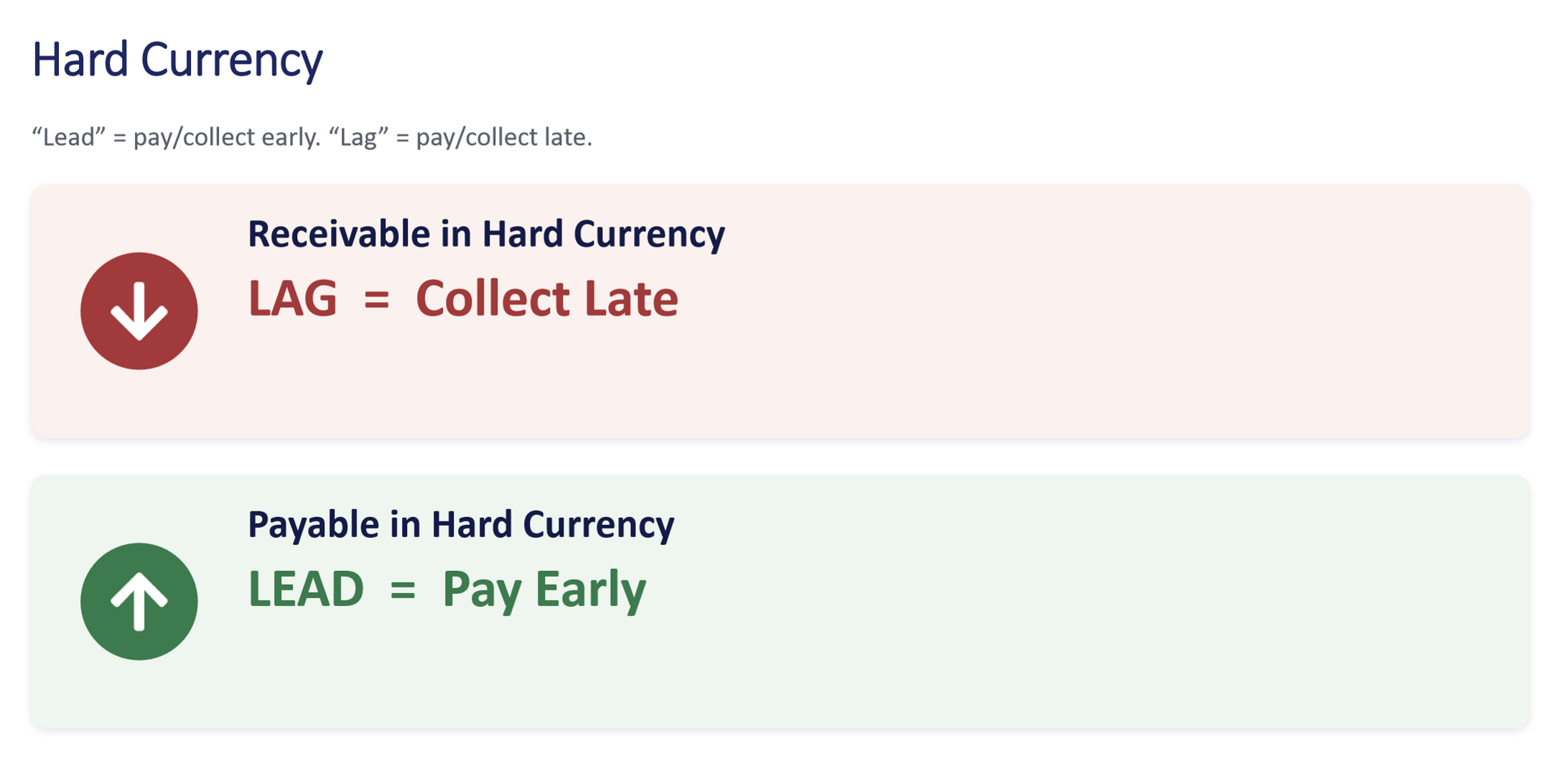
Lead = pay or collect early. Lag = pay or collect late. In French practice: le termaillage.
Soft vs Hard Currency

Hard Currency Recievable and Payable
Simple Examples
Imagine you run a US-based business (USD) and are dealing with transactions in Euros (EUR), which is currently acting as a Hard Currency (expected to get stronger relative to USD):
1. Receivable in Hard Currency —> LAG (Collect Late)
Scenario: You sold goods to a German customer for €100,000, with payment due in 60 days.
Why Lag? Because EUR is a hard currency, every day you wait, €1 becomes worth more USD.
Example:
If you collect today at EUR/USD1.10$, you receive $110,000.
If you delay (lag) payment for 60 days until EUR/USD1.20$, you receive $120,000.
Rule: You wait as long as possible so you convert back at a higher rate.
2. Payable in Hard Currency —> LEAD (Pay Early)
Scenario: You bought inventory from an Italian supplier and owe €100,000 due in 60 days.
Why Lead? Because EUR is getting stronger, paying later will cost you more USD.
Example:
If you pay early (lead) today at EUR/USD1.10$, it costs you $110,000.
If you wait 60 days and EUR rises to EUR/USD1.20$, it would cost you $120,000.
Rule: You pay immediately before the foreign currency becomes even more expensive.
Soft Currency Recievable and Payable
Simple Examples
Suppose you are a US-based firm (USD) dealing with transactions in a Soft Currency (e.g., Argentine Peso or a weak currency expected to fall against the USD)
A. Receivable in Soft Currency (ZMK) —> LEAD (Collect Early)
Situation: A German company exports machinery to Zambia, invoiced for ZMK 2,500,000, due in 60 days.
Strategy: Collect immediately (lead).
Math:
Collect today at 1EUR = 25ZMK
2,500,000ZMK/25 = 100,000EUR
Collect in 60 days at 1EUR = 30ZMK (ZMK depreciates)
2,500,000ZMK/30 = 83,333EUR
Result: Collecting early protects the German firm from a €16,667 loss caused by the Kwacha losing purchasing power.
B. Payable in Soft Currency (ZMK) —> LAG (Pay Late)
Situation: A German firm buys agricultural products from Zambia, owing ZMK 2,500,000 in 60 days.
Strategy: Delay payment (lag).
Math:
Pay today at €100,000
Pay in 60 days at €83,333
Result: Delaying payment allows the German buyer to settle the exact same Kwacha debt for €16,667 less
Lead/Lag in Practice
Lead/Lag Strategy (Termaillage) — Why It Fails in 3 Bullet Points
No Incentive to Prepay: Buyers won't pay off a weakening (soft) currency debt early unless given a real cash discount.
Relationship Risk: Demanding early payments from clients creates friction and damages business relationships.
Already Priced In: Known or expected currency drops are usually already built into the original invoice price.
When does lead/lag work best
Why Intrafirm Lead/Lag Works Best (In 3 Short Points)
Aligned Goals: Parent and subsidiaries share one corporate balance sheet, so internal managers gladly adjust payment timing to benefit overall group profit.
Zero Customer Friction: Avoids client disputes, relationship damage, or price discount demands associated with pushing outside third parties to pay early.
High Operational Control: Applies seamlessly across internal cash flows like materials, rents, royalties, management fees, and dividend payouts
Exposure Netting
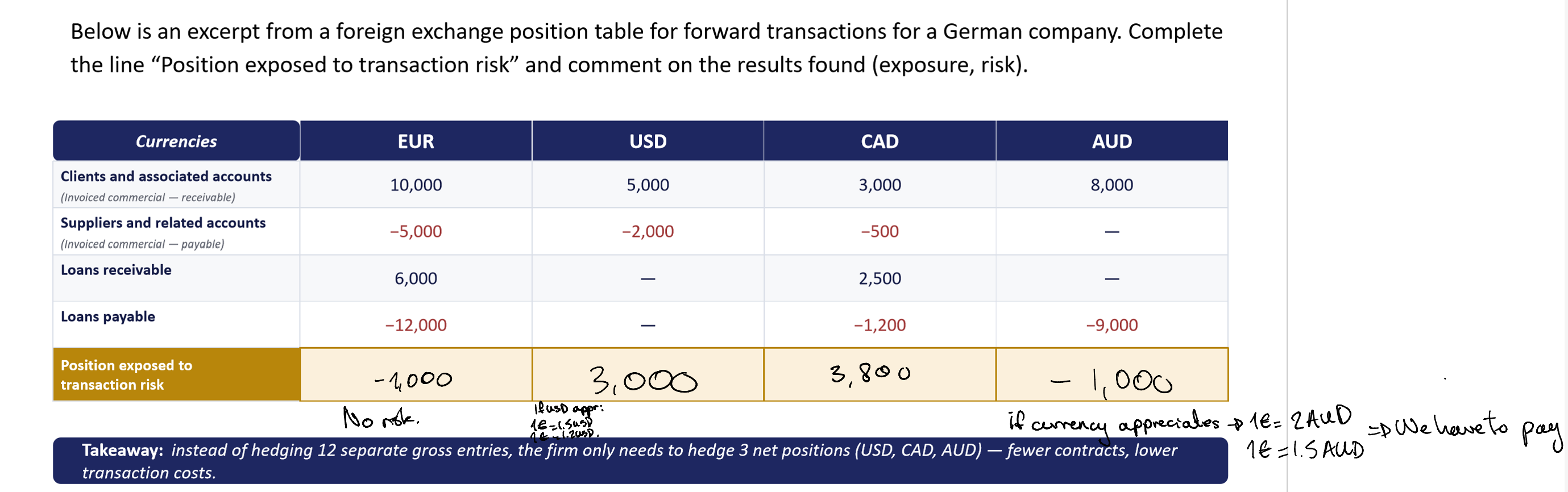
an operational hedging technique where a company offsets its total foreign currency inflows (receivables) against its total outflows (payables) in the same currency, hedging only the remaining net position rather than every gross transaction.
Translation Exposure
Translation exposure (or accounting exposure) is the potential for accounting-derived changes in owner's equity or consolidated income to occur because of the need to "translate" foreign currency financial statements of foreign subsidiaries into a single reporting currency to prepare worldwide consolidated financial statements.
Operation Exposure
Definition: The risk that unexpected exchange rate movements will change a firm's long-term present value by altering its future operating cash flows.
Key Drivers: Currency shifts directly affect a company's future sales volumes, pricing power, and production costs.
Real-World Impact: If the US Dollar becomes unexpectedly strong, US-made goods become expensive for foreign buyers. The US exporter loses market share to foreign competitors, shrinking future profits even if no specific sales contract has been signed yet