Intro to Cog Exam 3
 Call Kai
 Learn
 Practice Test
 Spaced Repetition
 Match
 Flashcards
 Knowt Play
1/101

There's no tags or description
Looks like no tags are added yet.
102 Terms
Visual imagery
Mental representations of sensory information without current sensory input
Perception
Processing information from currently available sensory input
Introspection
Examining and reporting one’s own mental experiences
Translation step
Converting internal mental experiences into verbal descriptions
Spatial structure
The preservation of distances, locations and relationships within mental images
Mental scanning
Greater imagined distances produce longer response times (the tree
Mental zoom
Accessing smaller details requires more time (the cat whiskers compared to a rhino)
Mental rotation
Response time increases with the angle of rotation (180 compared to 360)
Symbolic distance effect
Comparing similar objects takes longer than comparing very different objects (pug vs. collie is slower than a mouse vs. whale)
Demand characteristics
Cues that influence participants’ responses based on what they think researchers expect (does it actually take them that long to mentally scan or do they think it should take that long)
Selective interference
Tasks requiring the same cognitive resources interfere with each other, perception interferes with imagery
Neural activation
Brain activity associated with performing mental imagery tasks
Kosslyn - Mental Scanning
Participants memorized a map containing several landmarks they were instructed to:
Form a mental image of the map, imagine a black speck moving from one landmark to another and mentally scan between the two locations
Found that the greater the distance between landmarks, the longer participants took to mentally scan between them, suggesting that mental images preserve spatial structure
Kosslyn - Mental Zoom
Participants imagined objects of different sizes and inspected their details. Smaller details required more mental zooming and longer response times
Shepard and Metzler - Mental rotation
Participants mentally rotated 3D objects to determine whether they matched. Larger rotation angles produced longer response times
Carptenter - Neural Evidence for Mental Rotation
Researchers measured brain activity during mental rotation. Greater rotation angles produced greater neural activation, supporting spatial processing in imagery
Brooks - Selective Interference
Participants completed spatial tasks using spatial or verbal responses. Spatial responses caused greater interference, indicating imagery uses spatial resources
Farah - Imagery Facilitates Perception
Participants imaged H or T while detecting faint letters. Matching mental images improved detection, suggesting imagery and perception share mechanisms
Guariglia - Unilateral Neglect
Patients with unilateral neglect syndrome omitted one side of imagined scenes. This suggests imagery and perception share spatial organization
R.M. and C.K.
R.M. could perceive objects but not imagine them; CK could imagine objects but not recognize them. This demonstrates imagery and perceptions are partially independent
Levine - Visual vs. Spatial Imagery
Patient LH had impaired visual imagery but intact spatial abilities, supporting the separation of visual and spatial imagery systems
Intraub and Richardson - Boundary Extension
People remembered scenes extending beyond their actual boundaries. This boundary extension demonstrates that memory reconstructs visual information
Friedman - Schema-Based Expectations
People paid less attention to expected scene details, while unexpected details stood out. This shows schemas influence visual processing
Kosslyn - Mental Images vs. Propositions
Participants were asked whether cats have heads or claws, either while imagining a cat or simply thinking about cats. Response patterns differed, showing representation format affects information access
The Tacit Knowledge Explanation
Argued imager results might reflect learned expectations rather than picture-like images. Later evidence challenged this as a complete explanation
Paivio - Concrete Words and Memory
Concrete words were recalled better than abstract words. This supports the conceptual peg hypothesis: mental images provide memory anchors
Perceptual priming / Imagery facilitation
Imagining an object can improve detection of matching visual stimuli
Transcranial magnetic stimulation (TMS)
Disruption of visual brain areas can impair mental imagery
Unilateral neglect
Failure to attend to one side of space, sometimes affect both perception and imagery
Visual cortex / V1
Brain regions involved in visual processing and imagery
Fusiform face area (FFA)
Involved in processing faces and imagining faces
Parahippocampal place area (PPA)
Involved in processing and imagining places
Visual agnosia
Impaired object recognition despite preserved aspects of visual processing
Mental rotation in blind individuals
Evidence that spatial imagery does not require visual experience
Boundary extension
Remembering inferred surroundings beyond what was actually shown
Schema-based influences
Expected, schema-consistent details are processed less carefully, while unexpected or inconsistent details stand out
Mental perceptions vs. physical pictures
Physical pictures can be ambiguous, whereas mental perceptions are organized and interpreted. Mental images are not exact copies of physical pictures
Paper Folding Test
Measures spatial imagery ability, specifically mental rotation and spatial manipilation
Analog (Depictive)
Preserves spatial structure, picture-like and is supported by mental rotation and image scanning. Allows us to reason by mentally manipulating images
Propositional (descriptive)
Abstract and language-like, knowledge based. Allows us to reason using existing knowledge, facts, and beliefs. This can introduce systematic errors when we rely on what makes sense rather than what is spatially accurate
Aphantasia
Inability to voluntarily generate visual mental images, not all mental representations. Spatial abilities are often preserved
Eidetic imagery
Vivid, detailed visual images that persist briefly after viewing. Not photographic memory, extremely rare in children and has not been scientifically confirmed in adults
The Imagery debate between Kosslyn and Pylyshyn
Kosslyn argued that mental imagery is analog and preserved spatial structure (picture-like), while Ply argued that imagery is propositional and reflects tacit knowledge (what we already know about the world), but modern evidence suggests that imagery involves both spatial representations and knowledge-based influences
Tacit knowledge
People stimulate based on what they know, reaction times reflect knowledge, not images
Modern conclusion of the Tacit Debate
Imagery reflects internal spatial representations but can also be influenced by tacit knowledge
Dual coding
Encoding information in two formats; verbal and visual, providing multiple retrieval paths and improving memory
Concrete words
Are remembered more easily because they can be encoded both verbally and visually
Abstract words
Cannot be encoded visually, so they are harder to remember (justice vs. dog)
Mnemonic strategies
Use mental imagery to create associations and additional retrieval cues, making information easier to remember
Working memory and imagery
Preserves spatial structure and supports rotation, scanning and zooming (we can manipulate images in our working memory)
Long-term memory and imagery
Our long-term memory stores information in more abstract, integrated forms meaning it follows the general memory principles (including schemas and reconstruction)
LTM vs. WM: Imagery
Imagery is powerful in working memory but LTM is more reconstructive and flexible
Dual Coding and Memory
Imagery can strengthen memory because information can be encoded in both verbal and visual formats. It creates multiple retrieval paths and adds structure
This theory explains why a sparrow is judged as a better example of a bird than an ostrich
Prototype theory
People verify “apple is a fruit” faster than “olive is a fruit” this demonstrates
Typicality effect
Members of a category share overlapping features, but no single feature is required - this is known as
Family resemblance
Thinking of “fire” makes it easier to recognize “smoke” due to this process
Spreading activation
This model organizes knowledge in levels, such as “animal → bird → canary”
Hierarchical semantic network
This mental process occurs without direct sensory input but shares mechanisms with perception
Mental imagery
This system helps you imagine how objects move or where they are located
Spatial imagery system
Small details take longer to identify when imagined next to large objects due to this effect
Mental/image zooming
In this format, knowledge is stored as abstract relationships described in statements rather than visual images
Propositional representation
Imagining walking across a park takes longer than imagining crossing a small room because imagery uses this type of representation
Analog representation
Classical view: Representation theory
Categories are defined by necessary and sufficient features, all members share defining features (works well for some concepts like triangles)
Problem with the Classical view
Category boundaries are not fixed and can violate strict definitions, such as the Basenji dog not barking or hairless dogs existing
Family Resemblance: Representational theory
Uses “characteristic" features” across most category members, similarity and no defining features or strict rules
Prototype
An average representation of a category based on past experiences
Prototype theory: Representational theory
Category membership is judged by typicality- how much it resembles the prototype (related to the family resemblance effect)
Graded membership
Objects close to a prototype are “better” members of the category compared to objects farther from the prototype (a robin compared to a penguin)
Exemplar theory: Representational theory
Categories are represented by many stored examples (exemplars), you categorize based on comparison of new items to your stored instances
Exemplar vs. Prototype theory
Exemplar theory handles variability and atypical cases so it has better sensitivity to individual variation, prototype theory works well for large categories and generalizing, it has less memory storage demands.
Evidence for Categorization (Reaction time)
A sparrow is a bird was faster than a penguin is a bird, reaction time differences show graded category structure
Evidence for Categorization (Typicality)
Participants name typical category members first, supports typicality effects and graded membership hypotheses (Name a fruit: apple, orange, banana, blueberry, pear)
Similarity-based categorization
Categorizing objects based on their resemblance to prototypes or stored examples
Limits of similarity-based categorization
Similarity explains typical cases but fails to account for some atypical cases and underlying category membership
Theory-based categorization
Categorization based on prior knowledge and beliefs about how the world works rather than appearance alone
Feature weighting
Giving greater importance to certain characteristics based on knowledge of what matters
Context effects
The same object can be categorized differently depending on the situation or purpose
What are the limits of similarity-based categorization, and how do theory-based concepts and context influence categorization?
Similarity-based categorization works well for typical cases but fails for some atypical cases because category membership also depends on underlying knowledge, beliefs, and expectations, while context determines which features are important and how an object is categorized
Conceptual knowledge
Knowledge that enables us to recognize objects and events and make inferences about their properties
Inference
Using existing knowledge to predict properties that have not been directly observed
Category-based inference
Using knowledge about a category to predict the characteristics of its members
Typicality and inference
People generalize more readily from typical category members than atypical members
Knowledge-based inference
Making predictions based on existing beliefs, causal knowledge and expectations
How do concepts support inference, and what role does existing knowledge play?
Concepts allow us to predict unseen properties by applying existing category knowledge to new instances, with stronger generalizations from atypical members and inferences guided by prior knowledge, causal beliefs, and expectations
Semantic network model
Describes how conceptual knowledge is linked and coordinated, properties are stored in the network, and linked to concepts
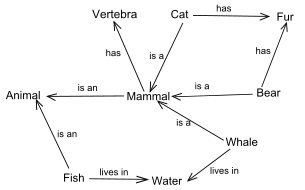
Node
A representation of an individual concept or idea within a network
Hierarchical semantic network
A network that organizes concepts from broad categories to more specific categories
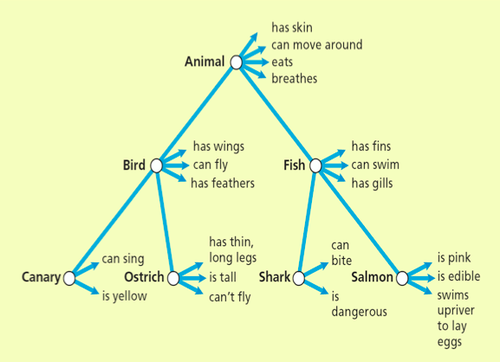
Cognitive economy
Storing shared properties at higher levels of a hierarchy to reduce unnecessary repetition
Nonredundancy
The principle that shared information is only stored once within a network
Spreading activation
Activation of one concept spreads to related concepts, making them easier to retrieve
Distance effect
Retrieval takes longer when concepts are farther apart within a semantic network (canary to heart compared to canary to bird)
Limitations of hierarchical networks
Cannot explain typicality effects and incorrectly assume strict nonredundancy
How do semantic networks organize knowledge, and what are their limitations?
Semantic networks organize knowledge through interconnected concepts arranged hierarchically, using cognitive economy to store shared properties and spreading activation to facilitate retrieval, but the hierarchical model fails to explain typicality effects and assumes strict nonredundancy
Proposition
The smallest unit of knowledge that can be either true or false
Propositional network
A network in which individual concepts or ideas are represented by nodes that can be connected to form more complex concepts
Local representation
Each individual node represents one concept or idea
Connectionist network
A network in which ideas are represented by patterns of activation across multiple units
Distributed representation
A concept is represented by a pattern of activation across a network rather than an individual node
Parallel distributed processing (PDP)
Information is processed across multiple units of a distributed network simultaneously