6. Sediments and Sedimentary rocks
 Call Kai
 Learn
 Practice Test
 Spaced Repetition
 Match
 Flashcards
 Knowt Play
1/47

There's no tags or description
Looks like no tags are added yet.
48 Terms

Clastic
a sedimentary rock comprised of material that was transported as clasts or fragments

Chemical
a sedimentary rock comprised of material that was transported as ions in solution

After weathering and erosion
are transportation, deposition, burial, and lithification

Classifying sedimentary clasts
based on their size, and variations in clast size have important implications for transportation and deposition

Clastic sedimentary rocks range
from conglomerate to mudstone.

important features that allow us to differentiate clastic rocks
Clast size, sorting, composition, and shape

Clast
a sedimentary fragment of mineral or rock

Boulder
is bigger than a toaster and difficult to lift. There is no upper limit to the size of boulder

Cobble
small one will fit in one hand, a large one in two hands.

Pebble
something that you could throw quite easily. The smaller ones—known as granules—are gravel size, but still you could throw one

Granules
gravel sized pebbles

Sand
You can’t really throw a single grain of it.
ranges from 2 millimetres down to 0.063 millimetres, and its key characteristic is that it feels “sandy” or gritty between your fingers—even the finest grains feel that way

Silt
too small for individual grains to be visible, and while sand feels sandy to your fingers, silt feels smooth to your fingers but gritty in your mouth

Clay
is so fine that it feels smooth even in your mouth.

two forces operating on a grain of sand in water
Gravity is pushing it down, and the friction between the grain and the water is resisting that downward force.
The faster the medium (water, wind) flows, the larger the particles it can move.

Bed load clasts
the fraction of a stream’s sediment load that typically rests on the bottom and is moved by saltation and traction
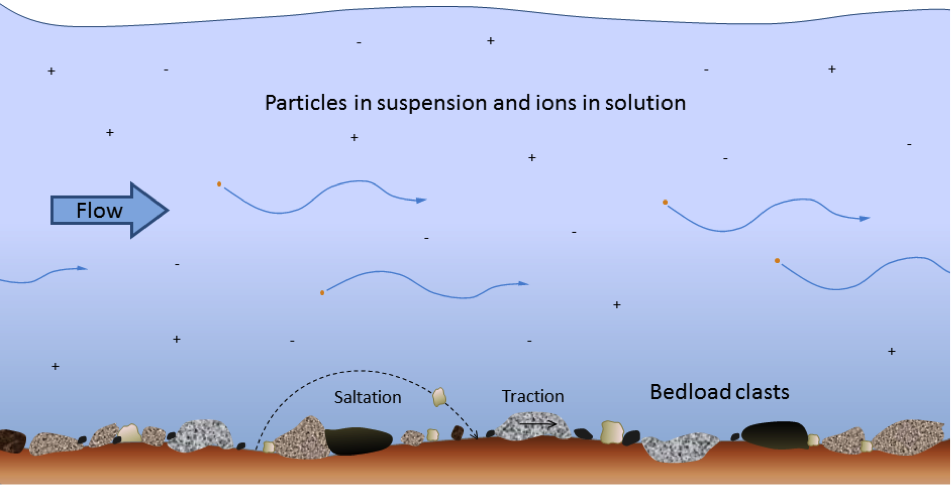
Transportation of sediment clasts by stream flow
The larger clasts, resting on the bottom (bedload), are moved by traction (sliding) or by saltation (bouncing). Smaller clasts are kept in suspension by turbulence in the flow. Ions (depicted as + and – in the image, but invisible in real life) are dissolved in the water.

Lithification
the conversion of unconsolidated sediments into rock by compaction and cementation

Cementation
the process of crystallization of minerals within the pores between the small clasts, and especially at the points of contact between clasts
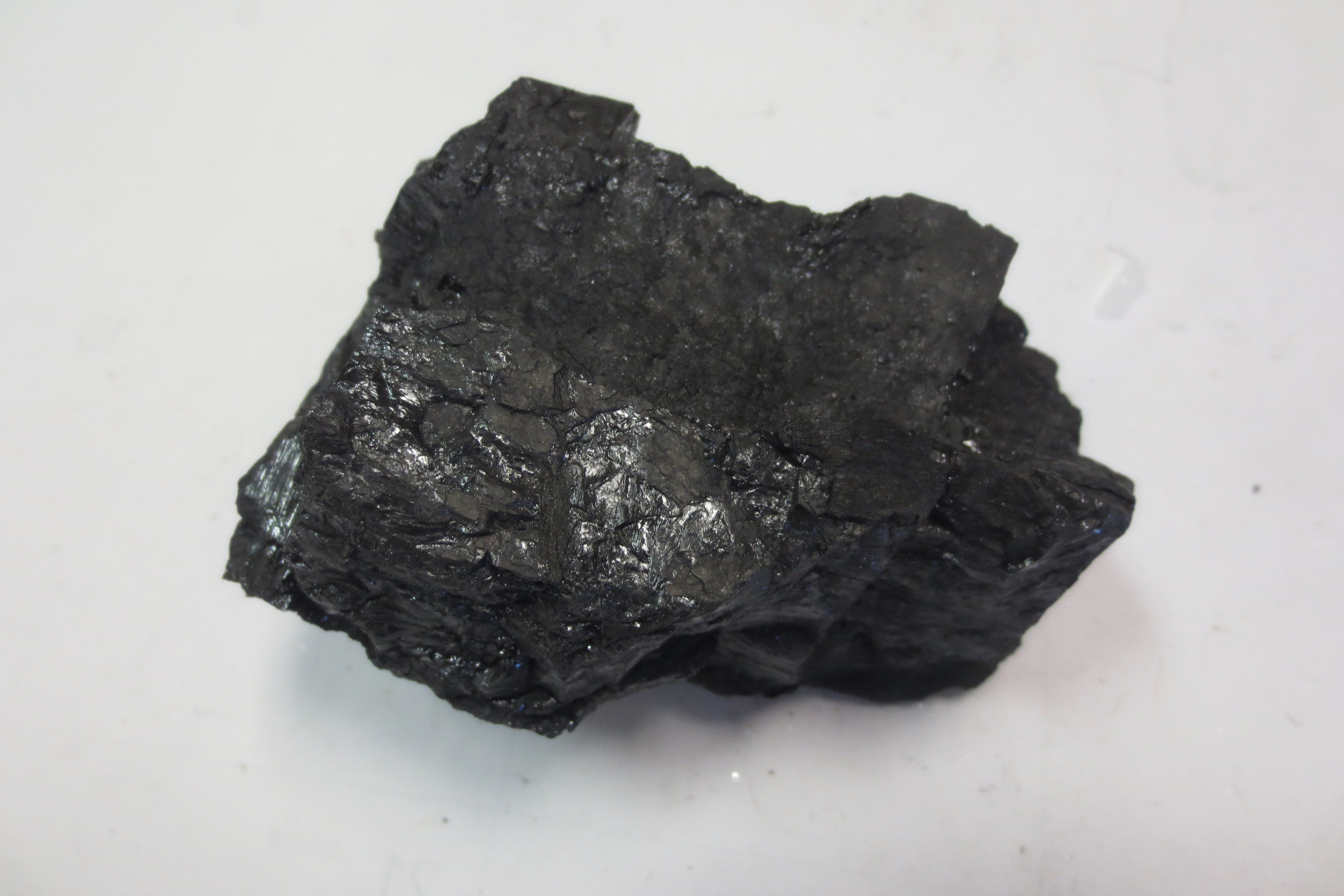
Coal
forms in fluvial or delta environments where vegetation growth is vigorous and where decaying plant matter accumulates in long-lasting swamps with low oxygen levels.
To avoid oxidation and breakdown, the organic matter must remain submerged for centuries or millennia, until it is covered with another layer of either muddy or sandy sediments

Conglomerates
a sedimentary rock that is comprised predominantly of rounded grains that are larger than 2 mm
form in high-energy environments such as fast-flowing rivers, where the particles can become rounded.

Breccias
a sedimentary- or volcanic-rock texture characterized by angular clasts
typically form where the particles are not transported a significant distance in water, such as alluvial fans and talus slopes

Formation of chemical sedimentary rocks
from ions that were transported in solution, and then converted into minerals by biological and/or chemical processes.

Limestone
most common chemical rock
comprised mostly of calcite
typically forms in shallow tropical environments, where biological activity is a very important factor

Evaporates
form where the water of lakes and inland seas becomes supersaturated due to evaporation

Chert
a very fine grained sedimentary rock formed almost entirely of silica
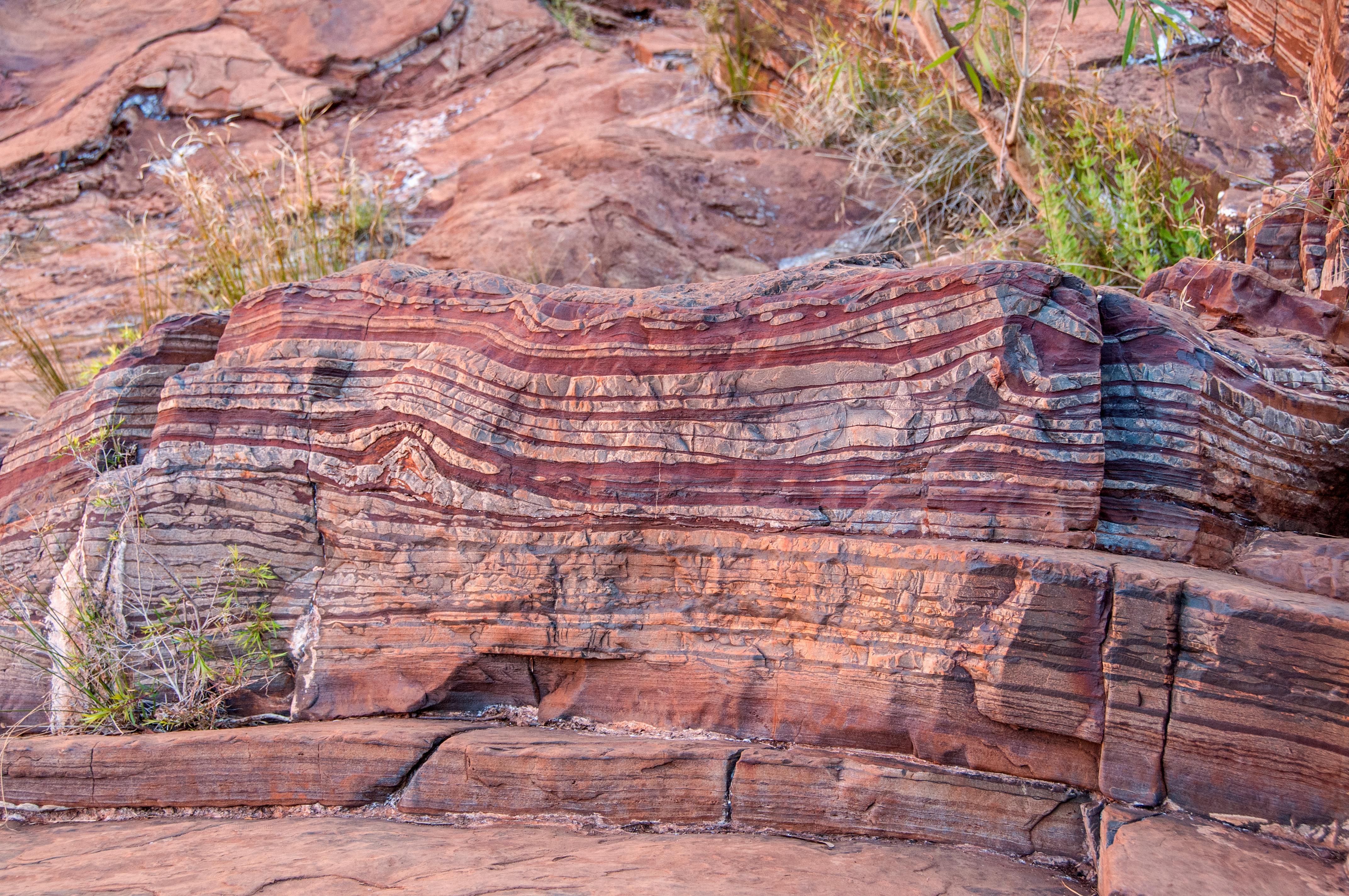
Banded-iron formation
an iron-bearing sedimentary rock that is rich in minerals such as hematite and magnetite, which may be interbedded with chert
A result of cyanobacteria

How reefs grow
tend to form in areas with clear water (e.g., not close to the mouths of large rivers), and near the edges of steep drop-offs because the reef organisms thrive on nutrient-rich upwelling currents. As the reef builds up, it is eroded by waves and currents to produce carbonate sediments that are transported into the steep offshore fore-reef area and the shallower inshore back-reef area

Dolomitization
the addition of magnesium to limestone during which some or all of the calcium carbonate is converted to dolomite

Depositional environments
Glacial, alluvial, fluvial, eolian, lacustrine, evaporite, marine

Glacial
gravity, moving ice, moving water | valleys, plains, streams, lakes | glacial till, gravel, sand, silt, and clay |

Alluvial
gravity | steep-sided valleys | coarse angular fragments |

Fluvial
moving water | streams | gravel, sand, silt, and organic matter (in swampy parts only) |

Eolian
wind | deserts and coastal regions | sand, silt |

Lacustrine
moving water (flowing into a lake) | lakes | sand (near the edges only), silt, clay, and organic matter |

Evaporate
moving water (flowing into a lake) | lakes in arid regions | salts, clay |

In order for sediments to be preserved long enough to be turned into rock
they need to have been deposited in a basin that will last millions of years. Most such basins are formed by plate tectonic processes

principle of original horizontality
that sediments accumulate in essentially horizontal layers. The implication is that tilted sedimentary layers observed to day must have been subjected to tectonic forces.

The principle of superposition
is that sedimentary layers are deposited in sequence, and that unless the entire sequence has been turned over by tectonic processes, the layers at the bottom are older than those at the top.

The principle of inclusions
is that any rock fragments in a sedimentary layer must be older than the layer. For example, the cobbles in a conglomerate must have been formed before the conglomerate was formed.

The principle of faunal succession
is that there is a well-defined order in which organisms have evolved through geological time, and therefore the identification of specific fossils in a rock can be used to determine its age.

Bedding
repeated layering in a sedimentary rock
an indication of changes in depositional processes that may be related to seasonal differences, changes in climate, changes in locations of rivers or deltas, or tectonic changes

Parting
a narrow gap between individual sedimentary layers
may represent periods of non-deposition that could range from a few decades to a few millennia

Cross-bedding
bedding that contains angled layers within otherwise horizontal beds, and it forms when sediments are deposited by flowing water or wind
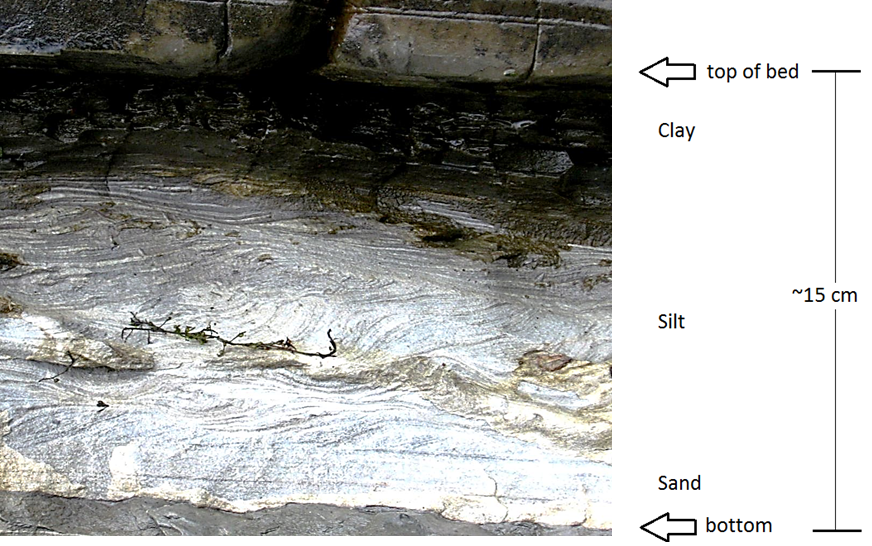
Graded bedding
an individual sedimentary layer that shows a distinctive gradation in grain size (normal graded bedding is finer towards the top, reverse graded bedding is coarser towards the top)

Ripples
on a series of small parallel ridges formed within sediment that has accumulated in moving water or wind

Mud cracks
a dessication crack formed in mud that has accumulated in a small body of water that later dries up or drains