Anatomy Unit 4 Week 1
 Call Kai
 Learn
Learn Practice Test
 Spaced Repetition
 Match
Match Flashcards
 Knowt Play
1/105

Earn XP
Description and Tags
Muscular System
Name | Mastery | Learn | Test | Matching | Spaced | Call with Kai | Chat |
|---|
No analytics yet
Send a link to your students to track their progress
106 Terms
What are all the functions of the muscular system?
movement, posture, joint stabilization, heat production, control of openings, movement of substances, and protection of organs
How do muscles help with movement?
muscles contract to move your body or body parts
How do muscles help with posture?
muscles help keep your body upright and stable
How do muscles help with joint stabilization?
muscles help hold joints in the correct position
How do muscles help with heat production?
muscle contractions produce heat that helps maintain body temperature
How do muscles help with substance movement in the body
smooth and cardiac muscles move substances internally (think digestive tract)
How do muscles help with the control of openings?
(sphincter muscles) open and close body muscles by contracting and relaxing
What are the five characteristics of the muscular system?
excitability, conductivity, contractility, extensibility, and elasticity
Excitability
the ability of a muscle to respond to a stimulus (like a nerve signal)
Conductivity
ability to spread the electrical signal throughout the muscle cell
Contractility
ability of a muscle to shorten and produce force
Extensibility
ability of a muscle to stretch or lengthen without being damaged
Elasticity
ability of a muscle to return to its original shape/length after being stretched or contracted

What type of muscle arrangement is this?
fusiform
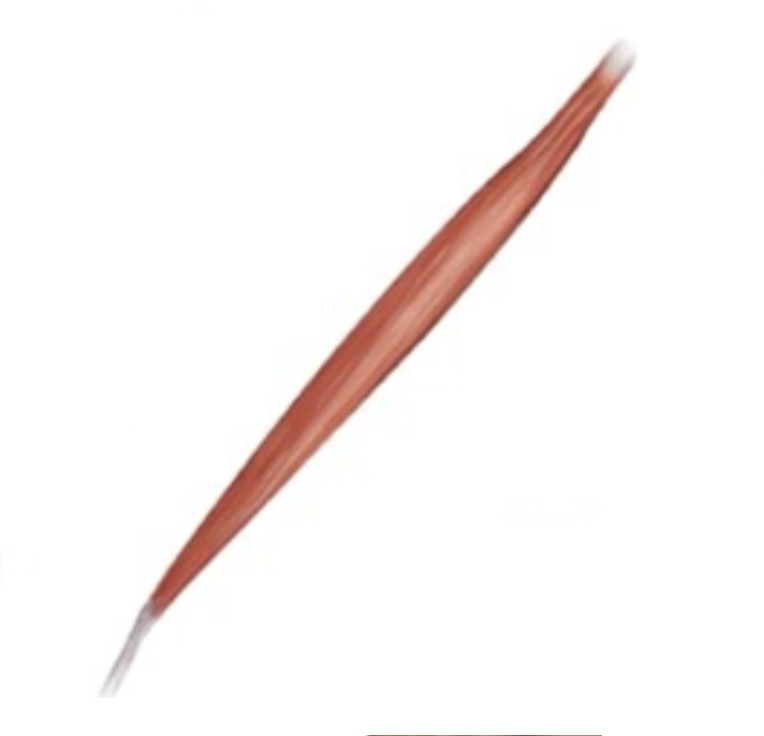
What type of muscle arrangement is this?
parallel

What type of muscle arrangement is this?
convergent

What type of muscle arrangement is this?
circular

What type of muscle arrangement is this?
Unipennate

What type of muscle arrangement is this?
Bipennate

What type of muscle arrangement is this?
multipennate
Primer Mover (agonist)
the main muscle responsible for action in a joint
Synergist
a helper muscle for a given action in a joint
Antagonist
a muscle that does the opposing action in a joint
Fixator
a muscle that holds a bone in place to help a primer mover have a stable bone to act on
What is innervation?
whatever the nerve sends a signal to, signaling nerve fibers that excites the muscle to cause it to contract

A?
Frontalis

B?
Zygomaticus major/minus

C?
Depressor Anguli Oris

D?
Epicranial Aponeurosis (galea aponeurotica)

E?
Orbicularis Oculi

F?
Orbicularis Oris

G?
Platysma
What is the innervation of the facial expression muscle group?
the facial nerve (cranial nerve #7)
What is an aponeurosis?
a broad, flat sheet of dense regular connective tissue that connects two muscle bellies or a muscle to a bone
What two bellies of muscle are connected by galea (epicranial) aponeurosis?
the frontalis and occipitalis
What is another word for chewing?
mastication
What is another word for swallowing?
deglutition

A?
Occipitalis

B?
Epicranial Aponeurosis

C?
Frontalis

A?
Buccinator

B?
Temporalis

C?
Masseter

A?
Lateral Pteygoid

B?
Medial Pteygoid

C?
Masseter
What is the innervation of the muscles of mastication?
trigeminal nerve (cranial nerve #5)
What nerve is the trigeminal nerve?
cranial nerve #5
What nerve is the facial nerve?
cranial nerve #7

A?
Suprahyoid
What does the suprahyoid do?
elevates the hyoid during swallowing and phonation(talking)

B?
Infrahyoid
What does the infrahyoid do?
depresses the hyoid during swallowing and phonation

C?
Sternocleidomastoid
What does the sternocleidomastoid do?
rotates head contralaterally

A?
Serratus anterior

B?
Transverse abdominis

C?
Internal abdominal oblique

D?
External abdominal oblique

E?
Anterior rectus sheath

F?
Pectoralis major

G?
Linea alba

H?
Tendinous intersections of rectus abdominis

I?
Rectus abdominis

J?
Inguinal Ligament
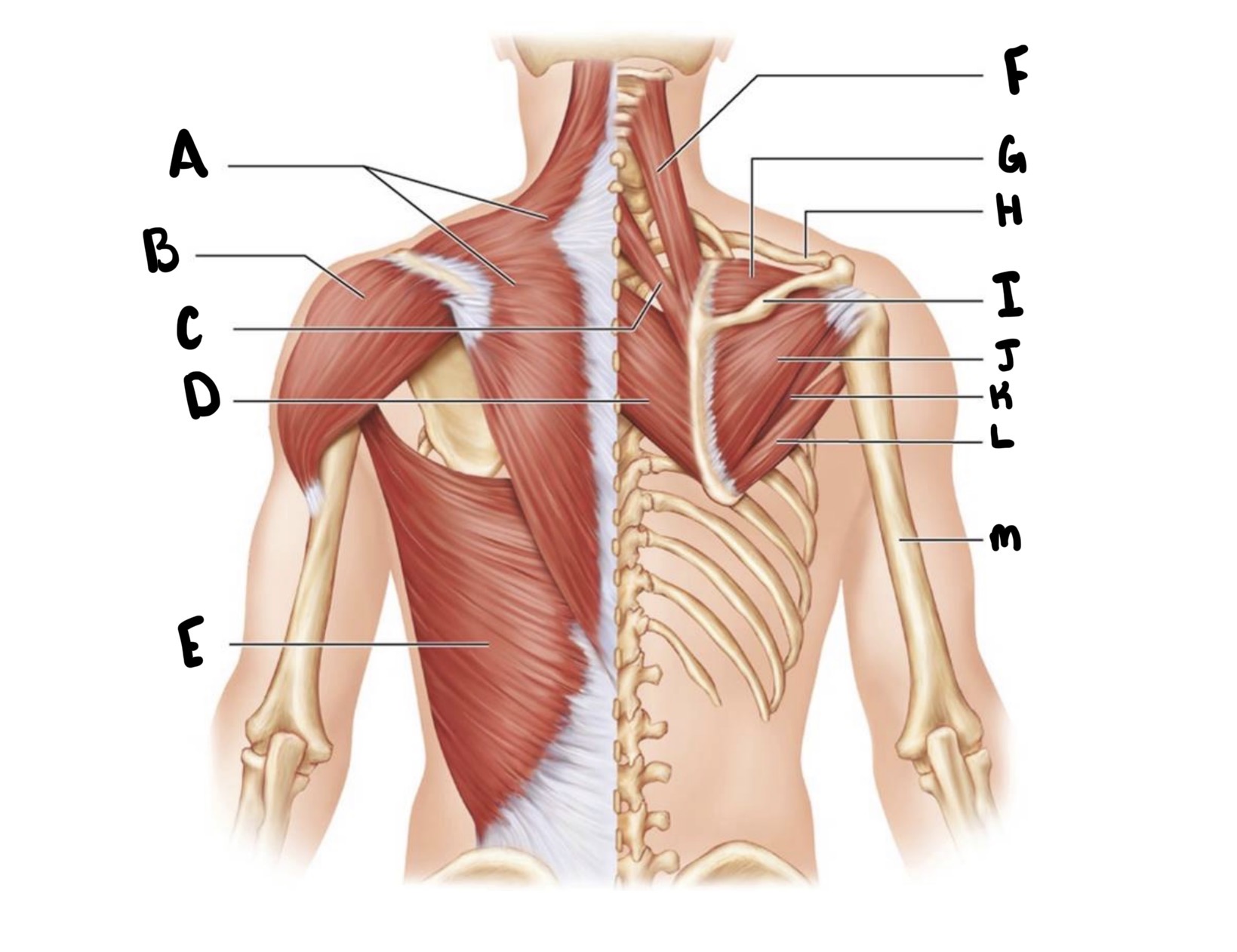
A?
Trapezius

B?
Deltoid

C?
Rhomboid minor

D?
Rhomboid major

E?
Latissimus dorsi

F?
Levator scapulae

G?
Supraspinatus

H?
Clavicle

I?
Spine of scapula

J?
Infraspinatus

K?
Teres minor

L?
Teres major

M?
Humerus

A?
Pectoralis major

B?
Deltoid

C?
Biceps brachii

D?
Supraspinatus

E?
Deltoid

G?
Infraspinatus

H?
Teres minor

I?
Teres major

J?
Triceps brachii

K?
Latissimus dorsi

A?
pectoralis minor

B?
coracobranchialis

C?
serratus anterior

A?
subscapularis

B?
coracobrachialis

C?
brachialis
What is the main innervation for the pectoral girdle?
the brachial plexus
What is the main innervation for the biceps brachii, brachialis, and the biceps brachii
the musculocutaneous nerve

A?
palmar aponeurosis

B?
hypothemar eminence

C?
palmaris longus tendon

D?
thenar eminence