1- Salivary Glands (Dr. Lahey)
 Call Kai
 Learn
 Practice Test
 Spaced Repetition
 Match
 Flashcards
 Knowt Play
1/98

There's no tags or description
Looks like no tags are added yet.
99 Terms
What are the three major salivary glands?
- Parotid
- Submandibular/submaxillary
- Sublingual
Where does the parotid gland drain?
Opposite the maxillary second molar on the buccal mucosa via Stensen's duct
Where does the submandibular gland drain?
Sublingual caruncle via Wharton's duct
Where does the sublingual gland primarily drain?
Sublingual fold via multiple ducts of Rivinus
The superior salivatory nucleus provides innervation to (3)
- CNV II (chorda tympani), submandibular ganglion
- Submandibular gland
- Sublingual gland
The inferior salivatory nucleus provides innervation to (3)
- CN IX (tympanic nerve to lesser petrosal n.)
- Otic ganglion
- Parotid gland
Which cranial nerve provides preganglionic parasympathetic innervation to the parotid gland?
CN IX
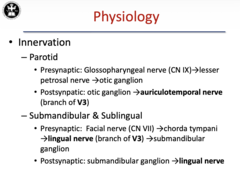
Which nerve carries preganglionic parasympathetic fibers to the otic ganglion?
Lesser petrosal nerve

Where do preganglionic parasympathetic fibers supplying the parotid gland synapse?
Otic ganglion

Which nerve carries postganglionic parasympathetic fibers to the parotid gland?
Auriculotemporal nerve (V3)

Which cranial nerve provides preganglionic parasympathetic innervation to the submandibular and sublingual glands?
CN VII (Facial)
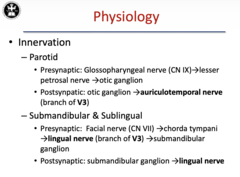
Which nerve carries preganglionic parasympathetic fibers from CN VII to join the lingual nerve?
Chorda tympani
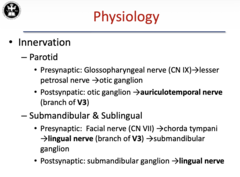
Where do preganglionic parasympathetic fibers supplying the submandibular and sublingual glands synapse?
Submandibular ganglion

Which branch of CN V3 carries parasympathetic fibers associated with the submandibular and sublingual glands?
Lingual nerve

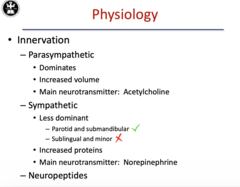
Which type of innervation dominates and results in increased volume?
Parasympathetic innervation
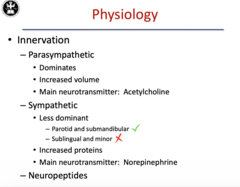
Which type of innervation is less dominant and results in increased proteins?
Sympathetic
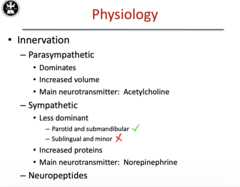
What is the main neurotransmitter for parasympathetic innervation?
Acetylcholine

What is the main neurotransmitter for sympathetic innervation?
Norepinephrine

T/F: Sympathetic innervation can effect parotid and submandibular glands and has no effect on sublingual and minor glands
True
All of the following are functions of saliva EXCEPT:
A) Digestion
B) Buffer
C) Tooth remineralization
D) Lubrication
E) Taste
F) Anitmicrobial
G) Flow
g

Which of the following is FALSE regarding the antimicrobial effect of saliva?
A) Promotes pathogenic growth
B) Prevents adherence
C) Promotes commensal growth
A - PREVENTS pathogenic growth

What type of secretory acini are found in the parotid gland?
Serous

What type of secretory acini are found in the submandibular gland?
Mixed (serous/mucinous)

What type of secretory acini are found in the sublingual gland?
Mucinous
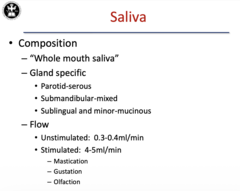
What is the normal unstimulated flow of saliva?
0.3-0.4 ml/min

What is the normal stimulated flow of saliva?
4-5 ml/min
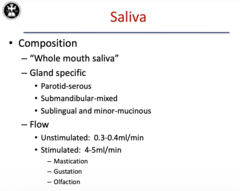
Saliva flow can be stimulated via... (3)
- Mastication
- Gustation
- Olfaction

Which major salivary gland plays the biggest role in unstimulated flow?
Submandibular gland
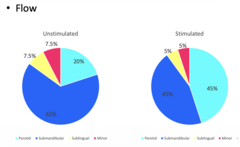
Which major salivary gland plays the biggest role in stimulated flow?
- Submandibular gland
- Parotid gland

Which of the following are signs/symptoms of an issue with salivary glands?
A) Swelling of the face/neck/mouth
B) Gustatory pain
C) Fever, anorexia, malaise, weight loss
D) Cranial nerve V/VII dysfunction
E) Lip/tongue numbness or facial weakness
F) Caries in atypical sites such as cusp tips and cervical margins or caries of increasing frequency
G) Dysgeusia
H) Dry mouth
ALL OPTIONS
What has the following characteristics?
- May or may not result in xerostomia
- NOT age dependent
- Usually secondary to medication or medical treatment
Hyposalivation

Hyposalivation is defined as an unstimulated saliva flow of what?
≤0.1ml/min

Hyposalivation is defined as a stimulated saliva flow of what?
≤0.7ml/min
What has the following characteristics?
- Altered saliva compositon
- Decreased volume (
Xerostomia

To make a differential diagnosis what acronym should we remember and what does it stand for?
VITAMIN CDE
- Vascular
- Infection/Inflammatory
- Trauma
- Autoimmune
- Metabolic
- Iatrogenic/Idiopathic
- Neoplasm
- Congenital
- Degenerative
- Endocrine

____% of vascular malformations occur in head and neck. What is the least common site?
50%, salivary gland

Predisposition to infection specifically _________ include all of the following:
- Decreased flow
- Age
- Recent illness/dehydration
- Recent surgery
Sialadenitis

Bacterial infection in the salivary glands is most commonly caused by __________
S. aureus
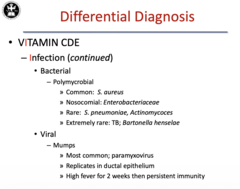
Bacterial infection in the salivary glands that is aquired through nosocomial means is most likely _________
Enterobacteriaceae

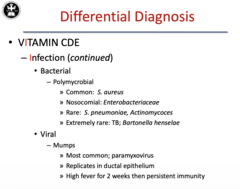
Viral infection Mumps in the salivary glands is most commonly caused by _________
Paramyxovirus

What has the following characteristics?
- Replicates in ductal epithelium
- High fever for 2 weeks then persistent immunity
Mumps
What are 4 viral infections that can affect salivary glands?
- Mumps
- HIV
- EBV
- Hep C
ID the viral infection:
-
HIV

ID the viral infection:
- Herpes viridae-infectious mononucleosis
- Saliva is only body fluid to contain this
Epstein-Barr Virus

ID the viral infection:
- Xerostomia and parotid enlargement
- Unclear etiology
Hepatitis C

85% of sialolithiasis obstruction occurs in the _____ gland
Submandibular
(85% intraductal; 15% intraglandular)
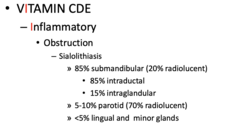
What percentage of sialolithiasis in the submandibular gland appear radiolucent?
20%

5-10% of sialolithiasis obstruction occurs in the _____ gland
Parotid

What percentage of sialolithiasis in the parotid gland appear radiolucent?
70%

Lingual and minor
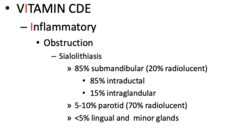
Sialolithiasis is most common in which gland? least common?
- Most common: submandibular
- Least common: lingual and minor glands

Mucocele, ranula, salivary extravasation are indicative of _______
Trauma

What are two types of toxins that are included in the differential diagnosis?
- Mercury
- Lead

What is the autoimmune disease discussed in lecture that can affect the salivary glands?
Sjorgen's Syndrome & Sarcoidosis

Sjorgen's Syndrome has a greater predisposition for which gender?
Female (mid 50s)

What percent of people are affected by Sjorgen's Syndrome?
0.5-1.2%

What is the difference betwen primary and secondary Sjorgen's Syndrome?
Primary - Patient only has Sjorgen's Syndrome
Secondary - Presence of other autoimmune disease
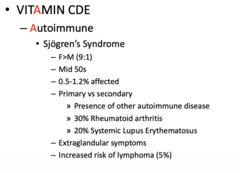
Sjogren's syndrome can present with what other autoimmune diseases?
- 30% Rheumatoid Arthiritis
- 20% Systemic Lupus Erythematosus (SLE)

Sjogren's syndrome experience ____ symptoms
Extraglandular

Sjogren's syndrome have a ________ risk of lymphoma (5%)
Increased

What are six parts of the Sjögren's Syndrome diagnostic criteria?
- Ocular symptoms
- Oral symptoms
- Ocular signs
- Histopathology
- Salivary gland involvement
- Autoantibodies
(NEED BIOPSY)

What has the following characeristics?
- Chronic, non-caseating granulomas
- 10-15% involve parotid gland enlargement
- Heerfordt's syndrome
Sarcoidosis

The following symptoms are indicative of what syndrome?
- Parotid enlargement
- Facial nerve palsy
- Anterior uveitis
- Fever
Heerfordt's syndrome

Sialadenosis is a chronic, bilateral, diffuse and non-inflammatory swelling of the major salivary glands. What category should you be thinking of for your differential diagnosis?
Metabolic

What metabolic condition is associated with parotid hypertrophy?
Bulimia nervosa

What metabolic condition is associated with...
- Glandular enlargement in 30-80% of cirrhosis
- Fatty infiltration with loss of acinar cells
- Decreased flow with altered composition
Chronic Alcohol Abuse

What major epidemiological change in head and neck squamous cell carcinoma began in the 1990s?
Increased incidence of HPV-associated oropharyngeal cancers
What are 3 iatrogenic diagnosis?
- Sialocele (fluid filled cavity)
- Radiation damage
- Radioactive iodine
____ effect of Radiation Damage to the salivary glands:
- 50-60% cell loss
Early (days to weeks)

____ effect of Radiation Damage to the salivary glands:
- Vascular damage and parenchymal loss
Late (months to years)
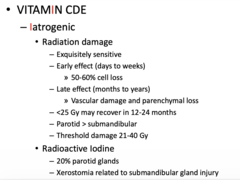
Radiation damage of
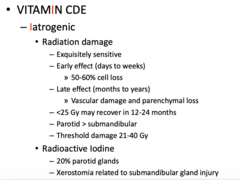
Radiation damage is greater to which gland?
Parotid

Radioactive iodine affects 20% of __________
Parotid glands

Xerostomia as a result of radioactive iodine is related to injury to what gland?
Submandibular

What has the following characteristics?
- Idiopathic
- Enlarged gland
- IgG4-positive plasma cell infiltration
- Fibrosis
- Kuttner's tumor
IgG4-related disease
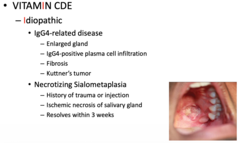
What has the following characteristics?
- Idiopathic
- History of trauma or injection
- Ischemic necrosis of salivary gland
- Resolves within 3 weeks
Necrotizing Sialometaplasia

Parotid gland tumors are ___% benign
80%
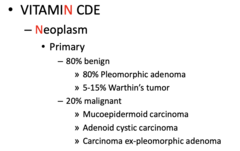
Parotid gland tumors are ___% malignant
20%

What is the most common benign tumor of the salivary glands?
Pleomorphic adenoma

All of the following are malignant tumors of the parotid gland EXCEPT:
A) Mucoepidermoid carcinoma
B) Warthin's Tumor
C) Adenoid cystic carcinoma
D) Carcinoma ex-pleomorphic adenoma
B - warthins tumor is benign and 5-15% occurrence in parotid gland

Which route is commonly involved in the regional spread of skin cancer to salivary glands?
Lymphatic

T/F: Secondary neoplasms of the salivary glands may result from metastatic, hematolymphoid, or lymphoid malignancies
True

Malignancy risk rises as gland size _______
Decreases

All of the following are congenital conditions associated with what gland?
- Treacher collins
- Hemifacial microsmia
- Ductal ectasia
- Branchial cleft cyst
- Cystic fibrosis
Parotid gland
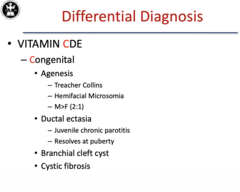
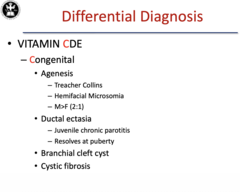
What congenital condition is associated with juvenile chronic parotitis and resolves at puberty?
ductal ectasia
What can cause degenerative changes in the salivary glands?
Duct ligation or denervation

What endocrine condition is associated with...
- Decreased secretory capacity
- Increased protein concentration
Diabetes Mellitus

What are all of the following used for?
- Ultrasound
- Sialogram
- Plain film
- CT scan
- MRI
Diagnostic imaging

For fine needle aspiration, use a ___-___ G needle
23-25 G

For fine needle aspiration, what is the sensitivity and specificity?
- 85% sensitivity
- 90% specificity

For fine core needle biopsy, use a ___ G needle
18 G

What diagnostic procedure?
- 18G needle
- Ultrasound guidance to avoid vessels
- Concern for seeding tumor
Core needle biopsy

What diagnostic procedure can be used for major and minor salivary glands, however, it is the last method we want to use?
Open biopsy

What diagnostic procedure?
Surgical correction of a salivary duct, often following the removal of a stone in a salivary gland, often opening or enlarging the duct
Sialodochoplasty
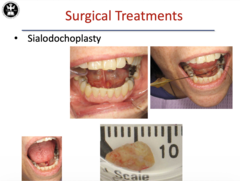
What diagnostic procedure?
Uses an endoscope to
- Diagnose and treat salivary gland disorders
- Can be used to: Remove stones with surgical instruments, Break up stones with a laser, Extract stone fragments
Sialoendoscopy

What type of biopsy is performed during submandibular gland excision?
Open excisional biopsy of a major salivary gland

What diagnostic procedure?
Procedure to remove the parotid gland, often used to treat tumors, stones or chronic infections in the parotid gland.
Parotidectomy

What surgical treatment can be used for pathology (i.e. malignant tumor) in the salivary glands?
Resection

What can be placed after removal of a malignant palatal tumor?
RPD
