Chapter 7 - Ninth week to Birth
 Call Kai
 Learn
Learn Practice Test
 Spaced Repetition
 Match
Match Flashcards
 Knowt Play
1/84

There's no tags or description
Looks like no tags are added yet.
Name | Mastery | Learn | Test | Matching | Spaced | Call with Kai | Chat |
|---|
No analytics yet
Send a link to your students to track their progress
85 Terms
Premature birth
Before 37 weeks
Nonviable birth
Before 24 weeks
In the fetal period, the focus shifts from organogenesis to what?
growth and tissue maturation
What rapidly increases during the fetal period?
Body size
Weight
-especially during final weeks
How much weight is gained per week from weeks 30-38?
½ lb
Fertilization age
38 weeks
Gestational age (LNMP)
40 weeks
Trimesters
Three 3-month intervals

Embryonic to Fetal Development
How large is the head at 9 weeks?
½ CRL
Body length nearly doubles by what week?
12 weeks
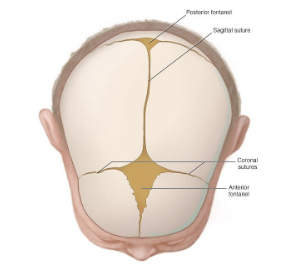
When do cranial bones begin ossifying?
During weeks 9-11
When is the brain fully grown?
6 years old

Allometry
How much one thing grows relative to another
Fetal facial development during weeks 9-12
Eyes are widely spaced
Ears lowset
Eyelids are fused
Fetal Limb development during weeks 9-12
Upper limbs near final relative length; 70% of lower limb length
Lower limbs shorter
When is external genitalia distinguishable?
End of week 12
Intestine development during weeks 9-12
Temporary herniation into umbilical cord
Return to abdomen by week 11
Stomach starts as one tube and rotates during development
Urine development during weeks 9-12
Swallowed amniotic fluid recycled by the placenta
Fetus with kidney problems usually result from less surrounding amniotic fluid and swallowing urine
Oligohydranamus
Low amniotic fluid
Internal fetal development occurs in weeks
9-12
When does rapid growth and earl movement occur?
Weeks 13-16
Coordinated limb movements occur by which week?
Week 14
Visible on ultrasound
not yet felt by mother
When are bones visible on ultrasound?
16 weeks
When does quickening occur?
Weeks 17-20
When are the first fetal movements felt by the mother?
Weeks 17-20

What is quickening?
Baby can be felt by the mother
Quick
Living
When do skin adaptations occur?
Weeks 17-20
Vernix Caseosa
Water
Lipids
Dead skin cells
Covers baby at birth
Vernix
Coating

Caseosa
Cheese

Lanugo
Fine fetal hair
Helps hold vernix against the skin
Thermoregulation
Preparing for life after birth occurs when?
Weeks 17-20
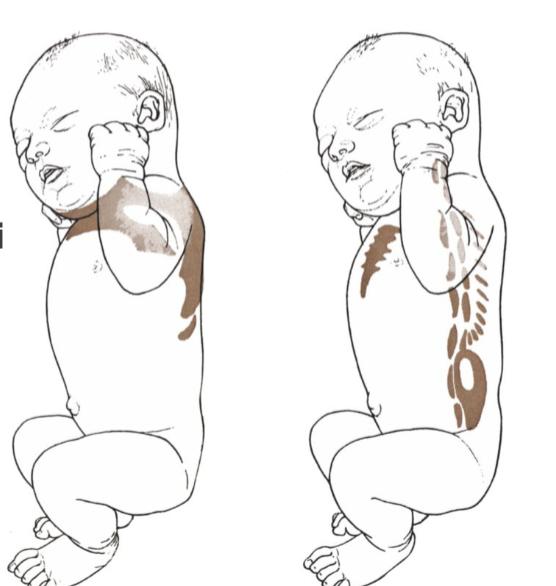
What occurs to prepare for birth in weeks 17-20
Brown fat begins to form
Important for heat production after birth - Thermoregulation
Approaching viability occurs during which weeks?
Weeks 21-25
What growth changes occur during weeks 21-25?
Significant weight gain
What appearance changes occur during weeks 21-25
Skin:
Think
Wrinkled
Reddish
Little subcutaneous fat
Underlying blood vessels remain visible

Singleton vs Dichorionic Twins vs Monochorionic Twins
Lung maturation occurs when?
Weeks 21-25
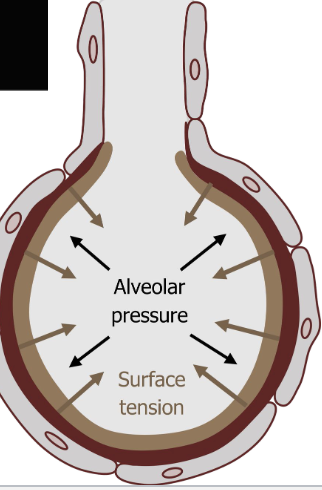
Lung maturation
• Type II pneumocytes begin secreting surfactant by ~24 weeks
-fetus not viable before this
• Surfactant reduces alveolar surface tension
• Helps prevent alveolar collapse

Alveoli
Ends of our lungs where O2 + CO2 exchange occur
Cohesion
H20 sticking to eachother
What does the surfactant do?
Breaks apart H2O
When does viability occur in infants?
Week 24
Birth at week 24
• Survival possible with intensiveneonatal care
Major risks include:
• Respiratory distress (NRDS)
• Brain hemorrhage: vessels not fully developed
• Sepsis
• Long-term neurodevelopmental
impairments
Continued Maturation occurs when?
Weeks 26-29
When do eyelids open
During weeks 26-29
When are lungs capable of gas exchange?
During weeks 26-29
When does the CNS continuously control rhytmic breathing and body temperature?
During weeks 26-29
When is there more subcutaneous fat?
During weeks 26-29
SIDS
sudden infant death syndrome
-medulla isn’t fully matured until 6 months after birth and it dictates rhythmic breathing
How can SIDS occur?
Babies that are covered in blankets can breathe in their own CO2 and this causes their blood to become acidic
-also stomach sleeping for babies is dangerous
When does Late Fetal Development occur?
Weeks 30-38
When does the pupillary light reflex present
30 weeks
By what week would most fetuses survive if born?
32 weeks
What else occurs during late fetal development?
subcutaneous fat increases and continued organ maturation
When are fetuses full term?
~38 weeks after fertilization or ~40 weeks gestational age
Average weight at birth
7.5 lbs or 3,400 grams
What is the appearance of the body at birth
Rounded
9-12 weeks snapshot
Rapid growth and changing proportions
13-20 weeks snapshot
Coordinated movement → quickening
21-25 weeks snapshot
Lung maturation and potential viability
26 weeks → birth snapshot
Functional maturation and fat accumulation
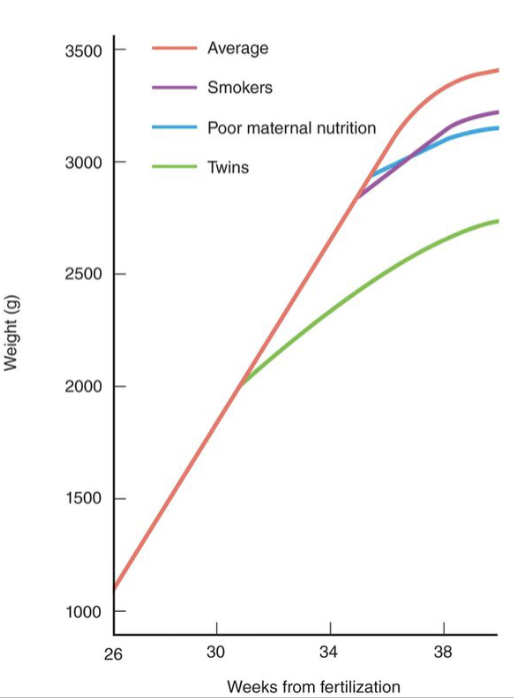
Factors influencing fetal growth
Genetic
Placental
Environmental
IUGR
Intrauterine Growth Restriction
-Fetus is too small
Macrosomia
Fetus is too large
Multiple pregnancy leads to
Lower birth weight
Maternal diabetes leads to
Larger
Ultrasonography
Used throughout the pregnancy to assess changes in the fetus
Early pregnancy ultrasonography
Around week 8 to determine:
Viability
Gestational age
Mid pregnancy ultrasonography
Around week 18 to determine:
Fetal anatomy
Later pregnancy ultrasonography
Around week 30 to determine:
Growth
Placenta
Presenation: direction baby is facing
What are the different fetal presenations
1.) Cephalic: Head first
2.) Breech: Feet first
3.) Transverse: Shoulder first

Chorionic Villus Sampling (CVS)
Samples Chorionic villi
Around 8-10 weeks
Used for:
Chromosomal abnormalities
Inherited genetic disorders
1% spontaneous abortion risk

Amniocentesis
Samples amniotic fluid
Around 13-16 weeks
Provides fetal cells for genetic/chromosomal testing
Amniotic fluid can be tested for AFP
0.5% spontaneous abortion risk

Percutaneous Umbilical Blood Sampling
Samples fetal blood in the umbilical vein
Around 16 weeks
Used to evaluate:
Fetal infections
Blood disorders
Genetic abnormalities
1.3% risk of spontaneous abortion
Alpha-fetoprotein (AFP) assay
Optimal around weeks 16-19
Neural tube defects
Ventral wall defects

Cell-free DNA/Noninvasive prenatal (NIPT) Screening
>10 weeks
Fetal DNA in maternal blood (up to 27 years later)
screens for common trisomies (13, 18, 21)
Fetal monitoring
Monitors fetal heart rate
Abnormal patterns may indicate fetal distress
MRI
Complex fetal abnormalities
Fetal surgery planning
Neonatal Period occurs when?
Birth to 4 weeks
What occurs at birth?
First breath
Fetal circulatory shunt begins to close
Early neonatal period
Cord falls off ~ 7-8 days
10%weight loss normal
Late neonatal (7–28 days)
Reflexes:
Grasp
Rooting
Turn toward cheek stimulus