Sect 7 - ALL, CLL, PLL, HCL
 Call Kai
 Learn
 Practice Test
 Spaced Repetition
 Match
 Flashcards
 Knowt Play
1/47

There's no tags or description
Looks like no tags are added yet.
48 Terms
Acute Lymphoblastic Leukemia
What does ALL stand for?
Chronic Lymphocytic Leukemia
What does CLL stand for?
Prolymphocytic Leukemia
What does PLL stand for?
Hairy Cell Luekemia
What does HCL stand for?
T-cell: CD3, CD4, CD8
B-cell: CD19, D20, CD23, CD5
What CD marker can be used to differentiate T cells and B cell leukemias
ALL: children
CLL: adults (median age is 70)
What age group are ALL and CLL most common in?
ALL
acute leukemia of immature lymphocytic cells that occurs most often in children
clinical features of ALL
malaise, fatigue, pallor, easy bruising
epistaxis
bone tenderness
acute onset, progressive
most common in 2-10 year olds
ALL lab features
increased WBC count (>100,000/ul)
1/3 of pts will have normal/low WBC
neutropenia, thrombocytopenia, and anemia
increased LD/uric acid
fibrinogen levels increased
cytochemical stains
blasts neg with Peroxidase, SBB, and NSE
PAS pos
TdT pos
hypercellular with lymphoblastss
bone marrow of ALL
AML has Auer rods
What cellular inclusion helps to differentiate between AML from ALL?
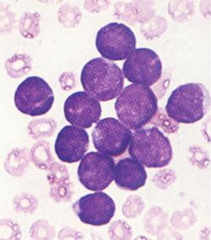
L1: dark, no cytoplasm
L2: larger with more cytoplasm, prominent nucleoli
L3: "starry sky", lots of vacuolization
Differentiate ALL-L1, L2, and L3.
ALL-L1
Clumps of cells
Clefting of cells
NO cytoplasm
ALL-L2
Larger with more cytoplasm
Prominent nucleoli
Vacuolization
Look like receive lymphs & monos

ALL-L3
"Starry Sky" - A LOT of vacuolization
Related to Burkitt's Lymphoma (B-cell lymphoma)

immunological types of ALL
Pro-B (early precursor)
Intermediate Pre-B (common ALL)
Pre-B cell ALL
Burkitt type (B-cell ALL)
Precursor T (T-cell ALL)
Natural Killer cell ALL
1. Remission Induction
2. CNS directed therapy
3. Consolidation
4. Continuation
4 phases of ALL treatment
CLL
malignant monoclonal proliferation of mature B lymphs
- immunologically incompetent
- disease blocks further development of B-cells
- median age 70 years
- men more affected (2:1)
causes of CLL
genetic factors
chromosome add/del (trisomy 12, del 13q, 16q, 11q)
immune imcompentency
clinical features of CLL
fatigue, reduced tolerance to exercise
lymphadenopathy, splenomegaly
persistent infection
easy bruising
pallor
increased bone tenderness
CLL lab features
neutropenia
thrombocytopenia
absolute lymphocytosis (10,000-150,000/ul) (mature)
fragile lymphocytes (smudge cells)
increased uric acid
fragile lymphocytes (smudge cells)
What cells are characteristic of CLL?
albumin
How do we correct smudge cells in CLL?
CD5, 19, 20, 23
CD markers of CLL
**hint: mature B cell lymphs
hypogammaglobulinemia
protein electrophoresis of CLL
stage 1
CLL Stages
lymphocytosis without anemia and thrombocytopenia
less than 3 areas of lymphoid involvement
stage 2
CLL Stages
lymphocytosis without anemia and thrombocytopenia
greater than 3 areas of lymphoid involvement
stage 3
CLL Stages
lymphocytosis with anemia and thrombocytosis
greater than 3 lymphoid involvement
- around 3% of CLL pts develop Richter's transformation (aggressive B-cell lymphoma)
treatment of CLL
control WBC count
reduce symptoms
corticosteroids
most pts are not treated initially
PLL
rare but very aggressive leukemia
- can have either mature B or T cell phenotype
- most cases are de novo, but some arise from CLL
clinical features of PLL
marked splenomegaly
minimal lymphadenopathy
frequent lymphadenopathy, hepatomegaly & skin lesion
7.5 months
median survival for PLL
PLL lab features
extremely high WBC count
absolute lymphocytosis (>300,000/ul)
>55% prolymphocytes
CD20 and 22+
FMC-7+
CD markers for B-cell PLL
CD2, 3, 4, 5+
CD marker for T-cell PLL
HCL
Leukemic Reticuloendotheliosis
- uncommon disorder
clinical features of HCL
disease of middle-aged men
malaise and fatigue
massive splenomegaly
HCL lab features
pancytopenia
bone marrow shows fibrotic replacement (dry tap)
CD19, 20, 22, and 11c
CD marker of HCL, mature B-cells
Tdt (terminal deoxynucleotidyl transferase)
stain that stains DNA polymerase
- stains lymphocytes (fluorescent)
- does not stain Burkitt's lymphoma
TRAP stain
all cells will stain positive for acid phosphatase
BUT only Hairy cell lymphs are resistant to tartaric acid and will remain positive
treatment for HCL
splenectomy
chemo with Cladribine (2-chlorodeoxyadenosine, Leustatin)
CLL: 10,000-150,000 /uL
PLL: >300,000 /uL
Differentiate between CLL and PLL in terms of WBC count
uric acid and Lactate Dehydrogenase (LD)
What two chemistry tests would you expect to be increased when cell proliferation increases?
B-cell leukemia
Is CLL a B-cell or T-cell leukemia?
determines the severity of the disease; helps with treatment
What is the importance of staging in terms of diagnosis?
Myeloblast
Myeloblast OR Lymphoblast
Larger, irregular/lobulated appearance
Positive for: Myeloperoxidase, Sudan Black B, and Specific Esterase
Lymphoblast
More uniform but still big
Positive for PAS