BPD - Anatomy: Euclides geometry and anatomy cranial

0.0(0)
Studied by 0 people
call kaiCall Kai
learnLearn
examPractice Test
spaced repetitionSpaced Repetition
heart puzzleMatch
flashcardsFlashcards
GameKnowt Play
Card Sorting

1/3

encourage image

There's no tags or description

Looks like no tags are added yet.

4 Terms

1
New cards

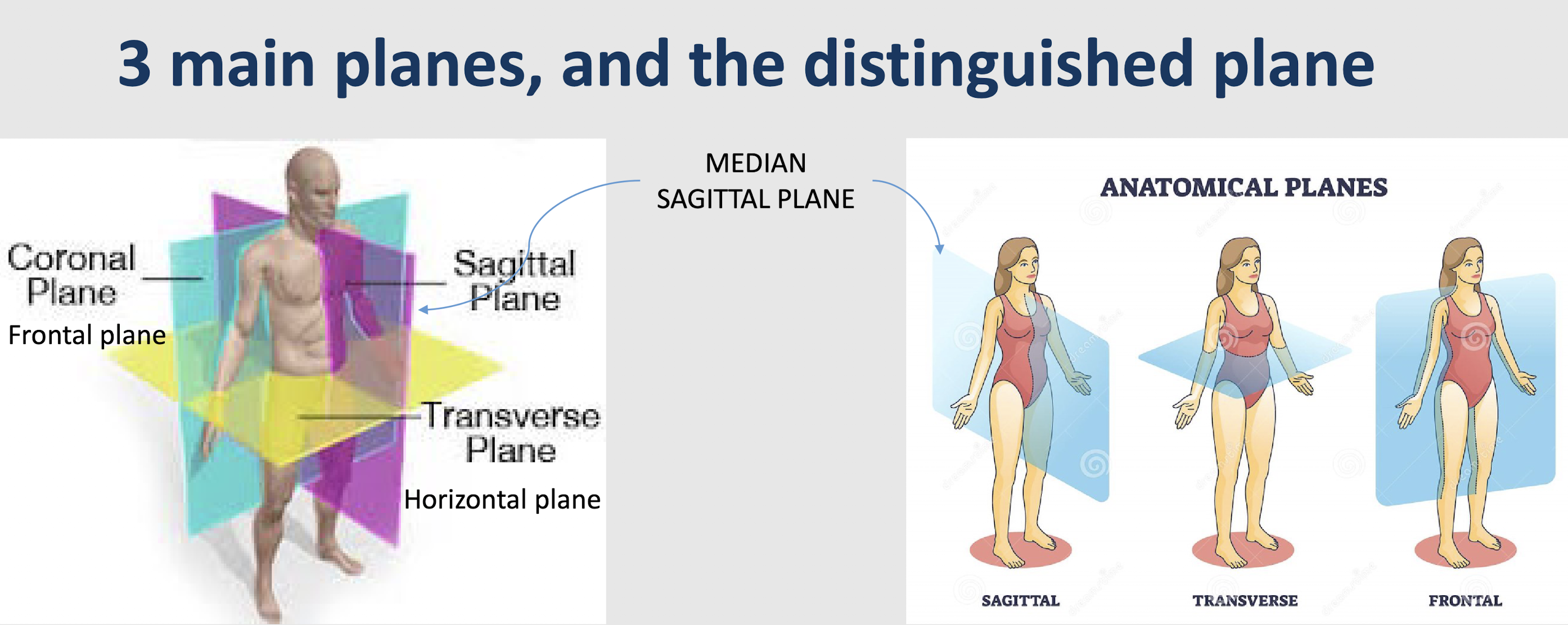
The three main anatomical (euclides) planes

  • Sagittal plane: A vertical plane that divides the body into left and right parts

    • Many sagittal planes are possible, but the most important is the median sagittal (midsagittal) plane, which passes through the midline and divides the body into equal left and right halves, and can describe the body with lateral and medial (closer to the median sagittal plane)

  • Coronal (frontal) plane: A vertical plane the divides the body into front (anterior) and back (posterior) parts.

  • Transverse (horizontal) plane: A horizontal plane that divides the body into upper (superior) and lower (inferior) parts

<ul><li><p><strong><u>Sagittal plane</u></strong>: A vertical plane that divides the body into <strong>left</strong> and <strong>right</strong> parts</p><ul><li><p>Many sagittal&nbsp;planes are possible, but the most important is the <strong>median sagittal (midsagittal) plane</strong>, which passes through the midline and divides the body into equal left and right halves, and can describe the body with lateral and medial (closer to the median sagittal plane)</p></li></ul></li><li><p><strong><u>Coronal (frontal) plane</u></strong>: A vertical plane the divides the body into front (<strong>anterior</strong>) and back (<strong>posterior</strong>) parts.</p></li><li><p><strong><u>Transverse (horizontal) plane</u></strong>: A horizontal plane that divides the body into upper (<strong>superior</strong>) and lower (<strong>inferior</strong>) parts</p></li></ul><p></p>
2
New cards

Anatomical directions

  • Superior/cranial = toward the head

  • Inferior/caudal = toward the feet


  • Anterior/ventral = toward the front

  • Posterior/dorsal = toward the back


  • Medial = toward the midline

  • Lateral = away from the midline


  • Proximal = closer to the origin/attachment

  • Distal = farther from the origin/attachemnt


<ul><li><p><strong>Superior</strong>/<strong>cranial</strong> = toward the head</p></li><li><p><strong>Inferior</strong>/<strong>caudal</strong> = toward the feet</p></li></ul><p>&nbsp;</p><ul><li><p><strong>Anterior</strong>/<strong>ventral</strong> = toward the front</p></li><li><p><strong>Posterior</strong>/<strong>dorsal </strong>= toward the back</p></li></ul><p>&nbsp;</p><ul><li><p><strong>Medial</strong> = toward the midline</p></li><li><p><strong>Lateral</strong> = away from the midline</p></li></ul><p>&nbsp;</p><ul><li><p><strong>Proximal</strong> = closer to the origin/attachment</p></li><li><p><strong>Distal</strong> = farther from the origin/attachemnt</p></li></ul><p></p>
3
New cards

Anatomy cranial

  • The cranium consists of several mostly flat bones connected by immovable joints called sutures.

  • The main facial bones are divided into two jaws:

    • Maxilla (upper jaw)

    • Mandibula (lower jaw) - the main movable bone in the skull, and connects to the termporal bone (a bone located on the side of the head, near the ear) on each side through the jaw joint (temporomandibular joint, TMJ), the only joint in the skull


  • Medial: toward the midline (skull)

  • Lateral: away from the midline

  • Mesial:  along the dental arch toward the midline/front teeth

  • Distal: along the dental arch away from the midline/front teeth, toward the back teeth

  • Coronal/cranial: toward the top/head

  • Caudal: toward the lower part of the body


<ul><li><p>The cranium consists of several mostly <strong>flat bones</strong> connected by immovable joints called <strong>sutures</strong>.</p></li><li><p>The main facial bones are divided into two jaws:</p><ul><li><p><strong><u>Maxilla</u></strong><u> (</u><strong><u>upper jaw</u></strong><u>)</u></p></li><li><p><strong><u>Mandibula</u></strong><u> (</u><strong><u>lower jaw</u></strong><u>)</u> - the main <strong><u>movable bone</u> </strong>in the skull, and connects to the <strong>termporal bone</strong> (a bone located on the side of the head, near the ear) on each side through the<strong> jaw joint </strong>(temporomandibular joint, TMJ), the only joint in the skull</p></li></ul></li></ul><p></p><ul><li><p><strong>Medial</strong>: toward the midline (skull)</p></li><li><p><strong>Lateral</strong>: away from the midline</p></li><li><p><strong>Mesial</strong>:&nbsp; along the dental arch toward the midline/front teeth</p></li><li><p><strong>Distal</strong>: along the dental arch away from the midline/front teeth, toward the back teeth</p></li><li><p><strong>Coronal/cranial</strong>: toward the top/head</p></li><li><p><strong>Caudal</strong>: toward the lower part of the body</p></li></ul><p></p>
4
New cards

Permanent and deciduous teeth

  • Deciduous teeth = the first, temporary set of teeth (“baby teeth”)

  • Permanent teeth = the seond set that replaces the deciduous teeth and is intended to remain through adulthood


<ul><li><p><strong>Deciduous teeth</strong> = the first, temporary set of teeth (“baby teeth”)</p></li><li><p><strong>Permanent teeth</strong> = the seond set that replaces the deciduous teeth and is intended to remain through adulthood </p></li></ul><p></p>



