Genetics 3000 DNA mutation and repair
 Call Kai
 Learn
 Practice Test
 Spaced Repetition
 Match
 Flashcards
 Knowt Play
1/63

There's no tags or description
Looks like no tags are added yet.
64 Terms
Mutations are not necessarily …
harmful, for example: people with a mutated CCR5 gene do not place certain proteins on the outside of the cell which make it impossible for HIV to bind which makes them immune
Mutations can happen in somatic cells where …
the area of the mutation may spread, but it doesn’t affect the entire body, and it CANNOT be passed to offspring
Mutations that happen in Germline cells are passed …
to offspring, their entire genome will reflect the mutation because that is what they inherited
A transition substitution is when …
same type of nitrogenous base is swapped (Pyrimidine for a Pyrimidine, or Purine for a Purine)
A transversion substitution is when …
a different nitrogenous base is switched (purine for a pyrimidine)
Frameshifts are also called …
indels - when one or a few nucleotides are added or removed
Expanding nucleotide repeats occur when a set of …
repeated nucleotides increase in number
Neutral mutations occur when they are in …
regions that do not affect gene products (places that aren’t expressed like UTRs, centromeres, transposons, highly condensed chromatin)
Loss of function is a mutation that …
reduces or eliminates the function of a gene product (complete loss results from a null mutation)
Gain of function is a mutation that …
enhances function of a gene product, could create a completely new function
A missense mutation is when …
a single amino acid is changed, could be detrimental could have no effect, depends on what amino acid it was changed to
Nonsense mutation is when the new codon is a …
stop codon producing a premature termination of translation, producing a short protein
A silent mutation is when …
there is a change in the nucleotide sequence but it codes for the same amino acid, resulting in no change to the gene product
Lethal mutations …
cause premature death of the organism
Suppressor mutations …
mask the effect of an earlier mutation
Mutation rate =
the frequency with which a wild type allele will undergo a mutation
Mutations can either be spontaneous or …
induced - associated with external factors, spontaneous - appear to occur naturally
Somatic cells have higher …
mutation rates than germ cells, because somatic cells interact with the environment
Causes of spontaneous mutations are …
replication errors - occasionally the wrong base is added during replication
When one strand of DNA is not tightly paired to the complimentary strand it will slip and the mRNA strand made from this will be missing that singular nucleotide causing a frame-shift, this is called …
replication slippage
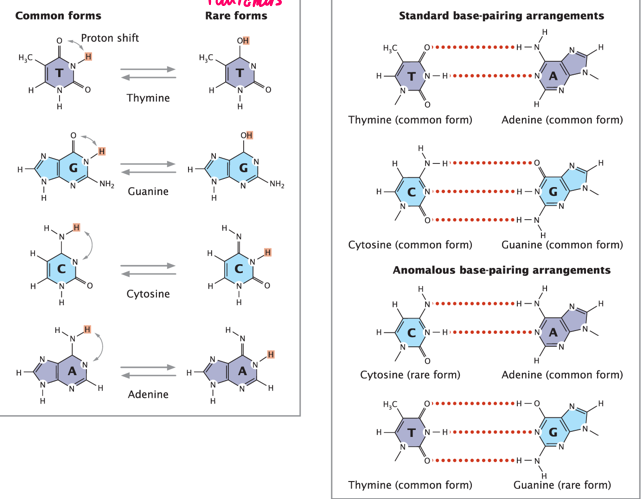
Along with the wrong nucleotides being added during replication, a differently formed nucleotide can be added and these are called …
tautomers, these are rare forms that have different structure causing them to pair differently
Replication slippage happens when DNA polymerase stalls because …
it has repeatedly made the same pairings over and over again, helicase doesn’t stop so we get a gap between DNA pol. and helicase, the unwound DNA will loop which then is cut off during meiosis/mitosis causing a loss in GI
Another cause of spontaneous mutations is that nitrogenous bases can be chemically …
modified, abasic sites are when the nitrogenous base is removed from the nucleotide by simply water which breaks the bond (also called depurination), will lead to the loss of a nucleotide

In addition to the formation of a abasic site, deamination can also take place which is when …
the amine group of the nitrogenous base is removed by water, this would make cytosine into uracil
Thymine cannot undergo …
deamination as it does not have an amine group
Causes of induced mutation are …
external environmental factors called mutagens
Examples of mutagens are …
chemicals and radiation, ex = radium which is a naturally occurring radioactive element, decaying radium can excite fluorescent materials and make them glow, but when ingested it mimics calcium and accumulates in the bones
Base analogs are …
chemicals that substitute for a nucleotide, like 5-bromouracil which will mispair with a guanine and lead to a transition mutation (TA to CG)

Chemical mutagens include …
base analogs, alkylating agents, intercalating agents, and adduct forming agents
Alkylating agents are chemicals that …
add on an alkyl group to a nucleotide, like mustard gas (Ethylmethylsulfonate - EMS)

Intercalating agents are …
chemicals that can slide between base pairs and distort the double helix, ex. Proflavin, acridine orange

Adduct forming agents are …
chemicals that add a chemical moiety to DNA via a covalent bond (there are a lot of these and they are environmental hazards), some moieties make bases stick together permanently and can trigger cell death
Two types of radiation can change DNA:
Ionizing radiation which removes e- (x-rays and gamma rays) and Ultraviolet rays (both directly damage DNA or excite neighboring molecules that will cause damage)
UV radiation is associated with the formation of …
Pyrimidine dimers (also called thymine dimers), they are a cross link of two adjacent pyrimidine bases (distorts shape of double helix, will cause cell death if damage is extensive

Ionizing radiation is more broad as it can excite …
stable molecules and create free radicals (which are just things with an unpaired e-) free radicals can break phosphodiester bonds (they are super reactive and will go around picking off things e- making those things reactive as well)
Transposable elements are sequences of DNA that can …
move throughout and between chromosomes, they vary in size, are found in all organisms and are a prominent contributor to expansion of genome size
Transposons have what flanking their ends?
Short repetitive mobile elements
DNA transposons do not produce …
RNA, they move between the genome via cut and paste, has an inverted terminal repeat that flanks the gene sequence for transposase, two types autonomous and nonautonomous

Transposase is found in …
DNA transposons and it finds transposons, cuts them out of the DNA and moves them
Retrotransposons produce …
RNA as an intermediate, they also move through the genome as copy and paste, there are two types nonautonomous and autonomous (long terminal repeat (LTR) and non-long terminal repeat
Retrotransposons contain gene sequences for …
reverse transcriptase - finds mRNA and copies DNA which then enters the nucleus and joins the genome
The insertion of another portion of the genome is …
random, transposons could be placed somewhere that disrupts the reading frame and create splicing errors, the insertion could enhance a gene product as well
If two transposable elements (TEs) are close to each other it can lead to …
chromosomal rearrangements
During cell division when transposable elements are close to each other two things can happen:
2 TEs pair forming a loop when they are oriented in the same direction and it gets spliced off during cell division (creates a deletion product)
2 TEs pair by bending and crossing over when they are oriented in the opposite direction = an inversion
TEs misalign and undergo unequal exchange, they are located on two sister chromatids = 1 chromosome with a deletion and 1 with a duplication
Monogenetic conditions are due to mutations in a …
single gene (sometimes called Mendelian diseases)
Complex diseases may have contributors from …
mutations in multiple different genes, the environment may also contribute to these diseases

Mechanisms of DNA repair include …
Homologous recombination, Non-homologous end-joining, Base excision repair (BER), nucleotide excision repair (NER) and Mismatch repair
Some types of DNA damage are repaired through simple …
reversal using specific enzymes (they don’t require an entire system to fix)
What two DNA repair systems fix Double stranded breaks (DSBs)?
Non-homologous end joining and homologous recombination
Homologous recombination can ONLY occur during the …
synthesis phase of the cell cycle and the S phase (synthesis), fills in the gaps when a double-stranded break occurs
In Nonhomologous end joining Ku proteins …
recognize the break and trim and add to the ends until the two ends of DNA can be reattached, happens when there is not sister chromatid present
Shine Dalgarno is highly …
conserved in prokaryotes
Base excision repair (BER) corrects damage that …
DOESN’T distort the shape of the double helix, DNA glycosylases do the repair
BER corrects …
oxidative, alkylation, and abasic damage, the proteins recognize the damage, remove it and add in a new base, only fixes SINGULAR nucleotides
Nucleotide excision repair (NER) removes …
MULTIPLE nucleotides that SIGNIFICANTLY distort the shape of the helix, mediated through specific NER enzymes
NER corrects …
pyrimidine dimers and DNA adducts (stuff that changes the helix shape), removes multiple nucleotides and polymerase and ligase replace the removed nucleotides
What disease shows the mutation of the NER proteins for the NER pathway?
Xeroderma pigmentosum, this greatly increases a patient’s sensitivity to sunlight exposure (will get freckles really early and sunburn within minutes of exposure, symptoms begin early in childhood
Xeroderma pigmentosum is a …
heritable, autosomal recessive disorder, non-functioning proteins can’t detect dimers and they aren’t removed, there is no treatment
Mismatch repair (MMR) corrects base …
mismatches and strand slippage loops that occur during replication, requires identification of the new strand and removal of MULTIPLE nucleotides surrounding the mismatch
What recognizes mismatches for the MMR?
MutSalpha heterodimer (its two polypeptides binded - a complex), it recruits other proteins to stabilize the parental strand while waiting for synthesis and ligation
MutSalpha recruits Exonuclease to …
remove the mismatched area from the new DNA strand
What disorder is the result of mutations in genes for making proteins for the MMR pathway?
Lynch Syndrome (formerly called hereditary non-polyposis colorectal cancer (HNPCC), is the increased risk developing multiple different types of cancer (colorectal, endometrial, stomach, pancreatic, etc.)
Mutations in the MMR pathway do not have to affect ALL of the proteins needed because …
they two are needed to form one functioning complex, when one of them is mutated it can’t bind
Repair systems are redundant and …
specialized, they come in to fix what DNA polymerase may have missed but each pathway is specific as to what it can fix