Conservation Bio lecture 14 on
 Call Kai
 Learn
 Practice Test
 Spaced Repetition
 Match
 Flashcards
 Knowt Play
1/134

There's no tags or description
Looks like no tags are added yet.
135 Terms
T or F: When a population gets depleted fishing typically moves on to target a new population
T
If environment varies how should you fish
more conservatively
What is a MPA (marine protected area)
spatial management and conservation tool
restricts some human activities- most often fishing
T or F: restrictions vary widely between MPAs
T
What has been happening to the global coverage of MPAs overtime
they have been increasing
What are the large effects of reserves
more biomass, more animals, larger animals, fecundity, more species, diveristy
Which fish size have the most young?
Bigger fish
T or F: Biological processes can also be different in MPAs
T
Marine reserves benefits, larval example
Marine reserves can help replenish fish populations outside protected areas, supporting both conservation and fisheries.
Biological effects outside of MPAs
larval export
adult spillover
concentration of fishing
Marine protected areas (MPAs) increase fish populations, allowing adults to
move into surrounding areas
Why can MPAs be better than traditional fisheries?
they protect entire ecosystems rather than just individual fish species
Do Effective fisheries management or MPAs require a lot of information?
Effective fisheries
What is the traditional approach to fishery management?
scientists estimate how many fish can be safely caught
what is the problem with traditional MSY based fishery management
you can crash your fishery if you make a mistake
Why are MPAs a safer form of management?
Its easier to be sure that enough fish are left after fishing

Sustainable Harvest / Maximum Sustainable Yield (MSY) graph
How can MPAs regulate harvest naturally?
without yearly management decisions or extensive population data

C
fishing the line
fishing is concentrated on the edge of MPAs
Appropriate MPA size depends on
mobility (home range size) of species
How can you compensate for smaller MPAs
by designing MPA network
T or F: Small reserves can have positive biological effects for some species
T
What is a MPA network
collection of MPAs designed with specific goals and ecologically connected
MPA networks are often a more feasible way to
protect sufficient amount of area (and different habitats)
MPA networks are often more or less disruption to human activities
less (less social and political opposition)
MPA networks spread out the risk for
environmental disaster
metapopulation
population with two or more discrete sub-populations
T or F: Natural habitats are patchy
T
T or F: people are making habitats less patchy
F
T or F: Regulations can make populations patchy even if habitat is not
T
Issues with small populations
demographic stochasticity, Allee effects, inbreeding depression, genetic drift, environmental stochasticity and catastrophes
Clicker Q: Imagine 10 small populations.
Each year, each population has a 10% chance
of going extinct. What is your best guess of
the number of years before they all go extinct?
A) About 10 years
B) About 22 years
C) About 100 years
D) Maybe never
B
Meta populations can make a set of individually small populations ..
persist longer
Discrete Habitat patches
areas of habitat that contain the necessary resources and conditions for a population to exist

discrete habitat patches diagram
metapopulation
consists of a group of spatially separated populations of the same species which interact to some degree
In a metapopulation what can can happen to individual populations
they may go locally extinct or be recolonized
How do metapopulations persist?
through a balance of extinctions and recolonization of subpopulations

Changes in the frequency of patch occupancy (f), are a
function of the balance between the probability of patch
colonization (p i) and probability of patch extinction (p e).
metapopulation model equation
colonization rate
speed at which unoccupied patches become colonized
extinction rate
speed at which occupied patches go extinct

extinction rate in the classic metapopulation model
extinction per year is proportional to
the number of occupied patches
Extinctions per year is proportional to the number of occupied patches
e.g., 10 patches => - extinction 20 patches = - extinctions
1,2

D
At low patch occupancy there are how many sources of potential colonizers?
few
At high patch occupancy there are how many sources of patches to become colonized?
few free
Few occupied patches means what
fewer colonizations in the next year
some occupied patches means
many colonizations in the next year
mostly occupied patches means
few colonizations in the next year
Change in occupied patches =
Colonization − Extinction
What does the intersection of colonization and extinction curves represent?
equilibrium
metapopulation size =
fraction of patches occupied

declines

stable

grows

c
Why might colonization go down
the spaces between habitats become harder to cross
the number of patches goes down, and each patch is more physically isolated from neighbors
T or F: The spatial pattern of a patch loss does not matter
F

C
If we remove unoccupied patches what will happen?
the number of occupied patched will fall over time to new equilibrium
Metapopulation will go extinct at what time point when all habitat is destroyed?
before
If the metapopulation persists through a balance between extinction and recolonization, then at equilibrium a fraction of suitable habitat patches will be -
empty
In order to conserve a species in a metapopulation, it is necessary to save suitable habitat patches even if
they are not currently occupied by the species
Do currently unoccupied patches matter?
yes

B
What size metapopulations are less likely to go extinct
larger
The number of occupied patches fluctuates around
an equilibrium
The number of extinctions increases with
the fraction of meadows occupied
What helps species persistence in metapopulations
migration between patches
T or F: in metapopulations some species require multiple patches of habitat
T
Multiple patches can dilute the risk of
stochastic extinction
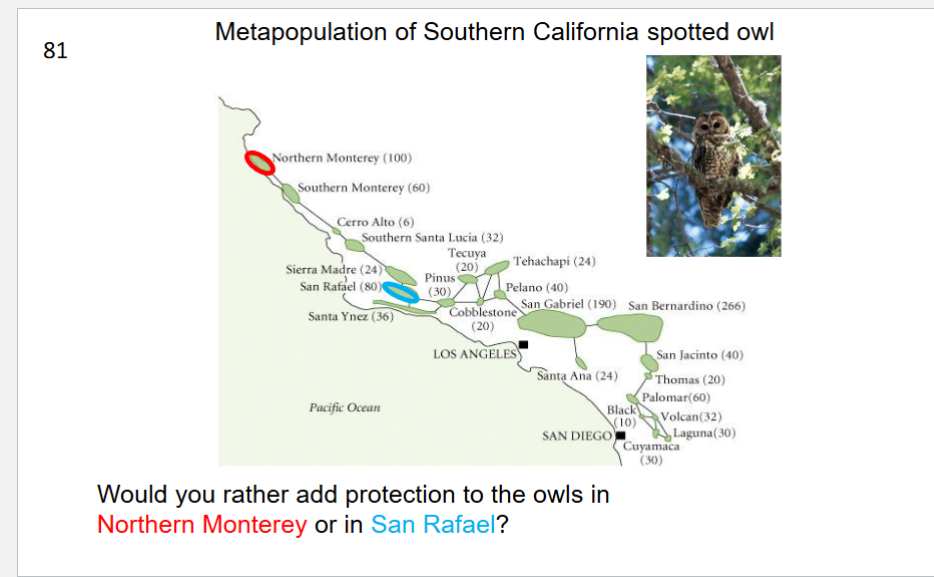
San Rafael better connected to the rest of the habitats

source

sink
source:
area with a net surplus of individuals, from which migration occurs. Might be able to survive in isolation
sink:
Area with negative population growth rate, which is only occupied because of immigration. Would go extinct without input from source populations.
T or F: Metapopulation dynamics can mean species are present in habitat that is not appropriate for them
T

B
sources/sinks are defined by
growth rate (lambda), not population size
Mainland island dynamics
large stable population does not go extinct. Recolonizes smaller populations that go extinct more rapidly.

A
edge habitat
areas near the border between one habitat and another (often more human dominated habitat)
What size habitat patches is most affected by edge effects
small
smaller or more irregularly shaped patches have
more % edge habitat
lower % core/interior habitat
higher perimeter to area ratios
More edge means
less core
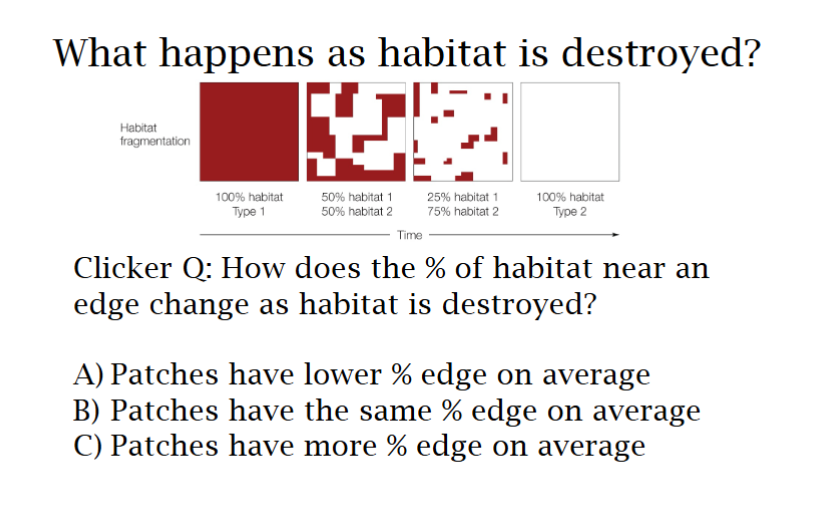
C
Large patches are mostly
internal habitat
small patches are mostly
edge habitats
Patches close to other patches have
low isolation, high connectivity
patches far from other patches have
high isolation, low connectivity

C
What major changes happen as habitat is destroyed
size: decreases
Isolation: increases
Perimeter/area ratio: increases
What does the metapopulation theory predict effects on
populations
What does island biogeography theory predict effects on
species diversity
Theory of island biogeography:
Observation 1)
there are more species on larger islands and habitat fragments
Number of bird species on Caribbean islands is higher on what islands
larger islands
What habitats are naturally island like
freshwater lakes, coral atolls, high alpine meadows
Destroying/ converting habitats can create
remnant “islands”