Mycology: Yeasts and Dimorphic Pathogens
 Call Kai
 Learn
 Practice Test
 Spaced Repetition
 Match
 Flashcards
 Knowt Play
1/13

There's no tags or description
Looks like no tags are added yet.
14 Terms
The formation of germ tubes when fetal bovine serum is inoculated with the yeast isolate leads to the presumptive identification of which of the following yeasts?
Candida albicans/dubliniensis

The morphology of yeasts inoculated to cornmeal agar can be helpful in making a species identification. The field of view shown in the image on the right is most consistent with the identification of which of the following Candida species?
C. parapsilosis
Which of the following is a phenotypic property of Saccharomyces yeast species that helps establish its species identification?
Ascospore production

The yeast forms of which of the following species of dimorphic fungi (represented in the image on the right) can be described as large yeast cells with multiple buds that are attached by narrow necks, giving the appearance of a "mariner's wheel"?
Paracoccidioides brasiliensis
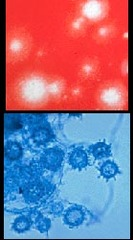
The colonies shown in the upper image were obtained on blood agar from a sputum specimen after 10 days of incubation at 30°C. The lower image is a lactophenol blue mount made from a portion of the colony.
The delicate cobweb appearance of the colonies on blood agar (upper image) and the production of macroconidia with a conspicuous prickly surface as seen in the lower image are characteristic of which one of these dimorphic pathogens?
Histoplasma capsulatum

The images below demonstrate yeast growth patterns on cornmeal agar. Which morphology is characteristic of Candida kefyr?
Image B-- Elongated blastoconidia that tend to line up along the pseudohyphae in a "logs in stream" arrangement
The transmission of which of the following organisms is associated with the guano of bats?
Histoplasma capsulatum
All of the following observations are consistent with the laboratory identification of Cryptococcus neoformans, except:
Negative urease test

The image on the right is a Gomori methenamine silver stain of a lung biopsy obtained from a patient with x-ray evidence of multi-focal pneumonitis. The infiltrating yeast cells are distinctly spherical, irregular in size, and separated by capsular material, appearing as a halo around each cell. Of the answer choices presented: What yeast will most likely be recovered in the culture of this tissue, based on the microscopic morphology that is observed?
Cryptococcus neoformans
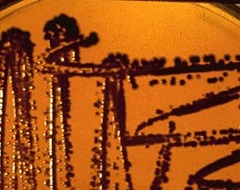
The colonies shown in this photograph were grown on Guizotia abyssinica (birdseed) agar at 30°C for 72 hours. What is the most likely identification?
Cryptococcus neoformans or C. gattii
Which of the following fungal species do not produce pseudohyphae on cornmeal agar?
Cryptococcus laurentii
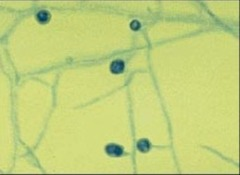
Which of the following dimorphic molds produces spherical or oval conidia, each supported by an individual conidiophore ("lollipop") as represented in the image on the right?
Blastomyces dermatitidis
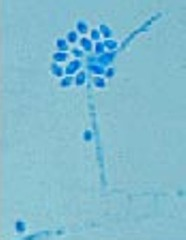
The image on the right is an ovoid microconidia arranged in a daisy-head pattern at the tip of a straight conidiophore. This is characteristic of the mold form of which of the following dimorphic pathogens?
Sporothrix schenckii
Which of the following fungal infections is endemic in desert regions of the southwestern United States?
Coccidioidomycosis