Animal Lab Final
 Call Kai
 Learn
 Practice Test
 Spaced Repetition
 Match
 Flashcards
 Knowt Play
1/53

There's no tags or description
Looks like no tags are added yet.
54 Terms
Mammalian sub-groups and how they are split up
Monotremes (eggs) (platypus)
Marsupials (pouch) (koala)
Placental mammals (placenta) (lions/humans)

Synapomorphies of different tetrapod groups, especially the mammals

Fish circuit/heart
1 circuit
2 chambered heart
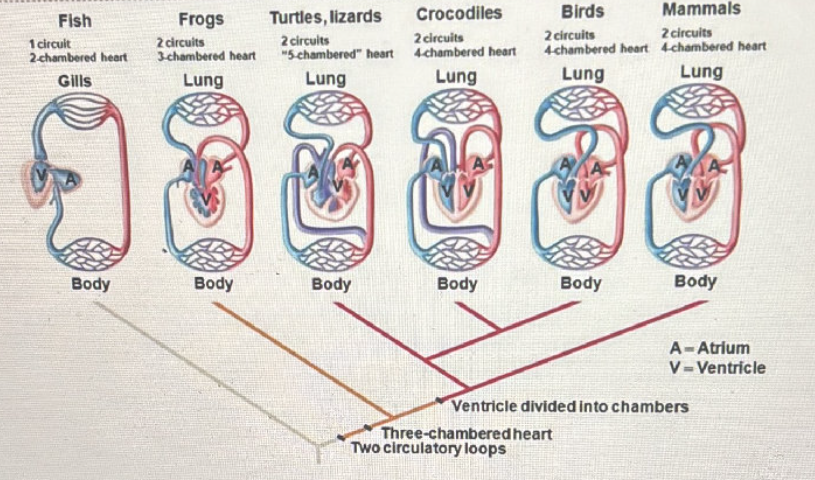
Frog circuit/heart
2 circuits
3 chambered heart

Turtles/lizards circuit/heart
2 circuits
5 chambered heart

Crocodile circuit/heart
2 circuits
4 chambered heart
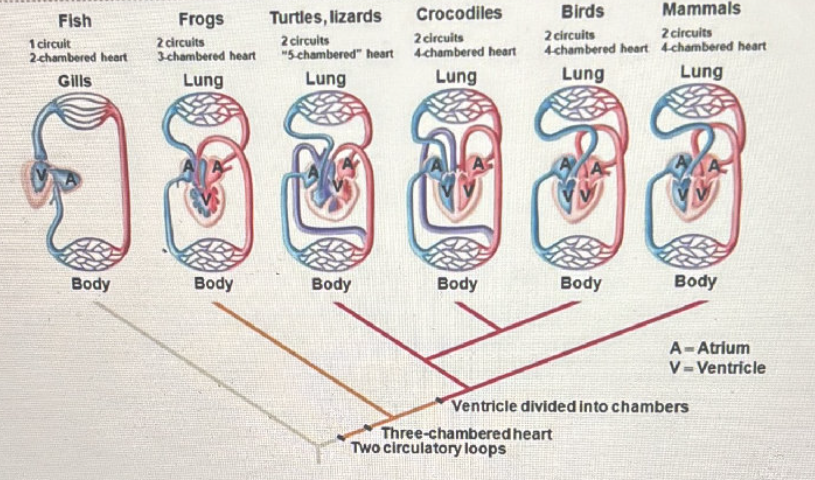
Bird circuit/heart
2 circuits
4 chambered heart

Mammal circuit/heart
2 circuits
4 chambered heart
Circulation (11 steps)
Body blood -> precava -> right atrium -> right ventricle -> pulmonary artery -> to lungs
-> left pulmonary vein -> left atrium -> left ventricle -> aorta -> to body
Fetal animals have a hole called the “foramen ovale”
Lungs and blood flow
Systemic circuit – body blood
Pulmonary circuit – Lung blood
4 chambered heart advantages
More efficient, no mixing of oxygenated and deoxygenated blood in the now separated ventricles
Urogenital system blood flow
Renal arteries, kidneys, renal vein
What bone modifications allow the frog to jump?
The pelvic girdle allows powerful hind legs.
The compact spine and upper body have evolved to absorb the impacts of jumping.
9 vertebrate in spine
Are turtles anapsid or diapsid? What is the difference?
Turtles are anapsid. Anapsid = 1 hole in skull (no temporal fenestra) Diapsid = 2 holes
4 ways in which birds are adapted for flight (HEFA)
Hollow bones
Enlarged sternum
Feathers
Air sacs for unidirectional air flow in lungs
Anapsid/Synapsid/Dyapsid/Polyapsid
Anapsid: no temporal fenestra, amphibian origin. Turtles.
Synapsid reptiles are now extinct but mammals are also synapsid and believed to be descendants of these reptiles. 1 temporal fenestra.
Diapsid: two temporal fenestrae. Reptile origin.
Polyapsid: dinosaurs
2 features that allow birds and reptiles to be independent from water.
Hard-shelled amniotic eggs and tougher, water-retaining skin
Frog skin to reptile. How does skin type link each animal to their habitat?
Frogs have soft, moist epidermis where-as reptiles have dry, tough, scaly skin.
Feeding strategies of each group
Ph. Amoeba = phagocytosis (engulf)
Ph. Ciliophora = oral groove (move food into cell)
Ph. Cnidaria Cl. Scyphozoa (true jellies) = tentacles/feeding pouch
Ph. Cnidaria Cl. Hydra (crim dell jellies) = nematocysts (stinging cells to capture prey)
Ph. Porifera = filter feeding/choanocytes
Ph. Platyhelminthes = Pharynx/pharyngeal sheath
Ph. Mollusca (not bivalves) = radula (scrape/cut food)
Ph. Mollusca Cl. Bivalves = filter feeding
Ph. Chordata = filter feeding, jaws/teeth, beaks, tongue
Ph. Euglenozoa = photosynthesis/organic matter
Ph. Viridiplantae = photosynthesis
Ph. Annelida = deposit feeding, filter feeding, fluid feeding (parasites)
Ph. Arthropoda = mouthparts (chewing, piercing, sucking)
Gas exchange of each group
Ph. Arthropoda, Ph. Chordata: Gills
Ph. Amoeba, Ph. Euglenozoa, Ph. Ciliophora, Ph. Porifera, Ph. Cnidaria, Ph. Ctenophora, Ph. Platyhelminthes = diffusion
Ph. Viridiplantae = stomata
Ph. Mollusca = counter-current exchange (not squids)
Ph. Annelida = parapodia
Ph. Chordata = lungs
Amphibians (chrodates) = breathe through their mouth and lungs via ‘positive pressure’, through their skin and through the lining of their mouths
Birds = air sacs
Endo and exo skeletons
Ph. Arthropoda: Striated muscle and chitinous exoskeleton
Ph. Echinodermata: Dermal skeleton of calcareous plates and spines
Ph. Chordata = endoskeleton
Mammal skeletons are unique because of single dentary bone, 3 inner ear bones, fused sacral vertebrae
Water vascular systems
Ph. Echinodermata (Water enters through the madreporite and circulates through the canals to power the tube feet)
Ph. Porifera (nutrient and gas exchange)
-Anconoid
-Syconoid
-Leuconoid
Internal pressure 5 have hydrostatic skeleton
Ph. Amoeba = Contractile vacuole regulates osmotic pressure
Ph. Nematoda, Cnidaria, Ctenophora, Mollusca, Annelida = hydrostatic skeleton
Ph. Chordata 5 traits
1. Notochord
2. Pharyngeal pouches and gill slits
3. Dorsal tubular nerve cord
4. Endostyle or thyroid gland
5. Postanal tail
6 traits of mammalian success (LP S D M H LC)
• Limb position
• Secondary palate
• Dentition
• Muscular diaphragm
• Hair and sweat glands
• Large cerebral cortex
Protostomes and animals
Split into 2 broad groups: Lophotrochozoa and Ecdysozoa
“Mouth first” Blastopore develops into mouth
Spiral
Determinate cleavage
Forms via apoptosis
Flatworms are example
Deuterostomes and animals
Anus develops from blastopore
Radial, indeterminate cleavage
Enterocoelous
Chordates
Lophotrochozoa and animals
Possess lophophore or trochophore larva
Ph. Platyhelminthes
Ph. Rotifera
Ph. Gastrotricha
Ph. Acanthocephala
Ph. Mollusca
Ph. Annelid
Ecdysozoa and animals
Molt to grow
Ph. Nematoda
Ph. Arthropoda
Eucoelomate and animals (true)
Cavity lined with mesoderm on both sides
Phylum Arthropoda
Ph. Mollusca
Ph. Annelid
Ph. Echinodermata
Ph. Chordata
Pseudocoelomate and animals
Cavity lined with mesoderm on one side
Ph. Nematoda
Ph. Rotifera
Ph. Acanthocephala
Acoelomate and animals
No fluid-filled cavity
Ph. Platyhelminthes
Ph. Gastrotricha
Ph. Amoebazoa
Ph. Porifera
Life cycles phylums
Ph. Amoebazoa: Usually binary fission, sometimes flagellated gametes
Ph. Euglenozoa: longitudinal binary fission
Ph. Viridiplantae: Asexual reproduction: daughter colonies. Development of sexual reproduction
Ph. Apicomplexa: Complex life cycle involving female mosquito and human hosts
Ph. Ciliophora: Asexual reproduction: binary fission. Sexual reproduction: conjugation
Ph. Porifera: Sponge larvae Parenchymella and Amphiblastula. Resting stage is Gemmules
Ph. Cnidaria: one in the picture
Ph. Platyhelminthes: regeneration in planaria
Ph. Nematoda: sexually dimorphic. Dauer larva resting stage
Ph. Annelida: Most reproduce sexually. Earthworms are hermaphrodite
Ph. Arthropoda: Most reproduce sexually. Usually have separate sexes. Metamorphosis.
Ph. Mollusca: Most reproduce sexually. Most have separate sexes, although some species are hermaphrodites.
Ph. Echinodermata: Usually reproduce sexually. Most have external fertilization.
Ph. Chordata: Most reproduce sexually. Fertilization can be internal or external. Development can be direct or indirect.

Important developmental traits
Ph. Cnidaria: Diploblastic
Ph. Ctenophora: colloblasts, probably most basal animal
Ph. Platyhelminthes: Triploblastic, bilateral, flame cells
Ph. Nematoda: Triploblastic, bilateral
Ph. Mollusca: Triploblastic, bilateral
Ph. Annelida: Triploblastic (three germ layers). Metamerism.
Phylum Arthropoda: Triploblastic. Tagmatization. Jointed appendages.
Ph. Echinodermata: Triploblastic. Bilateral.
Ph. Chordata: Triploblasic. Bilateral.

Ph. Cnidaria Cl. Scyphozoa life cycle
Ph. Cnidaria Cl. Hydrozoa
Reduced medusa stage
Hydra: no medusa stage
Ph. Cnidaria Cl. Anthozoa
Often clonal
No medusa stage

Ph. Platyhelminthes Cl. Trematoda
human blood fluke life cycle

Frog dissection external
Tympanic membrane
Eyes and nostrils
Countershading and camouflage

Frog dissection internal


Pig dissection

Function of lungs
Frog: draw air into their throat sac and then force it into the lungs. gas exchange. adult frogs can also absorb oxygen through their skin
Pig: The pulmonary artery delivers blood. Gas exchange. small and underdeveloped
Function of diaphragm
Frog: no diaphragm
Pig: Breathing. Contracts and relaxes to facilitate inhalation and exhalation. Separates abdominal and thoracic cavities
Function of stomach
Frog: Digestion. It is primarily responsible for the initial breakdown of food, both mechanically and chemically, before it moves into the small intestine.
Pig: Housing the amniotic fluid that the fetus swallows, preparing it for nursing after birth.
Function of intestines
Frog: Small intestine digests food and absorbs nutrients in bloodstream. Large intestine water conservation and waste processing.
Pig: Small intestine has final stage of digestion, breaking down food to absorb nutrients.
Function of ovaries
Frog: Oogenesis. Hormone secretion.
Pig: Development of ovocytes (or oocytes), and the production of hormones
Function of testes
Frog and pig: producing sperm and hormone
Function of oviduct
Frog: It transports eggs from the ovary to the cloaca
Pig: Primary location for fertilization. Transport of sperm and ova from the overaies to the uterus. Allows sperm to fertilize egg.
Function of bladder
Frog: The ability to reabsorb water. store urine produced by the kidneys.
Pig: Allowing urine to pass through freely into the amniotic cavity.
Function of liver
Frog: metabolic and detoxification organ
Pig: it gets all its nutrition directly from the mother's blood. regulation of metabolic functions.
Function of gallbladder
Frog and pig: stores bile
Function of pancreas
Frog: metabolic balance required for cold-blooded survival. endocrine and exocrine functions. blood sugar
Pig: Production of digestive enzymes. ensures the system is structurally ready to process the first meals
Function of kidney
Frog: osmoregulation. terrestrial conditions, the kidneys reduce the rate of urine formation. filter waste
Pig: filtering waste products from the blood and excreting them to the outside environment
Example of each phyla
Ph. Amoeba, Ph. Ciliophora, Ph. Euglenozoa= protists
Ph. Cnidaria = jellies
Ph. Porifera = sponges
Ph. Nematoda = roundworms
Ph. Platyhelminthes = flatworms
Ph. Mollusca: squids, snails, clams
Ph. Chordata = mammals, reptiles, amphibians =
Ph. Viridiplantae = algae
Ph. Annelida = earthworms, polychaetes, leeches
Ph. Echinodermata = sea stars, sea urchins, sea cucumbers, brittle stars
Ph. Arthropoda = insects, spiders, crabs