Conservation Bio Quiz 3
 Call Kai
 Learn
Learn Practice Test
 Spaced Repetition
 Match
Match Flashcards
 Knowt Play
1/56

There's no tags or description
Looks like no tags are added yet.
Name | Mastery | Learn | Test | Matching | Spaced | Call with Kai | Chat |
|---|
No analytics yet
Send a link to your students to track their progress
57 Terms
What are the methods for predicting population trends and risk of extinction
estimates of population size
predictions about trend in population
predictions about variability over time
What model performs the same way for a given set of initial conditions
deterministic

>

=

<
Which models can give a range of outcomes from the same initial conditions?
stochastic
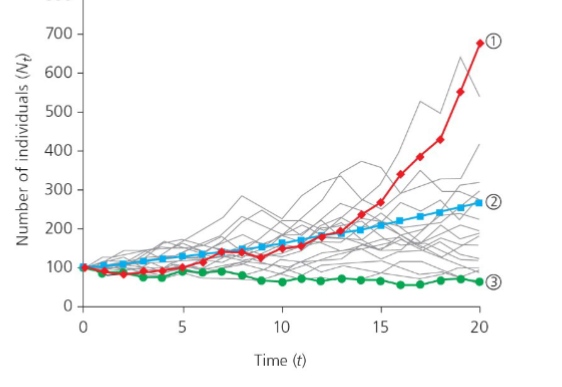
stochastic model graph
When are the effects of stochasticity and randomness most important?
when studying small population, and making short to medium term predictions
Most population viability analyses will include
some form of stochasticity
environmental stochasticity
temporal variation in vital rates drive by changes in the biotic or abiotic environment
Populations experiencing good and bad years can end up having a (smaller or larger) - population size than one experiencing a constant average growth rate
smaller
T or F: bad growth years have a large influence on population size / growth
T
stochasticity is
random population distribution
Adding stochasticity to population growth generally does what to the predicted long-term population size
lowers it
What population sizes does environmental stochasticity affect the growth rate of?
any
What sized populations are often more at risk for environmental stochasticity?
local or small
Models with no stochasticity predict a
population size
Models with stochasticity predict a
distribution of population sizes
Two populations each start at 1,000 and have
the same average one-year lambda of 1.0.
Population A: λ = 1.0 every year.
Population B: λ alternates between 0.5 and 1.5.
After 10 years, which population is larger?
A
More stochasticity predicts - populations
lower
catastrophes
hard to predict or model but ultimately may be a common contributor to extinction
In order to be resilient to catastrophe what populations are necessary
multiple viable ones
The heath hen could have avoid extinction if
there was spatial variation in the environment
Demographic stochasticity
extinction may occur due to order of births and deaths
When is demographic stochasticity important
when the population is so small that you can’t get away with rounding your predictions
Consider population in which 1 female has
50% probability of producing 1 female offspring in summer
30% probability of dying the following winter
what is the probability of extinction over this year?
A. 0%
B. 10%
C. 15%
D. 30%
E. 50%
C
50% probability of producing 1 female offspring
30% probability of dying every year.
Best case scenario is she survives and has a daughter,
now N = 2
Probability both die
0.09
50% probability of producing 1 female offspring
30% probability of dying every year.
Best case scenario is she survives and has a daughter,
now N = 2
Probability both do not breed
0.25
50% probability of producing 1 female offspring
30% probability of dying every year.
Best case scenario is she survives and has a daughter,
now N = 2
Probability both die = 0.3*0.3 = 0.09
Probability both do not breed = 0.5*0.5 = 0.25
So probability of extinction next year=
2.25%
Conservation genetics
application of genetic techniques to conservation problems
describing and preserving genetic diveristy
Techniques in conservation genetics
get DNA from some fraction (or all) individuals
sequence some portion of the genome
Infer statistics based on these loci (traditional approach)
genomics becoming increasingly important
What is the traditional approach in conservation genetics
infer statistics based on loci
Polymorphism
allelic diversity
fraction of gene loci in which alternative alleles of a gene occur in a population.
Population heterozygosity
proportion of gene loci at which the average individuals in the population is heterozygous
What does bein heterozygous mean
an individual carries two different alleles at this locus
As alleles are lost, polymorphism is going - and population heterozygosity -
down, goes down
Which individuals do better (in terms of genetic diversity)
individuals with more diverse genomes
Populations with higher heterozygosity often have higher
fitness

H=
fraction of heterozygosity remaining after one generation
genetic drift
random fluctuations of gene frequencies over time due to chance alone
H t = H^t
H t = heterozygosity at end of period
H = heterozygosity at beginning of period (H00)
t = length of period
If H near 1
diversity is being conserved
If H is well below 1
diversity is being lost
Based on this equation, as the
effective population size gets larger what happens to
the rate at which diversity is lost through genetic drift?
A. The rate of loss goes up
B. The rate of loss goes down
C. The rate of loss stays the same
B
The rate of loss goes down as effective population size
goes up
Drift can be very high in what sized populations?
small

10

100
Heterozygosity decreases much faster for what populations?
small
Effective population size (Ne)
population size relevant for determining genetic effects or the number of individuals contributing genes to the next generation.
What is Ne typically between - of N
0.1 and 0.5

o²= and k =
variance in number of progeny among females
average number of progeny
as the variance in the number of progeny (o²) increases, Ne -
decreases

Nm = and Nf =
number of breeding males, number of breeding females
The effective population size - (increases or decreases) when the number of males and females in a breeding population of individuals is increasingly unequal
decreases

Ni=
number in population at time t