exams 1-4
 Call Kai
 Learn
Learn Practice Test
 Spaced Repetition
 Match
Match Flashcards
 Knowt Play
1/140

There's no tags or description
Looks like no tags are added yet.
Name | Mastery | Learn | Test | Matching | Spaced | Call with Kai | Chat |
|---|
No analytics yet
Send a link to your students to track their progress
141 Terms
What binds to modified histones to stimulate or inhibit transcription?
a. promotors
b. repressors
c. writers
d. readers
e. erasers
readers
E. coli lac operon control by lacI is:
a. positive inducible.
b. negative inducible.
c. attenuation.
d. negative repressible.
e. positive repressible.
negative inducible.
Proteins that affect the structure of DNA bound to histones without altering histone chemical structure are called:
a. dicers.
b. splicing complexes.
c. RISCs.
d. MRE activator proteins.
e. chromatin-remodeling complexes.
chromatin-remodeling complexes.
Which of the following processes is also known as RNA silencing or posttranscriptional gene silencing?
a. transcriptional stalling
b. RNA splicing
c. transcriptional repression
d. RNA interference
e. protein degradation
RNA interference

Where would the lac repressor be bound in a (nonmutant) E. coli cell that is growing in low glucose and high lactose? (I = lac repressor gene; Z, Y, A = lac operon structural genes; P = lac promoter; O = lac operator)
a. O
b. I, P, O
c. P and O
d. The repressor would not be bound.
e. P
The repressor would not be bound.
The disorder xeroderma pigmentosum is associated with a defect in what type of DNA repair system?
a. nucleotide-excision repair
b. base-excision repair
c. homologous recombination
d. mismatch repair
e. photoreactivation
nucleotide-excision repair
Which of the following base changes in DNA is an example of a transition?
a. A to T
b. A to C
c. G to C
d. A to G
e. C to A
A to G
What type of genes are not regulated?
a. operator genes
b. constitutive genes
c. regulatory elements
d. repressible operons
e. inducible operons
constitutive genes
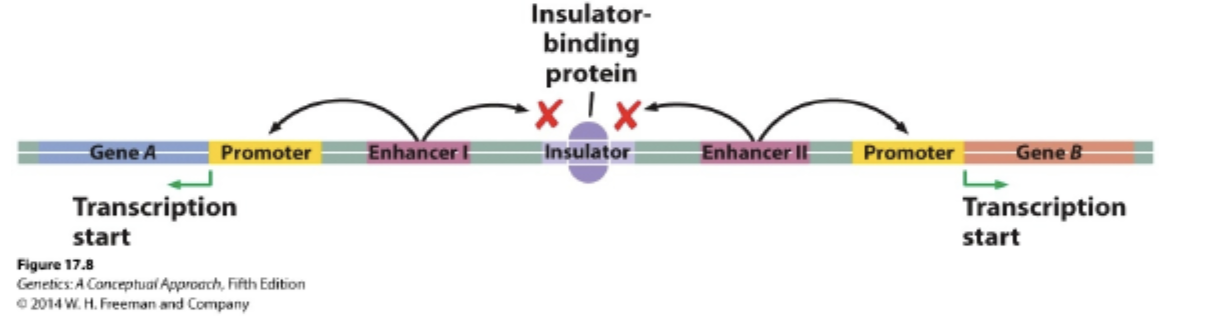
Given the following figure, what would be the effect of a mutation that occurred in the insulator that prevented the binding of the insulator-binding protein?
a. As long as the insulator sequence is not deleted, there will be no change in the transcription regulation of Gene A or B.
b. Enhancer I would no longer be able to stimulate the transcription of Gene B.
c. Enhancer I will be able to hypermethylate Gene B.
d. Enhancer II will no longer be able to stimulate the transcription of Gene A.
e. Both Enhancer 1 and Enhancer II would be able to stimulate the transcription of Genes A and B.
Both Enhancer 1 and Enhancer II would be able to stimulate the transcription of Genes A and B.
What turns on the transcription of a negative inducible operator?
a. an attenuator
b. the operator
c. an inducer
d. an allosteric repressor
e. the promoter
an inducer
A mutant E. coli strain is found that synthesizes β-galactosidase in the absence of glucose whether or not lactose is present. What two mutations might lead to this outcome?
a. lacP- mutation or lacIs mutation
b. lacI- mutation or lacOc mutation
c. lacIs mutation or lacOc mutation
d. lacP- mutation or lacI- mutation
e. lacP- mutation or lacOc mutation
lacI- mutation or lacOc mutation
A eukaryotic DNA sequence that activates transcription at distant promoters is called a(n):
a. insulator.
b. repressor.
c. silencer.
d. enhancer.
e. mediator.
enhancer
Which of the following types of eukaryotic gene regulation take place at the level of DNA?
a. mRNA stability
b. mRNA processing
c. RNA interference
d. posttranslational modification
e. alternation of chromatin structure
alternation of chromatin structure
Nonhomologous end joining repairs
a. bulky DNA lesions that distort the double helix
b. double-strand breaks using a homologous template.
c. mismatched bases in DNA replication.
d. double-strand breaks without using a homologous template.
e. errors through the removal of modified or abnormal bases.
double-strand breaks without using a homologous template
DNA-binding proteins influence the ability of ___________ to initiate ____________ .
DNA polymerase; translation
a. DNA polymerase; transcription
b. DNA polymerase; translation
c. DNA polymerase; transformation
d. RNA polymerase; translation
e. RNA polymerase; transcription
RNA polymerase; transcription
Which of the following statements about somatic mutations is FALSE?
a. Some may give rise to cancers in humans and other animals.
b. They may result in inactive gene products of the mutated genes.
c. They may result from both frameshift and base-pair substitution mutations.
d. They may be inherited by daughter cells after cell division.
e. They may be inherited in the offspring of mutated individuals.
They may be inherited in the offspring of mutated individuals.
Which of the following statements about response elements is INCORRECT?
a. Multiple response elements allow the same gene to be activated by different stimuli.
b. Different genes can possess a common regulatory element upstream of their start site.
c. Response elements allow complex biochemical responses in eukaryotic cells.
d. A single eukaryotic gene is regulated by only one unique response element.
e. Response elements are composed of specific consensus sequences that are different from the sequences of other response elements.
A single eukaryotic gene is regulated by only one unique response element.
A boundary element is also known as a(n):
a. repressor.
b. enhancer.
c. coactivator.
d. insulator.
e. mediator.
insulator.
Which of the following statements about chromosome 9 open reading frame 72 (C9orf72) and its association with amyotrophic lateral sclerosis (ALS) is FALSE?
a. Proteins translated from mRNAs with expanded GGGGCC repeats are primarily toxic to muscle cells.
b. Proteins are translated from mRNAs GGGGCC repeats in the absence of a start codon.
c. Expansion of the repeat GGGGCC in C9orf72 is observed in patients with ALS.
d. mRNAs are transcribed from both strands of DNA of C9orf72 containing GGGGCC repeats.
e. Proteins are translated from mRNAs with GGGGCC repeats in all three frames.
Proteins translated from mRNAs with expanded GGGGCC repeats are primarily toxic to muscle cells.
What is responsible for induction of the lac operon?
a. transacetylase
b. β-galactosidase
c. allolactose
d. glucose
e. lactose
allolactose
A mutation that changes a GC base pair to AT is a(n):
a. missense mutation.
b. induced mutation.
c. synonymous mutation.
d. transversion.
e. transition.
transition
Which of the following mutagens is MOST likely to cause a frameshift mutation?
a. UV light
b. base analog
c. intercalating agent
d. alkylating agent
e. ionizing radiation
intercalating agent
A _____ mutation changes a codon that specifies an amino acid into one that terminates translation.
a. neutral
b. silent
c. missense
d. reverse
e. nonsense
nonsense
A scientist created transgenic C. elegans worms that expressed a gene that made the worms glow green under fluorescent light. Then she injected double-stranded RNA complementary to this gene. Which of the following results was MOST likely to be seen?
a. The injection of double-stranded RNA was lethal and the worms died.
b. The CpG islands near the promoter of the gene became demethylated.
c. The worms had an increased life span.
d. The worms glowed green under fluorescent light.
e. The worms were not able to glow green under fluorescent light.
The worms were not able to glow green under fluorescent light.
A lac operon of genotype lacI+ lacP+ lacO+ lacZ+ lacY- will produce β-galactosidase but not permease when:
a. lactose is present.
b. glucose is present.
c. glucose and lactose are both present.
d. in the presence or absence of lactose.
e. lactose is absent.
lactose is present.
Which of the following statements about chromatin-remodeling complexes is INCORRECT?
a. They can cause conformational changes in nucleosomes.
b. They can interact directly with transcription factors.
c. They can reposition nucleosomes on DNA.
d. They can alter the chemical structure of histones.
e. They can cause conformational changes in DNA.
They can alter the chemical structure of histones.
Alternative splicing is known to be important in the regulation of the:
a. sexual development in Drosophila melanogaster.
b. production of heat-shock elements.
c. metallothionein gene.
d. None of the answers is correct.
e. lac operon in E. coli.
sexual development in Drosophila melanogaster.
The _____ is a type of regulator protein that binds to a region of DNA in the promoter of a gene called the operator and prevents transcription from taking place.
a. repressor
b. activator
c. inducer
d. terminator
e. inactivator
repressor
A lac operon of genotype lacI- lacP+ lacO+ lacZ+ lacY+ will produce β-galactosidase and permease when:
a. lactose is present.
b. lactose is absent.
c. glucose is present.
d. glucose and lactose are both present.
e. lactose is present or not.
lactose is present or not.
A mutant E. coli strain, grown under conditions that normally induce the lac operon, does not produce ß-galactosidase. What is a possible genotype of the cells?
a. lacI- lacP+ lacO- lacZ+ lacY+ lacA-
b. lacI+ lacP+ lacOc lacZ+ lacY+ lacA+
c. lacl+ lacP+ lacO+ lacZ+ lacY+ lacA+
d. lacI+ lacP- lacO+ lacZ+ lacY+ lacA+
e. lacI+ lacP+ lacO+ lacZ+ lacY- lacA+
lacI+ lacP- lacO+ lacZ+ lacY+ lacA+
When siRNAs are present, the rate of mRNA degradation _____ and the rate of protein production _____.
a. stays constant; decreases
b. increases; increases
c. decreases; increases
d. increases; decreases
e. decreases; decreases
increases; decreases
Suppose a scientist discovered a mutant strain of C. elegans worms that had lost the ability to regulate gene expression via RNA interference mechanisms. Which of the following might she predict is a possible source of this defect?
a. There is a mutation in the gene that encodes the Slicer enzyme that allows it to cut RNA more efficiently.
b. There is a mutation in a gene that encodes an enzyme that selects the correct splice site for alternative splicing.
c. There is a mutation in a gene that encodes an acetylase enzyme that prevents histone acetylation.
d. There is a mutation in the gene that encodes the Dicer enzyme that makes it nonfunctional.
e. There is a mutation that results in an overexpression of siRNAs.
There is a mutation in the gene that encodes the Dicer enzyme that makes it nonfunctional.
The radiation levels caused by the atomic bomb explosions in Japan led to an increase in incidents of which disease?
a. diabetes
b. multiple sclerosis
c. sickle cell anemia
d. influenza
e. leukemia
leukemia
Insulators can block the effects of enhancers only when they lie:
a. upstream of a promoter.
b. within the structural genes.
c. adjacent to a promoter.
d. within a consensus sequence.
e. between an enhancer and a promoter.
between an enhancer and a promoter.
In a cell, which molecules are translated into proteins as initiation factors increase?
a. mRNAs
b. miRNAs
c. rRNAs
d. tRNAs
e. siRNAs
mRNAs
Which of the following enzymes represents a writer of histone modification?
a. polymerases
b. nucleases
c. methyltransferases
d. demethylases
e. deacetylases
methyltransferases
What concept suggests that cells arise only from preexisting cells and that the cell is the fundamental unit of structure and function in living organisms?
a. Mendelian inheritance
b. cell theory
c. preformationism
d. blending inheritance
e. germ-plasm theory
cell theory
Gregor Mendel carried out a cross between two pea plants by taking pollen from a plant that was homozygous for round seeds and dusting the pollen onto the stigma of a plant homozygous for wrinkled seeds. Which of the following would be the reciprocal cross that Mendel had carried out for this experiment?
a. stigma of a plant homozygous for round seed pollinated with pollen from a plant homozygous for wrinkled-seed plant
b. stigma of a plant homozygous for round seed pollinated with pollen from a plant heterozygous for wrinkled-seed plant
c. stigma of a plant heterozygous for round seed pollinated with pollen from a plant homozygous for wrinkled-seed plant
d. stigma of a plant homozygous for wrinkled seed pollinated with pollen from a plant homozygous for round-seed plant
e. stigma of a plant homozygous for wrinkled seed pollinated with pollen from a plant homozygous for wrinkled-seed plant
stigma of a plant homozygous for round seed pollinated with pollen from a plant homozygous for wrinkled-seed plant
Round seeds (R) are dominant to wrinkled seeds (r), and yellow seeds (Y) are dominant to green seeds (y). A plant of unknown genotype is testcrossed to a true-breeding plant with wrinkled, green seeds. The offspring produced were 53 round and yellow, 49 round and green, 44 wrinkled and yellow, and 51 wrinkled and green. What is the likely genotype of the parent in question?
a. RRYY
b. RrYY
c. RRYy
d. RrYy
e. rryy
RrYy
A diploid somatic cell from a rat has a total of 42 chromosomes (2n = 42). What is the total number of chromosomes present in the cell during metaphase I of meiosis?
a. 21
b. 42
c. 84
d. 126
e. 168
42
In a certain species of plant, flowers occur in three colors: blue, pink, and white. A pure-breeding pink plant is mated with a pure-breeding white plant. All of the F1 are blue. When the blue F1 plants are selfed, the F2 plants occur in the ratio 9 blue : 3 pink : 4 white. What is the name for this type of interaction?
a. recessive epistasis
b. dominant epistasis
c. duplicate recessive epistasis
d. duplicate dominant epistasis
e. dominant and recessive epistasis
recessive epistasis
A mother with blood type B has a child with blood type O. Give all possible blood types for the father of this child.
a. O
b. B, AB
c. A, AB
d. A, B, O
e. A, B, AB, O
A, B, O
Which of the following sequences CORRECTLY shows the flow of genetic information during gene expression?
a. RNA → DNA → protein
b. protein → DNA → RNA
c. DNA → RNA → protein
d. DNA → protein → DNA
e. None of the answers is correct.
DNA → RNA → protein
Different versions of the same gene are called a(n)
a.locus.
b.allele.
c.homologous chromosome.
d.heterozygote.
e.homozygote.
allele
Kinetochore proteins bind to which of the following chromosomal locations?
a. telomere.
b. centromere.
c. origin of replication.
d. sister chromatid.
e. allele.
centromere.
The curly gene determines normal (X+) or curly (Xc) wing development in fruit flies (Drosophila). Select the statement that accurately predicts the F2 progeny created by crossing a heterozygous female fly with a curly-winged male fly.
a. 25% X+X+, 25% XcXc, 25% X+Y and 25% XcY
b. 50% X+Xc and 50% X+Y
c. 50% X+Xc and 50% XcY
d. 50% X+Xc, 25% X+Y and 25% XcY
e. 25% X+Xc, 25% XcXc, 25% X+Y and 25% XcY
25% X+Xc, 25% XcXc, 25% X+Y and 25% XcY
The fundamental unit of heredity is the
a. phenotype.
b. nucleus.
c. chromosome
d. gene.
e. allele.
gene
Select the statement that best predicts the outcome if a single pair of sister chromatids fails to separate properly during meiosis II.
a. Four gametes will lack a chromosome.
b. Two gametes will lack a chromosome, and two gametes will be normal.
c. Two gametes will contain an extra chromosome, and two gametes will be normal.
d. One gamete will contain an extra chromosome, one gamete will lack a chromosome, and two gametes will be normal.
e. Two gametes will contain an extra chromosome, one gamete will lack a chromosome, and one gamete will be normal.
One gamete will contain an extra chromosome, one gamete will lack a chromosome, and two gametes will be normal.
The complete genetic makeup of any organism is referred to as a
a. phylogeny
b. phenotype
c. genome
d. genotype
e. single-nucleotide polymorphism
genome
The centromere divides a chromosome into two sections or "arms." A chromosome is found to have two arms of equal lengths. Such a chromosome can be BEST described as
a. telocentric.
b. circular.
c. acrocentric.
d. metacentric.
e. homologous.
metacentric.
If two heterozygous Aa plants are crossed with each other, what will be the genotypic ratio found in the offspring?
a. 1:1
b. 3:1
c. 1:1:1:1
d. 2:1
e. 1:2:1
1:2:1
A person with albinism is likely to
a. have more melanin pigment.
b. be susceptible to sunburn.
c. see better in bright light.
d. have a decreased mating advantage.
e. have male children.
be susceptible to sunburn.
Women with Turner syndrome (XO) and normal women (XX) are clearly different phenotypically..........However, both XO and XX women have one active X chromosome since the X in XO women remains active and one might expect that they would therefore have similar phenotypes. What is the MOST reasonable explanation for their different phenotypes?
XO women do not have a copy of the SRY gene.
Some genes remain active on the inactive X chromosome, and XX women will have two copies of these genes expressed and XO women only one copy.
in XO women, the single X chromosome has no partner to pair with during mitosis so that each cell division is delayed by pairing problems with the single X not finding a pairing partner.
XO women are missing a copy of the Xist gene so that they are forced to develop partway along the male pathway during embryogenesis.
XO women have problems during development because mitosis is abnormal.
Some genes remain active on the inactive X chromosome, and XX women will have two copies of these genes expressed and XO women only one copy.
Why are viruses not classified as prokaryotes or eukaryotes?
a. Viruses do not contain their own genomes.
b. Viral cellular structures are evolutionarily distinct from other life forms.
c. Viral genomes are based on RNA, not DNA.
d. Viruses do not have cell structures that enable independent replication.
e. Viruses are pathogens that harm prokaryotes and eukaryotes.
Viruses do not have cell structures that enable independent replication.
Which of the following statements describes genetic maternal effect?
a. the phenotype of the offspring is determined by the genotype of the mother
b. it arises due the father's nuclear genes
c. the genes for a characteristic are inherited from only one parent, usually the mother
d. characteristics are encoded by genes located in the cytoplasm
e. offspring inheritance is determined by its own genotype
the phenotype of the offspring is determined by the genotype of the mother
You identify an XXX fruit fly (Drosophila) that has three sets of autosomes (AAA). Predict the sex of this fly.
a. female
b. male
c. metafemale
d. metamale
e. intersex
female
A mother with blood type A has a child with blood type AB. Give all possible blood types for the father of this child.
a. O
b. B, AB
c. A, AB
d. A, B, O
e. A, B, AB, O
B, AB
The concept of dominance states that
a. each individual diploid organism possesses two alleles for any particular characteristic.
b. one allele is inherited from the maternal parent and one allele is inherited from the paternal parent.
c. alleles segregate when gametes are formed in diploid organisms.
d. two alleles segregate into gametes in equal proportions.
e. when two different alleles are present in a genotype, only the dominant trait is observed in the phenotype.
when two different alleles are present in a genotype, only the dominant trait is observed in the phenotype.
Which of the following is fundamentally the study of evolution?
a. transmission genetics
b. ecology
c. population genetics
d. molecular genetics
e. heredity
population genetics
Select the answer that best describes the conceptual error contained in the following misconception: "Brown eyes are dominant over blue eyes."
a. Blue eyes are actually dominant over brown eyes.
b. Brown eyes and blue eyes are codominant.
c. Eye color is not determined by genes.
d. Dominance describes a relationship between alleles, not traits.
e. Brown eyes and blue eyes are determined by different genes.
Dominance describes a relationship between alleles, not traits.
If a female Drosophila that is heterozygous for a recessive X-linked mutation is crossed to a wild-type male, what proportion of female progeny will have the mutant phenotype?
a. 100%
b. 0%
c. 33%
d. 25%
e. 50%
0%
The experiments of Gregor Mendel can be placed into which subdivision of genetics?
a. molecular genetics
b. population genetics
c. transmission genetics
d. molecular genetics and transmission genetics
e. population genetics and transmission genetics
transmission genetics
In Mendel's peas, yellow seeds are dominant to green. A pure-breeding yellow plant is crossed with a pure-breeding green plant. All of the offspring are yellow. If one of these yellow offspring is crossed with a green plant, what will be the expected proportion of plants with green seeds in the next generation?
a. 0%
b. 25%
c. 50%
d. 75%
e. 100%
50%
In order to be functional, a eukaryotic chromosome requires all of the following EXCEPT
a. a centromere.
b. origins of replication.
c. a plasmid.
d. telomeres.
a plasmid.
The sex determination system used by Drosophila is called
a. the X:A sex determination system.
b. the ZZ-ZW sex determination system.
c. the XX-XO sex determination system.
d. the XX-XY sex determination system.
e. genic sex determination.
the X:A sex determination system.
How many Barr bodies does a person with Turner syndrome have?
a. 0
b. 1
c. 2
d. 3
e. 4
0
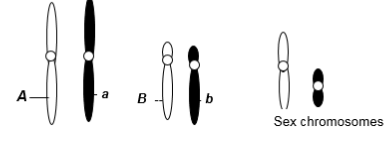
A eukaryotic diploid cell from an organism with the ZZ-ZW sex determination system has two pairs of autosomes and a pair of sex chromosomes, Z and W, shown here. What is the probability of a gamete from this individual that has the following genotype: alleles A and b, chromosome Z?
a. 1/2
b. 1/4
c. 1/6
d. 1/8
e. 1/16
1/8
What allows different cells of an organism to have different phenotypes?
a. advantages provided through environmental adaptation
b. the emergence of model genetic organisms
c. the process of competitive evolution
d. the regulation of gene expression
e. the genetic compositions of populations
the regulation of gene expression
Which of the following statements about the sex-linked recessive trait of red-green color blindness in humans is FALSE?
a. A phenotypically normal daughter can have a color-blind father.
b. A phenotypically normal daughter can have a color-blind mother.
c. A color-blind daughter can have a normal father.
d. A color-blind daughter can have a phenotypically normal mother.
e. A color-blind son could have a color-blind father.
A color-blind daughter can have a normal father.
Human males with XY chromosomes are _____ and produce two different kinds of gametes, whereas females with XX chromosomes are _____ and produce only one kind.
a. homogametic; heterogametic
b. dioecious; monoecious
c. heterogametic; homogametic
d. monoecious; dioecious
e. monoecious; heterogametic
heterogametic; homogametic
Which statement best describes the process of binary fission?
a. Replication during binary fission occurs at multiple locations along a linear chromosome.
b. Binary fission is the process by which prokaryotic cells divide.
c. Binary fission is part of the mitotic phases and the period of active cell division.
d. It is the series of stages through which a cell passes from one division to the next.
e. Binary fission allows or prohibits the cell's progression to the next stage of mitosis.
Binary fission is the process by which prokaryotic cells divide.
Wild-type Arabidopsis has five chromosomes (2n = 10). Trisomic plants are designated as "Tr" followed by the trisomic chromosome number—that is, Tr1 is trisomic for chromosome 1. Assuming that trisomy is fully viable and that all possible pairing configurations (including nonpairing) are possible at meiosis, what proportion of the progeny from the cross Tr1;Tr2 × Tr1;Tr2 will have a wild-type chromosomal complement?
a. 1/2
b. 1/3
c. 1/4
d. 1/9
e. 1/81
1/81
While doing research on deep-sea vents, you discover a very simple new life form. After some initial analysis, you find that this life form contains small fragments of DNA, small complementary RNA fragments, and proteins. Fortuitously, you collected two strains, one that is purple and one that is yellow. You wish to discover which of those three molecules could be the genetic material. The classic experiment of which of the following scientists would be the MOST appropriate to mimic?
a. Hershey, Chase
b. Avery, MacLeod, and McCarty
c. Franklin
d. Griffith
e. Fraenkel-Conrat and Singer
Avery, MacLeod, and McCarty
DNA strands grow in the 5′ to 3′ direction. This means that the _____ of an incoming nucleotide attaches to the _____ of the growing strand.
a. 5′ phosphate; 3′ hydroxyl
b. 5′ hydroxyl; 3′ phosphate
c. 5′ phosphate; 5′ hydroxyl
d. 3′ phosphate; 3′ hydroxyl
e. 5′ phosphate; 2′ hydroxyl
5′ phosphate; 3′ hydroxyl
Which statement does NOT describe a difference between DNA and proteins?
a. Trypsin enzymes break down proteins, but they cannot break down DNA molecules.
b. Proteins are polymers of 20 different amino acids, whereas DNA molecules are polymers of four different nucleotides.
c. Proteins contain sulfur, but not phosphorus. DNA contains phosphorus, but not sulfur.
d. DNA is located in the nucleus, whereas proteins are only located in the cytoplasm of cells.
DNA is located in the nucleus, whereas proteins are only located in the cytoplasm of cells.
Which scenario generates nonviable products during meiosis?
a. single crossover in the inverted region in a cell homozygous for a paracentric inversion
b. single crossover in the inverted region in a cell homozygous for a pericentric inversion
c. no crossover in a cell heterozygous for a paracentric inversion
d. two-strand double crossover in the inverted region in a cell heterozygous for a paracentric inversion
e. single crossover in the inverted region in a cell heterozygous for a paracentric inversion
single crossover in the inverted region in a cell heterozygous for a paracentric inversion
June has two brothers with Becker muscular dystrophy (BMD), an X-linked recessive condition that allows affected males to survive into adulthood. Her parents are phenotypically normal. She marries Sheldon, who also has BMD. June and Sheldon have a daughter. What is the probability that this daughter will have BMD?
a. near 0
b. 1/4
c. 1/2
d. 3/4
e. 1/8
1/4
Which term refers to mating between closely related people?
a. consanguinity
b. probanding
c. congenital
d. concordance
e. discordance
consanguinity
Which DNA modification is the addition of a -CH3 group?
a. triple strand
b. methylation
c. looping
d. cytosine substitution
e. hydroxylation
methylation
Which of the following would NOT necessarily be true for a DNA molecule?
a. A = T
b. C = G
c. A + G = C + T
d. A + C = G + T
e. A + T = G + C
A + T = G + C
How does histone acetylation affect chromatin?
a. It loosens the chromatin and allows increased transcription.
b. It allows DNA to become resistant to damage.
c. It helps the histones have a greater affinity for DNA.
d. It inhibits DNA replication by making it more difficult to separate the DNA strands.
e. It causes the chromatin to become more condensed in preparation for metaphase.
It loosens the chromatin and allows increased transcription.
Which statement is INCORRECT concerning an X-linked recessive trait in humans?
a. An affected man often has phenotypically normal parents.
b. All the sons of an affected woman will be expected to be affected.
c. An affected woman almost always has an affected mother.
d. An affected man usually has a mother who carries the recessive allele.
e. A phenotypically normal woman whose father was affected is likely to be heterozygous for the condition.
An affected woman almost always has an affected mother.
You are a research assistant in a lab that studies nucleic acids. Your advisor gave you four tubes for analysis. Each of these tubes differs in its contents by the source of its nucleic acids: mouse cytoplasm (single-stranded RNA), yeast nuclei (double-stranded DNA), rotavirus (double-stranded RNA), and parvovirus (single-stranded DNA). The approximate nucleotide base composition of each sample is given in the table below.
Tube 1: A-32, C-17, U-0, T-32, G-19
Tube 2: A-34, C-16, U-15, T-0, G-35
Tube 3: A-30, C-21, U-0, T-26, G-23
Tube 4: A-33, C-16, U-34, T-0, G-17
Which samples would be destroyed by a DNase?
a. tubes 1 and 3
b. tubes 2 and 4
c. tubes 1 and 2
d. tubes 3 and 4
e. all the tubes
tubes 1 and 3
Which of these sequences could form a hairpin?
a. 5′-GGGGTTTTCCCC-3′
b. 5′-AAAAAAAAAAAA-3′
c. 5′-AAAAGGCCCCCC-3′
d. 5′-TTTTTTCCCCCC-3′
e. 5′-GGGTTTGGGTTT-3′
5′-GGGGTTTTCCCC-3′
Enzyme X is an RNase, a molecule that breaks down RNA molecules. Enzyme Y is a DNase, an enzyme that breaks down DNA molecules. Which of the choices describes a likely similarity between enzyme X and enzyme Y?
a. Both enzymes cleave hydrogen bonds between base pairs.
b. Both enzymes bind 2′ hydroxyl groups on sugar molecules.
c. Both enzymes bind double-stranded molecules.
d. Both enzymes break phosphodiester bonds.
e. Both enzymes interrupt base stacking interactions.
Both enzymes break phosphodiester bonds.
Most strains of cultivated bananas were created by crossing plants within and between two diploid species: Musa acuminata (genome = AA) and Musa balbisiana (genome = BB). Some bananas have genome AAB, which is an example of which kind of polyploidy?
a. allodiploid
b. allotriploid
c. autotriploid
d. allotetraploid
e. autotetraploid
allotriploid
You are a researcher studying the genetic basis of colon cancer. You have been working with a colon cancer cell line to determine the expression levels of different genes that might contribute to cancer formation. You obtain the DNA methylation status of five genes of interest (the data are shown in the table below). The plus (+) sign indicates the level of DNA methylation; more plus signs correlate with increased methylation levels.
Gene: 1, Methylation levels: ++
Gene: 2, Methylation levels: +++++
Gene: 3, Methylation levels: +++
Gene: 4, Methylation levels: ++
Gene: 5, Methylation levels: +
Based on the information shown above, which gene would you predict to have the lowest rate of transcription?
a. gene 1
b. gene 2
c. gene 3
d. gene 4
e. gene 5
gene 2
Why do telomeres in somatic cells shorten each time the cell divides?
a. Chromosome fragments fail to move to the spindle pole.
b. Variant histone proteins in the nucleosome impact DNA synthesis.
c. Methylation of DNA changes protein expression.
d. DNA polymerases cannot replicate the ends of chromosomes.
e. Binding of nonhistone proteins impacts replication.
DNA polymerases cannot replicate the ends of chromosomes.
Pedigrees showing the hypothetical human trait have the following characteristics:
- Only males are affected.
- Affected fathers always pass the trait to sons.
What is the MOST likely mode of inheritance for this disorder?
a. autosomal recessive
b. autosomal dominant
c. X-linked recessive
d. X-linked dominant
e. Y-linked
Y-linked
Two chromosomes have the following segments, where · represents the centromere:
K L M · N O P Q R
S T U V · W X Y Z
What type of chromosome mutation would result in the following chromosomes?
K L M · N O P Q R
S T X Y U V · W X Y Z
a. deletion
b. tandem duplication
c. displaced duplication
d. reverse duplication
e. pericentric inversion
displaced duplication
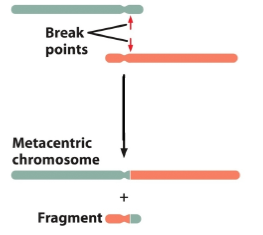
Which of the following is represented in the figure?
pericentric inversion
reciprocal translocation
nonreciprocal translocation
duplication
equal crossing over
reciprocal translocation
Which of the following is attached to the 2′ carbon of a ribose sugar in an RNA molecule?
a. a nitrogen
b. a phosphate group
c. a nitrogenous base
d. a hydroxyl group
e. a sulfoxide group
a hydroxyl group
Species I has 2n=18 and species II has 2n=22. How many chromosomes will be found in an autotetraploid of species II?
a. 27
b. 36
c. 33
d. 44
e. 27 or 36
44
Which of the following descriptions is NOT true of heterochromatin?
a. It remains in a highly condensed state throughout the cell cycle.
b. It makes up most chromosomal material and is where most transcription occurs.
c. It exists at the centromeres and telomeres.
d. It occurs along one entire X chromosome in female mammals when this X becomes inactivated.
e. It is characterized by the absence of crossing over and replication late in the S phase.
It makes up most chromosomal material and is where most transcription occurs.
What statement best describes supercoiling?
a. Supercoiling occurs when the DNA helix is subjected to strain.
b. Molecules that are over-rotated exhibit negative supercoiling.
c. Under-rotated molecules exhibit positive supercoiling.
d. Supercoiling occurs when free ends of linear DNA turn freely.
e. Most DNA found in cells is positively supercoiled.
Supercoiling occurs when the DNA helix is subjected to strain.
How did Alfred Hershey and Martha Chase contribute to our understanding of DNA?
a. They used X-ray diffraction to examine the structure of DNA.
b. They determined that DNA contains four different nitrogenous bases.
c. They found that the "transforming principle" is destroyed by enzymes that hydrolyze DNA.
d. They found that the phosphorus-containing components are the genetic material of phages.
e. They discovered the "transforming principle" that could genetically alter bacteria.
They found that the phosphorus-containing components are the genetic material of phages.
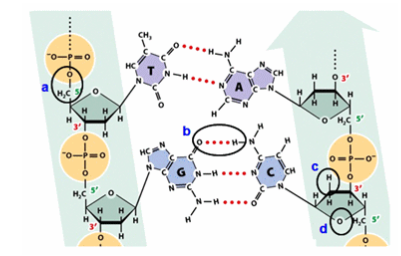
Which circle shows a noncovalent bond?
circle a
circle b
circle c
circle d
circle b
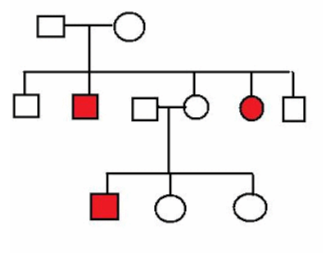
What is the MOST likely mode of inheritance for the trait segregating in the pedigree below?
X-linked recessive
autosomal recessive
could be either X-linked recessive or autosomal recessive
X-linked dominant
autosomal dominant
autosomal recessive
How did Fred Griffith contribute to our understanding of DNA?
a. He used X-ray diffraction to examine the structure of DNA.
b. He determined that DNA contains four different nitrogenous bases.
c. He found that the "transforming principle" is destroyed by enzymes that hydrolyze DNA.
d. He found that the phosphorus-containing components are the genetic material of phages.
e. He discovered the "transforming principle" that could genetically alter bacteria.
He discovered the "transforming principle" that could genetically alter bacteria.
The bonds that connect nucleotides in a single strand are called _____ bonds.
a. phosphodiester
b. peptide
c. ionic
d. hydrogen
e.
glycosidic
phosphodiester