Unit Processes - Mixing
 Call Kai
 Learn
 Practice Test
 Spaced Repetition
 Match
 Flashcards
 Knowt Play
1/22

There's no tags or description
Looks like no tags are added yet.
23 Terms
What is mixing?
Process of combining two or more components so that they become distributed as uniformly as possible throughout the mixture
In pharmaceutical manufacturing, mixing is particularly important for ensuring uniform distribution of the API and excipients
Why is mixing important in pharmaceutical manufacturing?
Mixing is important because it helps ensure:
Content uniformity between individual dosage units
Uniform distribution of the API
Uniform distribution of excipients
Consistent drug dose
Reproducible product quality
Consistent physical properties of the final product
Poor mixing can result in some tablets/capsules containing too much or too little API
What are the main aims of mixing?
Produce a uniform mixture
Distribute the API evenly
Distribute excipients evenly
Ensure consistent composition between dosage units
Reduce concentration differences within the powder
Produce a mixture suitable for subsequent manufacturing processes
What are positive mixtures?
Positive mixtures are formed from materials such as gases or miscible liquids which mix spontaneously and irreversibly by diffusion and tend to approach a perfect mix
There is no input of energy required with positive mixtures - input of energy will shorten the time required to obtain the desired degree of mixing
Energy will be required to separate a component out of the mix
Usually, materials which mix by positive mixing do not present any problems during product manufacture
What are negative mixtures?
Components will tend to separate out (quickly or slowly) spontaneously
Slowly such as emulsions, creams and viscous suspensions
Quickly such as a suspension of solids in a liquid of low viscosity (energy must be continuously input to keep the components adequately dispersed)
Negative mixtures are generally more difficult to form and to maintain and require a higher degree of mixing efficiency than do positive mixtures
What are neutral mixtures?
Components have no tendency to mix spontaneously or segregate spontaneously once work has been input to mix them e.g. mixed powders
Neutral mixes are capable of de-mixing, but this requires energy input
Why is mixing particularly important for low-dose drugs?
When the API is present in a very small quantity compared with the excipients, there is a greater risk of non-uniform distribution
Effective mixing is therefore essential to ensure that the small quantity of API is distributed throughout the much larger quantity of excipient
What could happen if a powder is poorly mixed?
Poor mixing can lead to:
Uneven API distribution → content uniformity problems → variable doses
This can potentially result in:
Sub-therapeutic doses
Excessive doses
Reduced efficacy
Increased risk of adverse effects
What are some mixing possibilities?
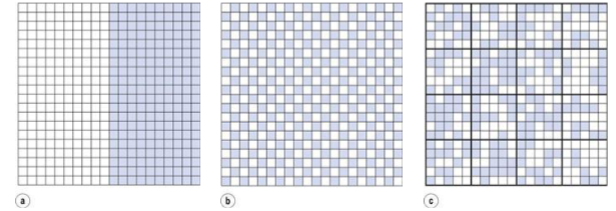
Powder particles A & B: equal quantities, same size, shape and density, different colours
In the diagram: completely segregation in (a), perfect mixing in (b) and random mix state in (c)
Perfect mix occurs when each particle lies adjacent to a particle of the other component
Proportion of A = proportion of B
Random mix is a mix where the probability of selecting a particular type of particle is the same at all positions in the mix and is equal to the proportion of such particles in the total mix
Positive, negative and neutral mixtures summary
Positive mixtues:
Mixing occurs spontaneously
Energy is required only to accelerate the process
Negative mixtures:
De-mixing occurs spontaneously, either quickly or slowly
Energy input is necessary to create these mixtures
Neutral mixtures:
Neither mixing nor de-mixing happens spontaneously
Mixing mechanisms
3 main mechanisms by which powder mixing occurs:
Convection
Shear
Diffusion
Liquids use different methods such as:
Bulk transport
Turbulent mixing
Molecular diffusion
What is convection mixing?
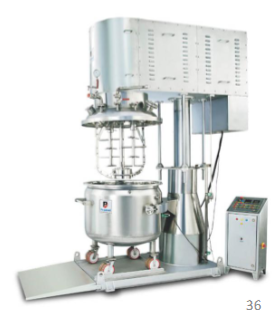
Occurs when large group of particles move from one part of the powder bed to another e.g. when a mixer blade or paddle moves through the mix
Planetary mixer uses convection mixing method
Convection mixing is a quick process & provides good mixing to powders with poor-flow properties
Convection mixing contributes to macroscopic mixing of powder mixtures thus, mixing does not occur within group of particles moving together as a unit, unless much long time is allowed
Convection mixing reduces the possibility of de-mixing
What is shear mixing?
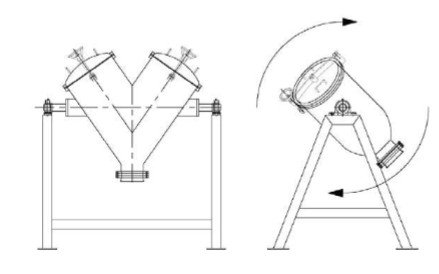
Occurs when a layer of material flows over another layer during the mixing process, resulting in mixing at the layer interface
Tumbling mixers use the shear mixing principle
Shear mixing contributes to semi- microscopic mixing or semi-micromixing
There is a high chance of de-mixing
What is diffusion mixing?
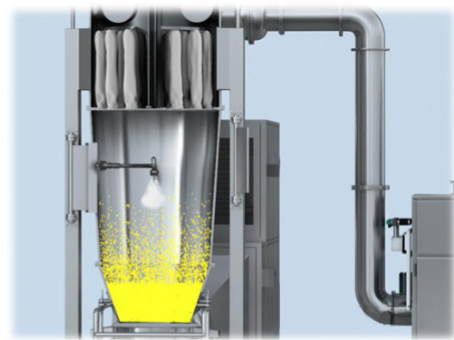
Provides good random mixtures
Contributes to microscopic or micromixing
The main mechanism for:
Fluidised bed mixers: used for drying, mixing and granules preparation
What is de-mixing (segregation)?
Segregation is the opposite effect to mixing: components tend to separate out
Segregation of powders in random mix converts it to non-random mix
Segregation negatively affect the uniformity of content
Powder mixtures are neutral mixtures, which require energy to de-mix
Handling (processing) of powders can provide sufficient energy to allow de-mixing
Cannot avoid handling/processing: check particles properties
Segregation arises because powder mixes encountered in practice are not composed of mono-sized spherical particles but contain particles that differ in size, shape, density and surface properties
These variations mean particles will behave differently when forced to move
Particles with similar properties tend to congregate together, which creates un-even distribution within the blend
The possibility, and extent, of segregation increases with vibration, and when particles have greater flowability
Size-based segregation - what are the 3 types?
Differences in the particle sizes of components of a formulation are the main cause of segregation in powder mixes in practice
Size-based separation:
Percolation
Trajectory
Elutriation segregation
Size-based segregation - percolation
Smaller particles fall through the gaps between larger particles
Percolation effect is more pronounced when powder bed is disturbed
Percolation is likely to occur during solid dosage forms preparation
Differences in densities may enhance Percolation effect

Size-based segregation - trajectory
Trajectory separation occurs when pouring a powder mix from a container
Large particles with more kinetic energies move to greater distances than smaller particles
Differences in densities may enhance Trajectory effect

Size-based separation - elutriation (sometimes called fluidisation or dusting out)
Elutriation segregation occurs as a result of having very small particles within the powder blend
This portion of particles creates “dust” when discharging form a container
“Dust” will be blown upwards by turbulent air currents as the mass tumbles, and remain suspended in the air
After discharging, “dust” will sediment and form a layer on top of larger particles

Density-based segregation
When particles are of different densities, the denser particles will move downwards even if particle sizes are similar
Differences in densities enhances the effect of Percolation and Trajectory segregation
Differences in densities have a bigger impact than differences in sizes on fluidised bed mixers
Density-based segregation is not common as most materials used in pharmaceutical formulations have similar densities
Shape-based segregation
Differences is shapes can be a serious risk of segregation
Spherical particles have good flowability, and are easy to mix, and to segregate
Non-spherical particles decrease the tendency to segregate
Non-spherical particles have more cohesive forces
Particles shape can change during processing (i.e. due to attrition, aggregation, etc) which change the possibility of segregation
Segregation prevention
Careful selection of formulation components according to their properties
Select particles with similar densities, and shapes
Select particles with similar sizes to narrow-down the size distribution
Use size separation methods such as sieving
When having large particles: use size reduction methods
When having small particles: use granulation
Reduce handling/processing
Use multitasking equipment to reduce transferring powder bed
Use ordered mixing principle
Ordered mixing
Occurs between very small particles (<5μm) and much larger particles (carriers)
Smaller particles adhere on the surface of larger particles (active sites)
Flow properties of small particles
Smaller particles have high specific surface area and thus the attractive forces holding the particles to the adsorption site are more likely to be greater than the gravitational forces trying to separate the components
In ordered mixing, particles are dependent of each other
There is a good degree of order to the mix - removing a larger particle (carrier), will remove some of the adsorbed particles from the mix
Segregation may still occur when the large particles have wide size distribution, or if there is a competition for active site on carrier particles, or when the proportion of carrier particles