Industrial and food micro
 Call Kai
 Learn
 Practice Test
 Spaced Repetition
 Match
 Flashcards
 Knowt Play
1/56

There's no tags or description
Looks like no tags are added yet.
57 Terms
6 benefits of microorganisms
Food fermentation
Pharmaceuticals
Agricultural productivity
Sewage treatment and potable water - removes bacteria not chemicals
Chemicals
Mining
Lactic acid fermentations
Glucose ferments to lactic acid, drops the pH from 3-5
prevents spoilage/disease causing bacteria from proliferating
Examples of lactic acid fermentation in food
Pickles, kimchi, olives, salami, shrimp paste, fish sauce, fermented rice, flatbreads, legumes pancakes, fermented milk foods(yogurt, sour cream etc)
Acetic acid fermentation example
Vinegar
made from oxidized ethanol in wine/cider → creates acetic acid
High pH fermentations
Involves bacillus and high protein foods like soy beans
bacteria breaks down amino acids by deamination → produces ammonia → raises pH
It can also make other nitrogen containing compounds like poly glutamic acid (affects properties of product)
Ex. Ogiri/iru made from fermented sesame seeds and locust beans
What microbes participate in ethanol fermentation? What is ethanol fermentation? What does ethanol do to bacterial growth at different concentrations
Microbes converting glucose into ethanol for fermentation
can be carried out by saccharomyces cerevisiae (yeast) and zymomonas mobilis
At 8% ethanol - stops bacterial growth (bacteriostatic)
12% ethanol - kills bacteria (bactericidal)
Fungal fermentation
The use of filamentous fungi to produce amylase, cellulase, proteases and lipases to break down complex carbohydrates that cant be broken down to simple sugars by bacteria or yeast
Whats the first step to ferment starchy foods
Growing fungi in the steamed rice or wheat
starter cultures like aspergillus species are often used
What do proteases and lipases do in Fungi fermentation
They breakdown proteins and lipids to produce precursors to flavour and aroma compounds
How does soy sauce fermentation work
Soybeans are steam, wheat is toasted
Mix together in a 1:1 ratio → crush → boil
Inoculate with aspergillus oryzae spores
Leave to grow in warm humid conditions for several days
Material gets mashed into 18% NaCl brine, fermented with yeast and LAB for 6-18 months
Finished product is filtered → pasteurized → bottled
2/3 of antibiotics are produced by what bacteria
Actinobacteria, actinomyces and filamentous ascomyces fungi
Penicillin G or V is the fermentation product of what microorganism
Penicillium chrysogenum
done in factories to avoid cross contamination
penicillin structure
Bicyclic compound made of a 4 member beta lactam ring fused to a 5 member thiazolidine ring (know structure)
R groups can diff and can be cleaved
-NH is very reactive

Penicillin fermentation
Discovered by Alexander Fleming in 1928
effective against staphylococci and streptococci (easy to test since they’re sensitive to penicillin) but not against gram -ve
Penicillin is a narrow spectrum antibiotic so its only effective against a limited range of bacteria
What was Fleming unable to do when developing penicilian fermentation
To purify penicilian (couldn’t isolate pure penicilian)
Timeline of penicillin development
1938/1939 - florey worked on microbial natural products and with chain, isolated and purified penicilian
1941 - penicillin was so rare it worth gold, so chain and heatley went to the states to convince Americans to produce it at larger scales
1955 - began major penicillin production, decreasing its value
(Went from $20/100 000 units to <10 cents/100 000 units)
Penicillin production over time
21 billion (1943) → 1663 billion (1944) → 6.8 trillion (1945)
Random vs targeted screening
Random - most used, tests random organisms from anywhere to see if they produce antibiotics
Targeted - looks for specific organisms that are more likely to produce a specific antibiotic
Submerged fermentation
Developed by chain and heatley
uses corn steep liquor and lactose
fungi releases penicillin into liquid which can then be collected and purified
What fermentation method was developed for large scale penicillin production
Submerged fermention
done by Pfizer in brooklyn New York 1944
How to turn a fermentation process into a commercial success
Find a useful natural product
Develop a production medium
Improve the producing microorganism
Develop a production process
How was penicillin discovered
It was discovered by accident
it caused a massive academic/industrial effort to purposefully search for useful microorganisms in 1943-1970s
What is Phenotypic screening
Grow isolates and test whether they stop another microbe from growing
they measured the clear zone of inhibition around the confluent growth
Larger zones = stronger inhibition
Describe the process of phenotypic screening
Isolate a microorganism based on its effect on another organism
Grow individual bacteria or fungi as pure cultures
Small fermentation occur
Supernatant (organic solvent) is screened for bioactivity
Biomass is extracted and screened for activity
What is the natural product, secondary metabolite, production by microorganisms dependant on
The growth medium
What is needed in a growth medium
inhibitory compounds
components that are cheap, easy to source, highly available
Does not interfere with downstream processing
Not heat sensitive
Compatible with process equipment
Supports fast growth, high cell yields, high product concentration to maximize growth rate and biomass yield
Examples of inhibitors required in biomass/fermentation
Iron and glucose
if used in the right amount, can speed up fermentation
If theres leftover it will stop the production of antibiotics
How can production of microorganism be improved using mutagenesis
Find wild type → mutate using mutagenesis (UV, X-ray, chemicals)
Most isolates produce very little natural products (1-10% have antibiotics)
Keep mutating until you get the highest possible organism
How can production of microorganism be improved using protoplast fusion
Removes cell walls from different strains so their protoplasm’s fuse and they combine genetic traits, creating hybrids with improved characteristics
How can production of microorganism be improved using modern genetic engineering
Creates targeted changes using gene replacement, gene duplication, metabolic engineering
What 2 things should be considered when developing a production process
Process should grow the microorganism up as fast and as much as possible
Should support the maximum yield of product
How to develop a production process
Start with a master culture kept frozen at -80 degrees celcius or lyophilized
Inoculate and grow successively larger cultures (usually done in 10 fold increases)
Final production tank are very large up >100 000 litres
Stainless steel tall cylinder with a heating/cooling jacket with pipes for entry, air, inoculation and for the recovery of product
Has central shaft with impellers to mix, distribute air and keep microorganisms suspended
Air sterilized by filtration, pumped under pressure and distributed by pipes or aerator
All industrial fermentations are…
Aerobic
must provide enough oxygen to organisms
What do you need to maintain in a production process
Ph with acid or base
Amount of oxygen (DO)
Temperature with heating/coolng
Grow organisms up to stationary phase then allow production of secondary product
Conditions can vary over the fermentation
What is involved in the downstream process of a production process
Downstream processes help recover products and occurs after fermentation
removes biomass by sedimentation, filtration and centrifugation
Recovers product by precipitation, extraction, adsorption and crystallization
Furthers purification
What has production strains of penicillium chrysogenum been mutated to
Mutated to produce 150 000 IU per mL in modern production processes
spores are used for the initial inoculation and scalped up by successive fermentation to 10 000 - 40 000L
In penicillin fermentation, how much production medium is used and what is in it
90 000 - 360 000L in a large stainless steel tank
3.5% corn steep liquor
3.5% lactose - non repressing sugar and is primary carbon/energy source
1% glucose - is repressing but non repressing at 1%
1% Ca carbonate
Conditions inside the production medium of penicillin fermentation
pH 6, 7-7.5
35-37 degrees. Celcius
0.5-1 vvm aeration
120-150 rpm agitation
3-5 days ferment
Fed batch fermentation for penicillin
Most penicillin fermentation are fed batched
they grow up to stationary then add small amounts of concentrated nutrients like glucose
Theres enough glucose to keep mycelium alive and producing without repressing penicillin production

How is penicillin fermentation halted
By removal of mycelia using continuous centrifugation
What happens to penicillin after fermentation
broth is cooled to 4 degrees celcius and acidified to pH 3 so penicillin reaches a neutral form
The neutral form is then extracted into amyl or butyl acetate
Amyl or butyl acetate is then treated with activated charcoal And back extracted with basic aqueous solution
This can be repeated with other solvents
Then crystallization of Na salt of penicillian occurs
What is the state penicillin is usually in
Is usually charged so must be put into low pH to become neutral
water soluble when charged
Soluble in organic solvents when uncharged
Top 3 cells that grow antibiotics
E.coli, yeast and mammalian cells (1/3 each)
Potable water
Water that is microbiologically safe to drink But still contains chemicals
Main 2 water sources
Surfaces - lakes
Underground - below gravel and sand
4 ways to filter water
Sedimentation / coagulation
Dissolved air flotation (DAF)
Sand bed filtration (Fast and slow)
Membrane filtration
Sedimentation /coagulation
Sedimentation - allows particles to drop
Coagulation - with ferric sulphate or aluminum sulphate to remove small particle and humic acid
Both remove bacteria and viruses
Dissolved air flotation (DAF)
air is blown into water and rises to the surface as a froth and then gets skimmed off
Ex. Skimming organic material off soup after boiling meats
Sand bed filtration (slow)
Bed of sand in concrete beds, long, wide and shallow
water moves using gravity
Biofilms grow on sand particles
Biofilm oxidizes organic material in water and reduces organic material to low levels
Sand bed filtration (fast)
Sand is in an enclosed container passed under pressure
material is removed in the pore space or sticks to sand particles
Is less efficient compared to slow sand bed filtration
Membrane filtration
Material like nylon or cellulose acetate removes al particles above a given size
What can ultrafiltration remove
Colloids, macromolecules, viruses and salts
4 types of membrane filters
Depth filter - fibrous, molecules stick to fibers, the longer the filter the better it acts
Absolute filter - membrane with pores, filters 100% of molecules larger than the pore
Dead end filter - type of absolute filter, filters small amount of bacteria but can cause build up
Tangential flow filter - filters through pores and uses Cl2 to disinfect portable water as it passes through pipes → ends with 0.2ppm cl2 to stop bacterial growth as it reaches to people
Primary vs secondary sewage treatment
Primary - screening, sedimentation of large material
Secondary - removal of biological oxygen demand (BOD) , dissolved organic material and most microbiological molecules

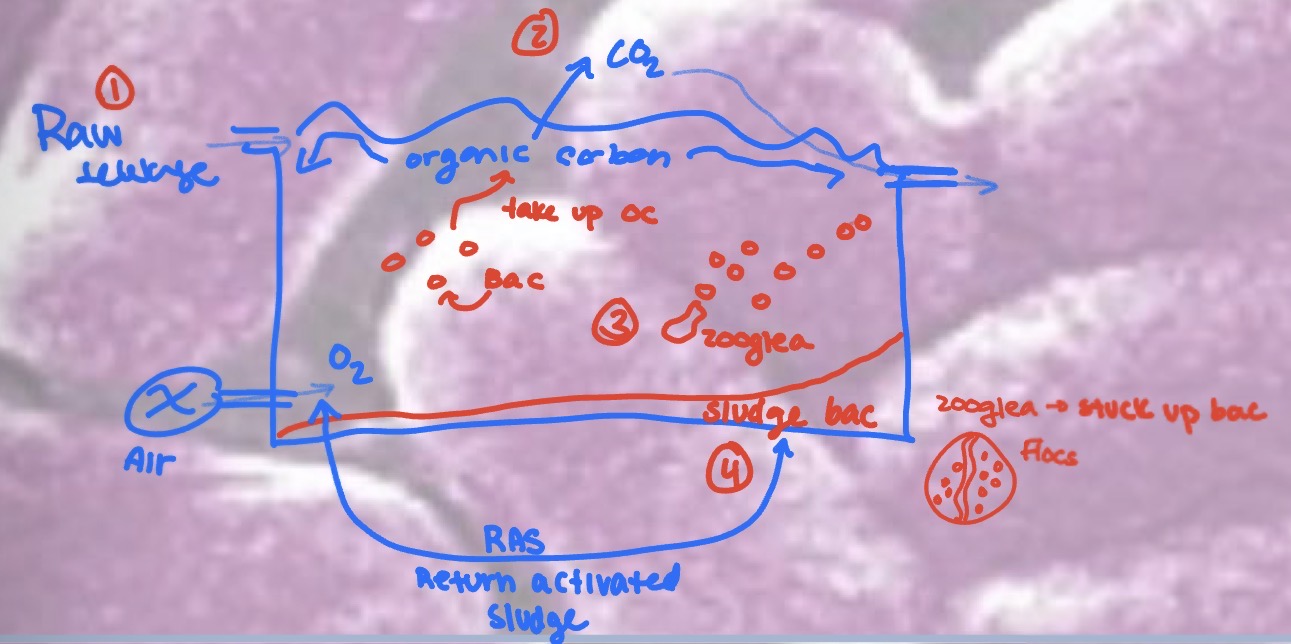
Activated sludge process
Sewage introduced into a large concrete tank with aeration
Bacteria proliferate and oxidize organic material → converts it to CO2
Bacteria stick together in flocs
Flocs recycle back to front of the tank
What does tertiary treatment involve in sewage treatment
filtration and activated carbon
Disinfection
Nitrogen removal
Nitrification to denitrification (Oxidation of ammonia → nitrate → reduction of nitrate → nitrogen gas)
Enhanced biological phosphorus removal
cells are removed and used as fertilizer
Poly phosphate accumulating bacteria accumulate phosphorus in their cells up to 20% of their mass
In anaerobic digestion, what occurs under anaerobic conditions
Protein lipids carbs break down → amino acids, FA and sugars → ferments to short chain FA (SCFA) and H2 → ferments to acetate and H2 → ferment to methane
CO2 and H2 convert to methane as well