Learn: Transcription and Translation

0.0(0)
Studied by 0 people
call kaiCall Kai
learnLearn
examPractice Test
spaced repetitionSpaced Repetition
heart puzzleMatch
flashcardsFlashcards
GameKnowt Play
Card Sorting

1/36

encourage image

There's no tags or description

Looks like no tags are added yet.

37 Terms

1
New cards

RNA

A type of nucleic acid consisting of nucleotide monomers with a ribose sugar and the nitrogenous bases adenine (A), cytosine (C), guanine (G), and uracil (U); usually single-stranded; functions in protein synthesis and as the genome of some viruses.

<p>A type of nucleic acid consisting of nucleotide monomers with a ribose sugar and the nitrogenous bases adenine (A), cytosine (C), guanine (G), and uracil (U); usually single-stranded; functions in protein synthesis and as the genome of some viruses.</p>
2
New cards

Transcription

It is the process of transcribing or making a copy of genetic information stored in a DNA strand into a complementary strand of RNA (messenger RNA or mRNA) with the aid of RNA polymerases. Happens in the nucleus.

<p>It is the process of transcribing or making a copy of genetic information stored in a DNA strand into a complementary strand of RNA (messenger RNA or mRNA) with the aid of RNA polymerases. Happens in the nucleus.</p>
3
New cards

Translation

(genetics) the process whereby genetic information coded in messenger RNA directs the sequence of the amino acids to form polypeptide at a ribosome in the cytoplasm

<p>(genetics) the process whereby genetic information coded in messenger RNA directs the sequence of the amino acids to form polypeptide at a ribosome in the cytoplasm</p>
4
New cards

mRNA

A type of RNA, synthesized from DNA or transcribed, that attaches to ribosome in the cytoplasm and specifies the primary structure of a protein. It has the codons. Recipe to make a polypeptide

<p>A type of RNA, synthesized from DNA or transcribed, that attaches to ribosome in the cytoplasm and specifies the primary structure of a protein. It has the codons. Recipe to make a polypeptide</p>
5
New cards

tRNA

An RNA molecule that functions as an interpreter between nucleic acid and protein language by picking up specific amino acids and recognizing the appropriate codons in the mRNA. The tRNA carries the ANTI CODON.

<p>An RNA molecule that functions as an interpreter between nucleic acid and protein language by picking up specific amino acids and recognizing the appropriate codons in the mRNA. The tRNA carries the ANTI CODON.</p>
6
New cards

Ribosomal RNA

type of RNA that makes up the major part of ribosomes

<p>type of RNA that makes up the major part of ribosomes</p>
7
New cards

Codon

Group of three nucleotide bases in mRNA that specify a particular amino acid to be incorporated into a protein

<p>Group of three nucleotide bases in mRNA that specify a particular amino acid to be incorporated into a protein</p>
8
New cards

Anti Codon

Group of three nucleotide bases in tRNA that specify a particular amino acid to be incorporated into a protein and it is complimentary to the codon.

<p>Group of three nucleotide bases in tRNA that specify a particular amino acid to be incorporated into a protein and it is complimentary to the codon.</p>
9
New cards

Amino Acid

Molecules that are the building blocks of proteins

<p>Molecules that are the building blocks of proteins</p>
10
New cards

Ribose

A five-carbon sugar present in RNA
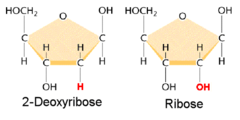
<p>A five-carbon sugar present in RNA</p>
11
New cards

Polypeptide

A polymer (chain) of many amino acids linked together by peptide bonds.

<p>A polymer (chain) of many amino acids linked together by peptide bonds.</p>
12
New cards

Protein

An organic compound that is made of one or more chains of amino acids and that is a principal component of all cells.

<p>An organic compound that is made of one or more chains of amino acids and that is a principal component of all cells.</p>
13
New cards

Genetic Code

The information encoded within the genetic material that can be translated into a protein

<p>The information encoded within the genetic material that can be translated into a protein</p>
14
New cards

Gene Expression

process by which a gene produces its product and the product carries out its function
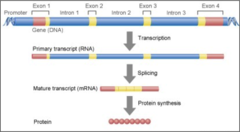
<p>process by which a gene produces its product and the product carries out its function</p>
15
New cards

Gene

Specific section of DNA - codes for one protein

<p>Specific section of DNA - codes for one protein</p>
16
New cards

Cell Differentiation / Specialization

Cells have specific functions unique from other cells

<p>Cells have specific functions unique from other cells</p>
17
New cards

Hydrogen Bonds

Bond holding together Nitrogen Bases (A,T,C,G,U)

<p>Bond holding together Nitrogen Bases (A,T,C,G,U)</p>
18
New cards

Mutation

A change in the sequence of a DNA or RNA strand sometimes resulting in different traits being expressed

<p>A change in the sequence of a DNA or RNA strand sometimes resulting in different traits being expressed</p>
19
New cards

Nitrogen Bases

A,T,C,G, & U - the sequence of these codes for different proteins

<p>A,T,C,G, & U - the sequence of these codes for different proteins</p>
20
New cards

Substitution

When one nitrogen bases is replaced with another

<p>When one nitrogen bases is replaced with another</p>
21
New cards

Insertion

When a different nitrogen bases is added (inserted) into a DNA/RNA sequence
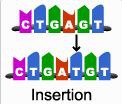
<p>When a different nitrogen bases is added (inserted) into a DNA/RNA sequence</p>
22
New cards

Deletion

When a nitrogen base is removed (deleted) from a sequence of DNA or RNA

<p>When a nitrogen base is removed (deleted) from a sequence of DNA or RNA</p>
23
New cards

Frameshift

When a sequence of DNA or RNA is re-arranged

<p>When a sequence of DNA or RNA is re-arranged</p>
24
New cards

Nucleic Acid

Polymer of DNA/RNA

<p>Polymer of DNA/RNA</p>
25
New cards

Nucleotide

Monomer of DNA/RNA

<p>Monomer of DNA/RNA</p>
26
New cards

peptide bond

The chemical bond that forms between the carboxyl group of one amino acid and the amino group of another amino acid

<p>The chemical bond that forms between the carboxyl group of one amino acid and the amino group of another amino acid</p>
27
New cards

RNA polymerase

an enzyme that links together the growing chain of RNA nucleotide during transcription using a DNA strand as a template

<p>an enzyme that links together the growing chain of RNA nucleotide during transcription using a DNA strand as a template</p>
28
New cards

RNA processing in eukaryotes

Occurs in nucleus.

After transcription:

1.) Capping on 5' end (7-methylguanosine)

2.) Polyadenylation on 3' end (~200 A's)

3.) Splicing out of introns Only processed RNA is transported out of the nucleus.

<p>Occurs in nucleus. </p><p>After transcription: </p><p>1.) Capping on 5' end (7-methylguanosine) </p><p>2.) Polyadenylation on 3' end (~200 A's)</p><p>3.) Splicing out of introns Only processed RNA is transported out of the nucleus.</p>
29
New cards

rRNA (ribosomal RNA)

an organelle that contains most of the RNA in the cell and that is responsible for ribosome function

<p>an organelle that contains most of the RNA in the cell and that is responsible for ribosome function</p>
30
New cards

Nucleus

Transcription and Translation happen here

<p>Transcription and Translation happen here</p>
31
New cards

Protein synthesis

Forming proteins based on information in DNA and carried out by RNA

<p>Forming proteins based on information in DNA and carried out by RNA</p>
32
New cards

codon chart

shows which codon codes for a specific amino acid based on mRNA

<p>shows which codon codes for a specific amino acid based on mRNA</p>
33
New cards

Central Dogma of Molecular Biology

information is transferred from DNA to RNA to protein

<p>information is transferred from DNA to RNA to protein</p>
34
New cards

introns and exons

In most eukaryotic genes, coding regions (exons) are interrupted by noncoding regions (introns). During transcription, the entire gene is copied into a pre-mRNA, which includes exons and introns. During the process of RNA splicing, introns are removed and exons joined to form a contiguous coding sequence.
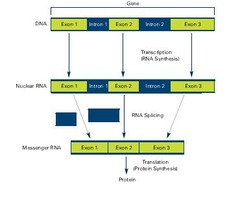
<p>In most eukaryotic genes, coding regions (exons) are interrupted by noncoding regions (introns). During transcription, the entire gene is copied into a pre-mRNA, which includes exons and introns. During the process of RNA splicing, introns are removed and exons joined to form a contiguous coding sequence.</p>
35
New cards

RNA polymerase

Enzyme similar to DNA polymerase that binds to DNA and separates the DNA strands during transcription, adds complimentary RNA nucleotides

<p>Enzyme similar to DNA polymerase that binds to DNA and separates the DNA strands during transcription, adds complimentary RNA nucleotides</p>
36
New cards

DNA polymerase

Enzyme involved in DNA replication that joins individual nucleotides to produce a DNA molecule

<p>Enzyme involved in DNA replication that joins individual nucleotides to produce a DNA molecule</p>
37
New cards

Amino acid attached to tRNA

tRNA transfer amino acid to the mRNA, it's the building block of polypeptide



