Lecture 3: Marriage & Family
 Call Kai
 Learn
 Practice Test
 Spaced Repetition
 Match
 Flashcards
 Knowt Play
1/18

There's no tags or description
Looks like no tags are added yet.
19 Terms
Topic 1: Why Marriage
What are the economic motives for marriage?
Specialization
Scale economies- The idea is that
sharing rent and other costs of living will decrease the average (per person) cost - it means that
sharing the cost of living is cheaper than living solo.
Public goods- Non-excludable, and non-rival goods. If more people consume it, it does not increase its cost. For such goods, gains increase from joint consumption. EX: physical home, cable television, blender.
Marriage specific investments- kids
Risk Pooling
Institutional advantages (joint taxation)
Economic Rule for Marriage, and (3) other factors that influence marriage decision.
Get married if Bennefit (Marriedi) > Cost (marriedi)
Other Factors:
availability of partners
government policies (encourage/discourage)
upward mobility for women.
Trends regarding marriage, cohabitation, median age at first marriage, and divorce rates in the US
In the US (and even more so Europe) marriage rates are down.
Cohabitation rates up
Median age at first marriage up
Divorce rates up in 1960-70s but are pro-cyclical)
What is meant by “divorce rates are pro-cyclical”?
Divorce rates rise during economic booms (when the economy is doing well) and fall during recessions (when the economy is doing poorly).
TOPIC 2: Specialization and Exchange Model (Becker, 1970)
Absolute advantage
Ability to produce a greater amount of a good, product, or service using the same amount of resources.
Comparative Advantage
Ability to produce a good a lower opportunity cost (give up/gained) than peers/competition.
Comparative advantage is self reinforcing
Absolute versus Comparative Advantage Example

Example: Draw the individual and joint PPF’s for Jim who can produce 30 units of home goods and 80 units of Market Goods in a day, and Kathy who can produce 90 units of Home Goods, and 50 units of Market Goods in a Day.

Example Cont: To get one more $ of H, how much M does each person need to give up? To get one more $ of M, how much H do they give up?

TOPIC 3: Utility and Household Preferences- Continuation of Specialization & Exchange model
Indifference Curves
Model bundles of time allocation one derives equal utility from.
The properties of an indifference curve include completeness, transitivity, and continuity.
How are single indifference curves able to encapsulate the utility values of an entire family?
a) Consensus Decision making models
Samuelson (1956)- partner shares same preferences, households can reach a decision that incorporates everyones likes or dislikes.
Becker (1947)- Altruistic Dictator, one figure in the house accounts for everyones utilities within their own preference.
b) Bargaining Models
Partners have different preferences, bargaining ensues.
Who’s preferences have more weight depends on bragging power.
Threat point: divorce

Kathy & Jim Example Cont: In what 3 ways could their IC be drawn, and what do these indifference curves say about who is specializing versus mixing?
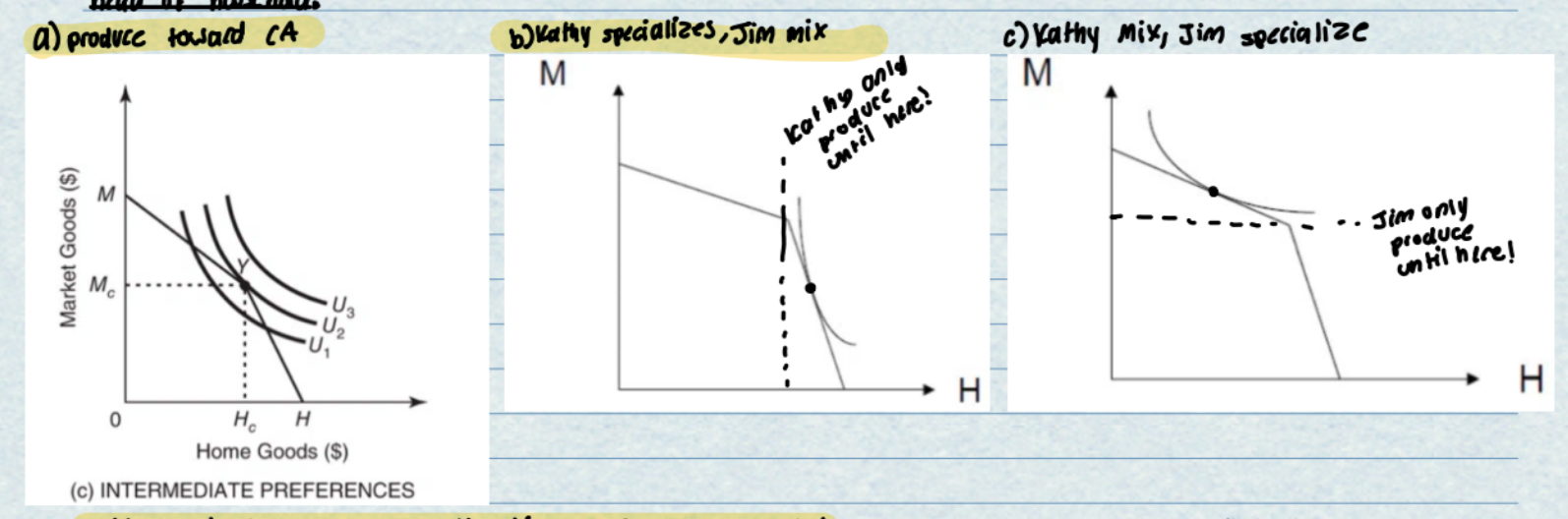
Limitations of Specialization & Exchange Model
Makes home production monolithic (women may not have a CA in lawn mowing, for example).
Only captures opportunity cost through forgone production value, does not assume other sacrifices/forms of utility are forgone.
Assumes preferences can be readily aggregated (most couples have different preferences, bargaining power matters).
TOPIC 5: Marriage Market
What is the marriage market?
Describes set of individuals at a given time and place who are looking for a specific kind of partner to marry.
List 4 changing dynamics within the marriage market
1) Women’s educational attainment > men: difficulties in assoritlive matching. Less skilled men have fared worse in labor markets since the 1970s “skills based technological change,” declining real wage.
2) Comparative advantage has started to equalize for market work: wages, LFP, employment and occupational convergence.
3) Divorce laws have changed: fault divorce laws banned in the 1970s, and no-fault/ unilateral divorce laws prevailed (explicit consent of both parties in divorce not required).
4) Technological Advancements: Contraception= declining rates of marriage.