Oral medicine RED STAR
 Call Kai
 Learn
 Practice Test
 Spaced Repetition
 Match
 Flashcards
 Knowt Play
1/30

There's no tags or description
Looks like no tags are added yet.
31 Terms
Patient history for new patient
Diagnose properly and formulate a treatment plan
Patient history with existing patient
Gain new information to support ongoing care
Patient history includes
All relevant information about a patient’s health
Different ways to guide patients to describe pain:
Aching, pulsating, itching, burning, dull/sharp
ABCDE’s of Melanoma
A= asymmetry
B= border irregularity
C= color (non-uniform)
D= Diameter >6mm
E=evolution (crusting, heaving, etc.)
Symblepharon clinical sign
A fiber band build-up in the eye, can be observe during dental exam
Sjogren’s syndrome symptoms
Itchy burning eyes (like sand in eyes), dry mouth and tongue
Pterygium clinical sign
Aka surfer’s eye, a result of lots of sun exposure
When you suspect an underlying condition you should:
Make a referral, and take initiative to do so. DON’T leave referral up to patient to do
Clinical evaluation main signs to look for:
locations: uni or bi-lateral
Consistency: firm, soft, rubbery, movable, fixed
Size: ideally less than 1cm², >1cm²=RED FLAG
Symptoms: tenderness, pain, non-tender
Unstimulated(resting) LOW salivary flow:
<0.1mL/mm
Unstimulated(resting) NORMAL salivary flow:
0.3-0.4 mL/min
Stimulated NORMAL salivary flow:
1-2 mL/min
Stimulated LOW salivary flow:
<0.7mL/min
Considerations when taking vital signs
AV shunt- kidney dialysis
Lymphedema- breast cancer
Arms should be free of clothing (if AV shunt, use other arm)
False(+) from recent coffee
Incisional vs excisional biospy
Incisional= take a portion of the lesion
Excisional= take the whole lesion
When do you order a biopsy?
When you suspect a tumor or something else, and need to refer to a physician
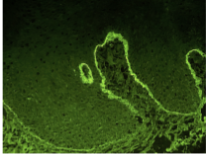
Direct immunofluorescence (DIF)

Microscopic/hematoxylin and eosin (H&E)
When do you refer as a dentist?
When there’s anything outside the scope of your practice and expertise. Like further evaluations, dental procedures, or biopsies.
Kidney dialysis consideration when taking vitals:
Use the arm without the AV shunt (if present)
Kidney dialysis consideration for scheduling:
Consider treatment on non-dialysis days. Dialysis uses Heparin which can cause excessive bleeding
Kidney dialysis consideration for recent labs:
Make sure to obtain patient’s permission prior to reaching out to physicians for recent labs

Pseudomembranous candidiasis/oral thrush
Oral manifestations of diabetes:
opportunistic infections (bacterial, fungal, viral)
hyposalivation
oral burning sensation
periodontal disease
Sialosis= non-inflammatory swelling of parotid gland
Orla ulcerations and trauma in setting of hyposalivation
Normal Mallampati classification
M1 and M2 ideal

Yellow in eye as a result of bilirubin not being properly removed from eyes
Cardiovascular symptoms
Chest pain, palpitation, peripheral edema, dyspnea on exertion
Gastrointestinal symptoms
Appetite changes, dysphagia, nausea, vomiting, diarrhea, constipation, heart burn
Hematologic symptoms
Easy bruising or bleeding, lymphadenopathy
Neurologic symptoms
Seizures, memory loss, loss of consciousness, paresthesia, paralysis