2.4 bio
 Call Kai
 Learn
Learn Practice Test
 Spaced Repetition
 Match
Match Flashcards
 Knowt Play
1/49

There's no tags or description
Looks like no tags are added yet.
Name | Mastery | Learn | Test | Matching | Spaced | Call with Kai | Chat |
|---|
No analytics yet
Send a link to your students to track their progress
50 Terms
Diffusion
Diffusion is the movement of particles across a semi-permeable membrane from an area of high concentration to an area of low concentration. The particles move passively/does not require energy as they are moving down the concentration gradient. Small, uncharged particles pass directly through the membrane.
Facilitated Diffusion
Facilitated diffusion is the movement of large, charged particles across a semi-permeable membrane from an area of high concentration to an area of low concentration, with the aid of a specific channel protein. The particles move passively/does not require energy as they are moving down the concentration gradient.
Osmosis
Osmosis is the movement of water molecules across a semi-permeable membrane from an area of high concentration to an area of low concentration. The water molecules move passively/does not require energy from an area of high concentration (example) to an area of low concentration (example). Water molecules move down the concentration gradient, therefore osmosis does not require energy.
Osmoregulation
Osmoregulation is the process by which organisms regulate the movement of water in and out of their cells to maintain a stable internal water balance, preventing cells from swelling or shrinking.
This is important for unicellular organisms living in fresh water (hypotonic environment). Water continuously enters the cell by osmosis, and if the excess water is not removed, the cell will swell and burst. To prevent this, unicellular organisms have a contractile vacuole that collects excess water and expels it from the cell, maintaining the correct water balance and prevents the cell from bursting.
Active transport
Active transport is the movement of substances across a semi-permeable membrane, from an area of low concentration to an area of high concentration, using ATP and specific carrier proteins (protein pump). Particles move against the concentration gradient, therefore this process requires energy.
Photosynthesis
Photosynthesis is the process by which plants use light energy to convert carbon dioxide and water into glucose and oxygen. Photosynthesis takes place in the chloroplasts of palisade cells, where chlorophyll captures the light energy needed for this process.
Carbon dioxide + water —> (with sunlight on top) glucose + oxygen
Light-dependent phase (LDP)
The first phase of photosynthesis is the light-dependent phase, and it occurs in the thylakoid membranes of chloroplasts, where the green pigment chlorophyll absorbs light energy, which is used to split water into oxygen, hydrogen ions (H+), and electrons. This process generates ATP and NADPH, which provides the energy and hydrogen needed for the next phase. Oxygen diffuses out of the leaf as a waste product (via stomata).
Light-independent phase (LIP)
The next phase of photosynthesis is the light-independent phase, and it takes place in the stroma of the chloroplast. The ATP and NADPH produced in the LDP are used to convert carbon dioxide into glucose through a series of enzyme-controlled reactions.
Water affecting photosynthesis
The amount of water available to plants affects the rate of photosynthesis because water is split in light-dependent reactions to produce hydrogen ions and electrons, which are required to make ATP and NADPH. These molecules provide the energy and hydrogen needed for LIP to produce glucose.
If water is limited, the light-dependent reactions slow down, producing fewer hydrogen ions (H+) and electrons. This reduces the supply of ATP and NADPH, causing the production of glucose to decrease and therefore lowering the overall rate of photosynthesis.
If more water is available, the light-dependent reactions occur faster, producing more hydrogen ions and electrons and increasing the supply of ATP and NADPH. This increases glucose production and therefore increases the rate of photosynthesis until another factor becomes limiting.
Light intensity affecting photosynthesis
Light intensity affects the rate of photosynthesis because light provides the energy needed for the light-dependent reactions.
As the light intensity increases, the rate of photosynthesis increases because more light energy is available for the light-dependent reactions. The rate of photosynthesis continues to increase until it reaches a maximum. At this point, chloroplasts are saturated with light or another factor, such as CO2 concentration, becomes limiting. As a result, the rate of photosynthesis levels off and cannot increase further.
At low light intensity, there is not enough energy to drive the light-dependent reactions efficiently, so the rate of photosynthesis is slow.
no need to talk about nadph/atp if already explained in ldp and lip
CO2 concentration affecting photosynthesis
CO2 is needed for photosynthesis because it provides the carbon atoms required to produce glucose in the light-independent phase.
As the CO2 concentration increases, the rate of photosynthesis increases because more CO2 is available for the light-independent reactions, allowing glucose to be produced more quickly. The rate of photosynthesis continues to increase until it reaches a maximum, where chloroplasts are saturated with CO2 or another factor (limited CO2 / temp too low) becomes limiting. At this point, the rate of photosynthesis levels off and cannot increase further.
Temperature affecting the rate of photosynthesis (same for respiration, just change rop to respiration)
Because photosynthesis involves enzymes, an increase in temperature will increase the rate of photosynthesis as enzyme-substrate collisions occur more frequently. The rate of photosynthesis continues to increase until it reaches the enzyme’s optimum temperature. Above this optimum, the enzymes begin denature, changing the shape of their active sites. As a result, the rate of photosynthesis rapidly decreases and eventually stops.
Structure 1 helping photosynthesis (diffusion again) - leaves
Leaves of a plant have large surface areas, allowing more space for CO2 to diffuse. Leaves are also thin so there is a short diffusion distance for gases to travel, allowing a faster rate of diffusion. Leaves also have a spongy mesophyll layer which contains air spaces, allowing gases to effectively diffuse.
Structure 2 helping photosynthesis (water absorption)
Plants have a lot of thin root hair cells which greatly increase the surface area of the root epidermis, allowing more water to be absorbed by osmosis.
Respiration definition
Respiration is a series of enzyme-controlled reactions that break down glucose to produce ATP. ATP is used to fuel chemical reactions within cells.
Aerobic respiration (definition + process)
Aerobic respiration is a form of cellular respiration that requires oxygen. Glycolysis occurs in the cytoplasm where glucose is broken down into two pyruvate molecules with the production of 2 ATP. The pyruvate is further broken down in the Krebs cycle in the matrix of the mitochondria, releasing CO2 and producing hydrogen ions and electrons. The hydrogen is carried to the electron transport chain (ETC) on the cristae. Oxygen acts as the final electron acceptor, forming water, and the ETC efficiently produces the remaining large amounts of ATP, giving around 36 ATP per glucose molecule.
Glucose + oxygen —> carbon dioxide + water (+36ATP)
Anaerobic respiration (definition + process)
Anaerobic respiration is a form of cellular respiration that does not require oxygen. When oxygen is unavailable, pyruvate from glycolysis is converted into lactic acid (or alcohol for plants) with the production of only 2 ATP molecules.
Glucose —> lactic acid (+2 ATP)
Advantages of aerobic respiration
An advantage of aerobic respiration is that it produces large amounts of ATP (around 36 ATP per glucose). No lactic acid is produced, meaning the process is a more efficient and sustainable way of producing ATP for longer periods of activity and recovery.
Disadvantage of aerobic respiration
A disadvantage of aerobic respiration is that it requires continuous oxygen supply, which cannot be delivered to the muscles fast enough during intense activity such as [action]. ATP is also produced more slowly, so aerobic respiration cannot provide muscles with ATP fast enough to enable (action).
Advantage of anaerobic respiration
An advantage of anaerobic respiration is that it allows to generate ATP quickly without needing oxygen for short bursts of high-speed activity, which is crucial for [action]. When oxygen is scarce, anaerobic respiration allows the muscles to continue producing ATP so that they can continue contracting. Therefore uses anaerobic respiration during actions with rapid consistent contraction such as [action], as oxygen cannot reach the muscles quickly enough for aerobic respiration.
Disadvantage of anaerobic respiration
A disadvantage of anaerobic respiration is that it produces much less ATP per glucose molecule (only 2 ATP). Continued anaerobic respiration will also result in the build up of the product lactic acid, which can become toxic and can damage muscle cells. This means that anaerobic respiration cannot provide energy for muscle cells for long periods of time.
Enzyme definition
Enzymes are biological catalysts made of folded proteins that speed up the rate of reactions. They lower the activation energy required for a reaction to occur by providing an alternative reaction pathway. Enzymes have specific 3D shapes, meaning the active site is complementary to only one particular substrate.
They are essential for cellular processes because they speed up reactions such as respiration, DNA replication, and photosynthesis, allowing cells to function efficiently at body temperature.
Catabolic and anabolic
Catabolic reactions break down larger molecules into smaller ones and release energy. A large substrate molecule binds to the enzyme's active site, forming an enzyme-substrate complex. The enzyme weakens the bonds within the substrate, causing it to split into smaller products. These products are then released from the active site, while the enzyme remains unchanged and can be reused.
Anabolic reactions build larger molecules from smaller ones and require energy. The enzyme’s active site binds two or more substrate molecules in the correct orientation so that bonds can form between them. A larger product is produced and released.
Lock and key model
An enzyme’s active site has a specific shape that is complementary to only one substrate. The substrate fits exactly into the active site, forming an enzyme-substrate complex. The enzyme then catalyses the reaction, producing products that are released while the enzyme remains unchanged and can be reused to catalyse another reaction.

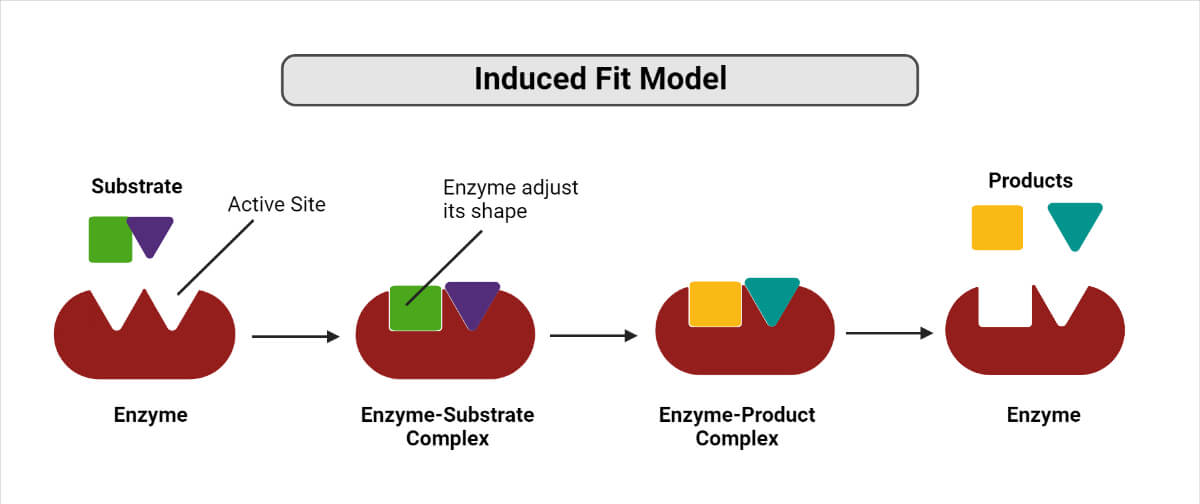
Induced fit model
The induced fit model states that the enzyme’s active site is not a rigid shape. When the substrate binds to the active site, the active site changes shape slightly to fit the substrate more closely, forming an enzyme-substrate complex. The enzyme then catalyses the reaction, and the products are released. The enzyme then returns to its original shape and can be reused to catalyse another reaction.
Factor affecting enzyme activity - temperature
Temperature affects enzyme activity because each enzyme has an optimum temperature where it works most efficiently.
At low temperatures, molecules have less kinetic energy, so successful enzyme-substrate collisions occur less frequently, so the rate of reaction is slow.
As temperature increases, the frequency of successful enzyme-substrate collisions increases, so the rate of reaction increases until it reaches the enzyme’s optimum temperature. Above this optimum, the enzyme’s structure begins to change and unfold, causing the active site to lose its correct shape and the enzyme to become denatured. Once denatured, the substrate can no longer fit the enzyme’s active site, so the rate of reaction rapidly decreases and eventually stops as the enzyme can no longer catalyse the reaction (non-functional).
Factors affecting enzymes - inhibitors
Inhibitors prevent enzymes from functioning. Competitive inhibitors bind themselves to the enzyme’s active site, inhibiting the real substrate from attaching. This prevents the enzyme from catalysing the reaction. Non-competitive inhibitors attach themselves to different parts of the enzyme, altering the enzyme’s active site’s shape so it can no longer fit the substrate. This means that inhibitors prevent enzymes from catalysing and functioning.
Factors affecting enzyme activity - substrate concentration
Increasing the substrate concentration will increase the number of substrate particles available to collide. This will increase the number of successful collisions between the substrate and the enzyme’s active site, resulting in a higher the chance of a enzyme-substrate complex forming. Therefore, the rate of reaction will increase.
However, all the enzyme active sites will eventually be occupied (saturated), so there is no further increase in rate of reaction at this point.
Factors affecting enzymes - pH
pH affects enzyme activity as each enzyme has an optimum pH level at which they function best. At pH levels above or below optimum, the enzyme’s structure is disrupted and unfolds.
This causes the enzyme to denature, changing the shape of its active site. As a result, the substrate can no longer fit into the active site, so the enzyme cannot catalyse the reaction (non-functional).
Factors affecting enzyme - co-factor
A co-factor is a substance that completes an enzyme’s active site. These co-factors work by binding themselves to the enzyme’s active site and the substrate. [give context now saying __ enzyme needs the __ co-factor to complete the active site so substrates can fit].
Without the co-factor, the enzymes will not be able to function, as the substrates they act upon will not successfully fit the active site. Therefore, the enzyme will not catalyse the reaction successfully, resulting in less/no [product] produced. As [product] is essential blah blah
Insert diagram!
![<p>A co-factor is a substance that completes an enzyme’s active site. These co-factors work by binding themselves to the enzyme’s active site and the substrate. [give context now saying <strong>__ </strong>enzyme needs the __ co-factor to complete the active site so substrates can fit].</p><p></p><p>Without the co-factor, <strong>the enzymes will not be able to function,</strong> as the substrates they act upon <strong>will not successfully fit the</strong> active site. Therefore, the enzyme will not catalyse the reaction successfully, resulting in less/no [product] produced. As [product] is essential blah blah</p><p></p><p>Insert diagram!</p>](https://assets.knowt.com/user-attachments/85b31f8e-9296-4d02-b56c-d4d8c0333e36.png)
DNA Replication where
DNA replication takes place inside the cell nucleus. It occurs during the S phase of the interphase, which happens before mitosis.
DNA replication process
DNA replication is carried out by a series of enzyme-controlled reactions. An enzyme separates the DNA strands by breaking the hydrogen bonds holding them together. The exposed strands are copied by an enzyme called DNA polymerase, which base-pairs free nucleotides with the exposed bases (ATCG). However, because the two strands are anti-parallel, the two new strands are synthesised in opposite directions. One end of each strand is labelled 3’, and the other end is labelled 5’. DNA polymerase can only synthesise DNA in a 5’ —> 3' direction. The leading strand is the strand that is continuously synthesised by DNA polymerase, and the lagging strand is the strand that must be synthesised in short bursts/sections (okazaki fragments). Another enzyme joins the fragments together. DNA replication is semi-conservative as each new DNA molecule keeps one original strand and one newly synthesised strand.
Purpose of DNA replication
The purpose of DNA replication is to produce two identical copies of a DNA molecule so that each new cell receives a complete and exact set of genetic information during the S phase of the interphase. This is essential because it ensures that every new daughter cell receives an identical and complete copy of the DNA before cell division (mitosis) occurs.
Mitosis description + purpose
Mitosis is the process by which chromosomes in the nucleus of a cell are divided into two identical daughter cells, each in its own nucleus. This process ensures that each daughter cell gains the exact copy of chromosomes and DNA sequence as the parent cell.
Mitochondria
Mitochondria are the organelles in every cell that carry out aerobic respiration and produce ATP. They have an inner and outer membrane. The inner membrane has lots of folds called cristae, which greatly increase the surface area for the ETC, allowing more ATP to be produced. The space within the inner membrane is the matrix, which contains the enzymes needed for the Krebs cycle. These structural features make mitochondria highly efficient at producing ATP.

Chloroplasts
Chloroplasts are the organelles in plant cells that are the site of photosynthesis. They produce glucose using light energy from the sun, carbon dioxide, and water. Chloroplasts are surrounded by a double-walled semi-permeable membrane. The fluid inside the inner membrane is the stroma, which contains many flattened membranes called thylakoids, which are arranged into stacks called grana. These stacks increase the surface area for light absorption, which increase the rate of photosynthesis. The thylakoid membranes contain chlorophyll, which is a pigment responsible for capturing sunlight needed for photosynthesis.

Hypotonic
High concentration of water, low conc of solutes
Animal cell gains water, swells, and bursts (cell is lysed).
Plant cells gain water, but cell wall rigid and turgor pressure builds up inside cell, prevents excessive amounts of water entering and stops bursting (cell is turgid when filled with water)
Hypertonic
Low concentration of water, high conc of solutes
Animal cell will lose water and shrivel up
Plant cell will lose water and turgor pressure, making cell flaccid. Further water loss causes cell membrane to peel away from cell wall, cell is plasmolysed.
Why is co2 a limiting factor for photosynthesis in aquatic environments compared to terrestrial environments?
CO₂ is often a limiting factor for photosynthesis in aquatic plants, compared to terrestrial plants, due to differences in availability and diffusion between water and air.
• Availability: In terrestrial environments, CO₂ is readily available in the atmosphere. Plants can easily absorb CO₂ through their stomata. In aquatic environments, CO₂ is less available because it is dissolved in the water, so plants cannot easily access it.
• Diffusion: CO₂ diffuses much more slowly in water than in air, so aquatic plants often receive less CO2 for photosynthesis. This limits their photosynthesis rate, especially in deep water where CO2 levels can be even lower.
• Insufficient or reduced carbon: There is less carbon atoms from CO2 available in aquatic environments to produce glucose during the light-independent phase, so the rate of photosynthesis is low. [now say opp for terrestrial environment, i can’t be bothered]
say opp for everything actually!
chloroplasts in shaded leaves and exposed leaves
Leaves exposed to direct sunlight adapt to process a lot of sunlight at high intensity. They require less chlorophyll and have smaller and fewer chloroplasts, because the light intensity makes it easier to capture the energy required for photosynthesis.
Leaves that are found in the shade (e.g. on the forest floor) receive far less sunlight, meaning there is less energy to absorb. Therefore, to maximise the rate of photosynthesis, these plants have larger and greater number of chloroplasts, which allow them to trap as much light as possible.
shade leaves vs exposed leaves water loss
Leaves exposed to sunlight deal with more heat and drying wind in their locations, so they are smaller. Their faster rate of photosynthesis means they do not need a large leaf, and the reduced surface area helps prevent water loss.
Leaves in the shade are larger so they can capture more light, and their sheltered locations prevent them from water loss.
Sun and shade leaves also differ in their stomata distribution: sun leaves have small but dense stomata, while the shade leaves have fewer but larger ones. Because shade leaves have a thinner cuticle and a larger stomata, they lose more water if exposed to the same heat and humidity as sun leaves.
factors affecting enzymes - enzyme conc
Increasing enzyme concentration increases the frequency of enzyme - substrate collisions, which increases the rate of reaction. However, there will eventually be more enzymes than substrates, so some enzymes become redundant and there is no further increase in reaction rate.
why the rate of photosynthesis changes from sunrise to sunset
The rate of photosynthesis changes from sunrise to sunset because both light intensity and temperature vary throughout the day.
At sunrise, light intensity is low, so the rate of photosynthesis is slow as there is less light available for the light-dependent reactions. As the sun rises higher, light intensity increases which causes the rate of photosynthesis to increase because more light energy is available for the light-dependent reactions. The rate of photosynthesis continues to increase until it reaches a maximum, where chloroplasts become saturated with light (or another factor becomes limiting). Temperature also increases during the morning, which increases the rate of photosynthesis because photosynthesis is enzyme‑controlled, and enzyme–substrate collisions occur more frequently. The rate of photosynthesis increases until it reaches the enzyme’s optimum temperature. However, enzymes begin to denature above this optimum, changing the shape of their active sites, so the rate of photosynthesis rapidly decreases.
Towards sunset, light intensity falls again, reducing the amount of light energy available for light-dependent reactions, so the rate of photosynthesis slows and eventually drops to very low levels once night arrives.
the mechanism by which enzyme functions (how they work)
Enzymes work by binding a specific substrate at their active site to form an enzyme-substrate complex, lowering the activation energy required and speeds up a reaction.
the role of chlorophyll
Chlorophyll is the green pigment in plants that captures light energy, which is essential for driving the light-dependent reactions.
relationship between cell size and sa:v ratio + how this affects diffusion
Cells are limited in size because of the relationship between cell size, surface area, and volume.
As a cell becomes larger, its volume increases more rapidly than its surface area, causing the surface area to volume ratio to decrease. This means that larger cells have less SA available relative to their volume for the exchange of substances, and smaller cells have more SA available relative to their volume for the exchange of substances.
aerobic short version
Aerobic respiration occurs mainly in the mitochondria of the __’s cell when oxygen is available. This process completely breaks down glucose into carbon dioxide and water, efficiently producing a large amount of ATP (around 36 ATP per glucose).
anaerobic short version
Anaerobic respiration is a form of cellular respiration that does not require oxygen. When oxygen is unavailable, pyruvate from glycolysis is converted into lactic acid (or alcohol for plants) with the production of only 2 ATP molecules.
how sa:v ratio affects diffusion + limits cell size
The SA:V ratio affects how efficiently diffusion can occur. Cells with a high SA:V ratio have a large amount of membrane surface area available for the exchange of substances relative to their volume. However, as a cell grows its SA:V ratio decreases, so diffusion becomes less efficient because there is less membrane surface area available relative to the cell's volume. As a result, oxygen and nutrients cannot enter the cell quickly enough to meet the cell's metabolic demands, and waste products cannot leave quickly enough. Therefore, the decreasing SA:V ratio limits the maximum size a cell can reach.
why cells divide when sa:v too low
When the SA:V ratio becomes too low, the cell can no longer exchange materials efficiently enough to maintain normal cellular processes. This may cause the cell to divide, producing two smaller daughter cells. These smaller cells have a higher SA:V ratio, allowing diffusion to occur more efficiently and ensuring that sufficient oxygen and nutrients can enter while wastes are removed effectively. Therefore, cells are limited in size because as they grow, their decreasing SA:V ratio reduces the efficiency of diffusion, eventually triggering cell division to restore a more favourable SA:V ratio.